


How to Improve RAP Crushing and Screening Efficiency: 8 Practical Strategies
Introduction: What Does RAP Crushing and Screening Efficiency Really Mean?
In asphalt recycling production, RAP (recycled asphalt pavement material) crushing and screening process is the core link that determines the capacity of the whole asphalt recycling production line, the stability of finished product gradation and the comprehensive production cost. Many asphalt mixing plants and recycled asphalt processing plants are generally faced with a common problem: the capacity of the equipment nameplate is very high, but the actual discharge is unstable, the fine material exceeds the standard, the return amount is large, and the frequent screen blocking stops, which finally leads to the effective capacity far lower than the design value.
Most operators have a cognitive misunderstanding: the actual capacity of the whole crushing and screening production line ≠ the rated capacity of the crusher nameplate. The real RAP processing efficiency is a set of multi-dimensional and systematic comprehensive indicators, which cannot be defined by a single equipment speed or throughput.
Complete RAP crushing and screening efficient production must meet the following core indicators at the same time: actual stable throughput, consistency of finished product particle size, controllable fine material generation, effective screening rate, reasonable proportion of oversized materials, effective start-up time of equipment, controllable wear and maintenance costs.
At the same time, the processing quality of RAP front-end crushing and screening directly determines the finished product quality of asphalt recycling and mixing at the back end, the stability of RAP blending ratio, the uniformity of mixture and the overall production energy consumption. Disorder of front-end grading, out of control of fine materials and overload of returned materials will directly cause imbalance of back-end mixing ratio, increase of waste rate and rework rate, and greatly reduce the profit margin of the project.
Efficient RAP processing is not blindly pursuing “more and faster”, but minimizing ineffective crushing, repeated material return, unplanned downtime and abnormal wear of equipment under the premise of stable production capacity and standard grading. The following will share 8 optimization strategies that can be directly landed and oriented to equipment and process to help processing plants systematically improve the overall efficiency of RAP crushing and screening.
Start with the Right RAP Feed Material
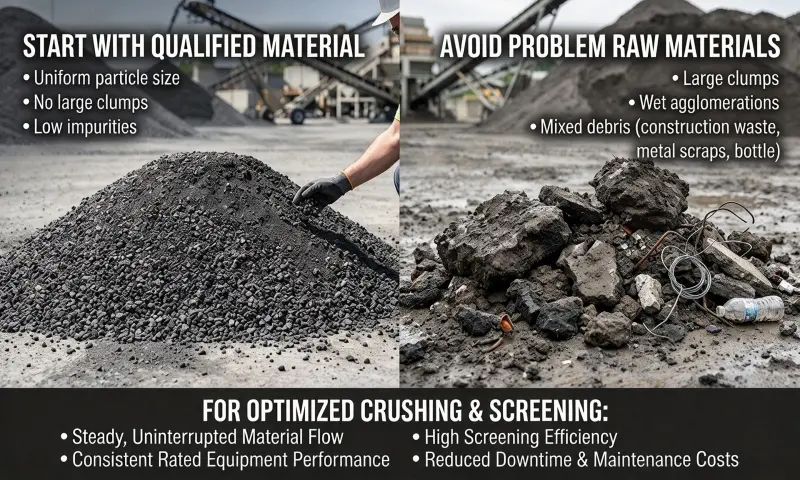
All equipment optimization, parameter debugging premise, are stable and qualified feed materials. If RAP raw material particle size disorder, humidity exceeds the standard, agglomeration is serious, impurities, even high-quality crushing and screening equipment can not play rated performance. To improve overall efficiency, the first step must start with feed control.
Check RAP Feed Size and Particle Distribution
It is first necessary to clarify the maximum particle size allowed by the production line, and prevent the oversized bulk materials from directly entering the crushing host. At the same time, the proportion distribution of coarse, medium and fine particles in the incoming materials should be regularly detected to determine whether the grading of the incoming materials is uniform. A large number of irregular oversized materials will cause crusher load fluctuation, instantaneous overload, blocking machine; and serious particle size polarization, it will directly lead to uneven screening load at the back end, through the screen instability, finished product grading fluctuation. A stable feed particle size distribution is the basis for all subsequent efficient processing.
Monitor Moisture and Material Condition
Moisture content of RAP material is a key hidden factor affecting screening efficiency. RAP with too high humidity will cause problems of agglomeration and poor fluidity, and it is easy to adhere to the screen and cause clogging of the screen holes, greatly reducing the effective screening area. In addition, RAP site temperature, asphalt aging and bonding state, material agglomeration degree will change the crushing difficulty and screening characteristics. Do not regard all RAP materials as uniform materials, and must adjust production parameters differently according to incoming conditions.
Remove or Control Oversized and Foreign Materials
Before the material enters the main crushing and screening system, it must complete the pre-treatment, timely clean up stones, construction waste, metal debris and other foreign matters, and control the oversized bulk material in advance. Foreign matter entering the host can easily cause equipment jamming, component damage and abnormal wear, which not only increases downtime and maintenance time, but also disrupts the material conveying rhythm of the whole production line, resulting in ineffective energy consumption and capacity loss.
For more details of pre-control, please refer to “How to Prepare High-Quality RAP for Asphalt Recycling Plants”
Pre-Screen RAP Before Crushing When Appropriate
The core reason for the inefficiency of many production lines is to send all materials into the crusher, including a large number of qualified fine materials that have reached the standard particle size. Ineffective repeated crushing not only wastes energy consumption, accelerates equipment wear, but also causes fine material exceeding standard. Pre-screening is the key process to solve this problem.
Why Pre-Screening Can Reduce Unnecessary Crushing
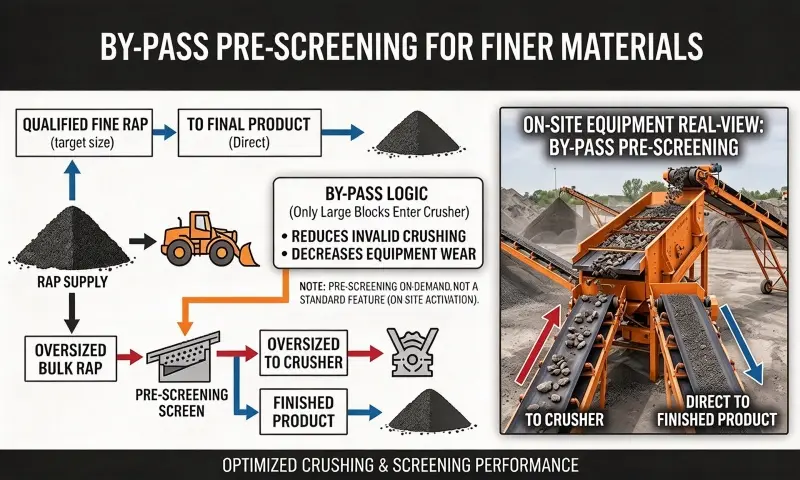
The core logic of pre-screening is to separate out the materials that have met the requirements of finished product particle size before the raw materials enter the primary crusher. This kind of qualified fine material does not need to be crushed and extruded, and can directly enter the finished material pile or the lower screening system, reducing the processing load of the crusher from the source and avoiding unnecessary mechanical wear and excessive crushing problems.
Allow the materials that meet the target particle size requirements to bypass the crusher directly
Allow Finer RAP that Meet Target Particle Size Requirements to Bypass the Crusher
Through the pre-screening feed screening, and directly screen the original fine materials and small particle materials that meet the standards, so that only the bulk materials that really need to be crushed enter the host. This method can significantly reduce the continuous load of the crusher, stabilize the operating conditions of the equipment, reduce the heat, vibration and wear loss of the equipment, and improve the material circulation efficiency of the whole RAP crushing and screening production line.
When Pre-Screening May Not Be Necessary
Pre-screening is not a common standard for all RAP production lines. Blindly adding or enabling pre-screening will increase equipment redundancy and increase operation and maintenance costs. Whether to enable pre-screening needs to be judged in combination with five core conditions: raw grading distribution of incoming materials, target particle size standard of finished products, dry and wet caking state of RAP materials, design and processing capacity of production line, and configuration layout of existing equipment.
Allow Finer RAP to Bypass the Crusher
Reasonable pre-screening process can greatly reduce the ineffective workload of the crusher, stabilize the flow rhythm of the whole line of materials, and avoid problems such as material accumulation, blocking and overload. It should be noted that pre-screening is the process optimization link of the whole system, which cannot be treated separately. It must be combined with the overall debugging of crushing, screening and recycling system to maximize its value.
Core summary: Pre-screening is a process design decision, not a necessary configuration for all RAP crushing production lines. On-demand activation is the key to efficient production.
Optimize Crusher Settings to Avoid Over-Crushing
Many factories habitually improve production capacity by increasing crusher speed and increasing crushing compression ratio, which is a typical efficiency misunderstanding. Excessive crushing will not improve the quality of finished products, but will cause a series of efficiency loss problems such as excessive fine materials, increased wear, soaring energy consumption, and increased return. The core of efficient crushing is controlled crushing, not maximum crushing.
Adjust Crusher Settings to Match the Target Product Size
According to the type of crusher, adjust core parameters such as gap, rotating speed, and crushing ratio to match the RAP grading requirements of finished products, and at the same time dynamically adjust the feed particle size in real time. According to different sizes of incoming materials and different finished product standards, match the corresponding crushing intensity, prevent parameter settings from being too radical, and avoid high-intensity crushing operations beyond process requirements.
Avoid Excessive Size Reduction
The most direct consequence of excessive crushing is the large increase of fine powder, which disturbs the grading design of recycled asphalt mixture. At the same time, it will bring multiple losses: the proportion of fine materials exceeds the standard, the wear rate of wear-resistant parts is accelerated, the energy consumption per unit output is increased, and the recycling amount of oversized materials is increased, forming a vicious circle of “the finer the crushing, the more the recycling, the lower the production capacity”. More crushing action does not mean better processing effect.
Match Crusher Capacity to Actual Feed Conditions
Equipment nameplate rated capacity is only theoretical reference value, actual production capacity will be affected by multiple factors: feed particle size, dry and wet state of materials, asphalt caking degree, target finished product particle size, equipment operation configuration. Operators must abandon the solidified thinking of “capacity according to nameplate” and dynamically match crushing capacity according to real-time operating conditions to ensure stable equipment load.
Monitor Fines Generation
Fine material generation is the core KPI to judge whether the crushing condition is reasonable. During the production process, it is necessary to continuously track the proportion of fine materials in the finished products and returned materials. Once the fine materials suddenly rise, it is necessary to immediately investigate the problems such as crusher parameter deviation, incoming material working condition change, abnormal return cycle, etc., and timely adjust the process to ensure that the crushing quality is controllable.
Core principle: The goal of high-quality RAP crushing is precise and controllable particle size reduction, not unlimited high-intensity crushing.
Improve RAP Screening Efficiency and Prevent Screen Blinding
The processing capacity of the crusher does not determine the final capacity of the entire RAP production line. According to the different materials and plant configurations, the screening system may become the main bottleneck of the regeneration production line. Screening blockage, incomplete screening and uneven material distribution will directly offset all optimization effects of front-end crushing, resulting in limited production capacity, unqualified finished products and sharp increase in return volume.
Select Screen Media for RAP Characteristics
RAP material has aging asphalt viscosity, high humidity uncertainty and complex particle shape, so the selection of screen can not copy the screening standard of common stone. According to the particle size range, dry and wet state and bonding characteristics of incoming materials, the appropriate screen material and mesh specification shall be matched, and the screen with anti-clogging, high wear resistance and suitable viscous materials shall be selected preferentially to reduce the problems of mesh clogging and material adhesion from the hardware level.
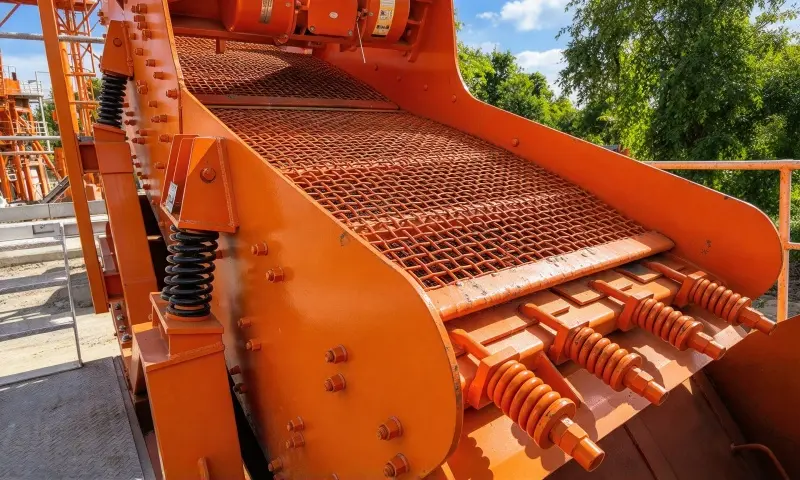
Match Screen Area and Deck Configuration to Throughput
Screen effective screening area, number of screen layers, screening capacity, must be fully matched with the crusher discharge capacity. If the crushing capacity is blindly increased, but the screening system is not configured enough and the effective screening surface is too small, it will directly form a screening bottleneck, resulting in material accumulation, insufficient screening and excessive residue of oversized materials, which will seriously restrict the overall production capacity. At the same time, the sieve layer structure should be reasonably configured according to the material classification quantity required by the finished product.
Control Feed Distribution Across the Screen
Many problems with low screening efficiency are not screen failures, but uneven distribution. Material concentrated accumulation in the local area of the screen surface will cause local overload, insufficient screening, local blank screen surface idle, a substantial waste of screening effective area. It is necessary to optimize the feed chute, diversion structure and material falling point in a normal way to ensure uniform spreading of materials and realize efficient screening of the whole screen surface.
Reduce Screen Blinding and Pegging
The core causes of RAP screen plugging and stuck holes include: high humidity of materials, strong adhesion of residual asphalt, fine particle plugging, and long-term accumulation and scaling of materials. Typical manifestations of abnormal screening conditions are: screening capacity decline, continuous increase in the proportion of oversized materials, material flow stagnation, manual screening frequency greatly increased. It is necessary to adjust the screening amplitude and frequency according to the material working conditions, and match the appropriate anti-blocking screen to solve the blocking problem from the dual dimensions of process and equipment.
Reduce Screen Blinding and Pegging
Loose, damaged and deformed screens will directly destroy the material screening track, resulting in reduced screening accuracy and disorder of finished product grading. “During daily operation and maintenance, it is necessary to regularly check the wear, cracking and insufficient tension of the screen, timely clean the screen area materials, replace the aging parts in advance, and avoid small faults from evolving into production bottlenecks.
IMPORTANT: There is no universal screen and all screening configurations must be customized to match the finished product specifications with the field RAP material characteristics.
Optimize Oversize Recirculation and Closed-Circuit Crushing
In closed-circuit RAP crushing and screening systems, controlled cycles help maintain the desired particle size distribution. Excessive recycle cycle will seriously lower production efficiency and increase equipment loss. Reasonable recycle ratio is to improve quality and efficiency, and excessive recycle load is ineffective internal friction.
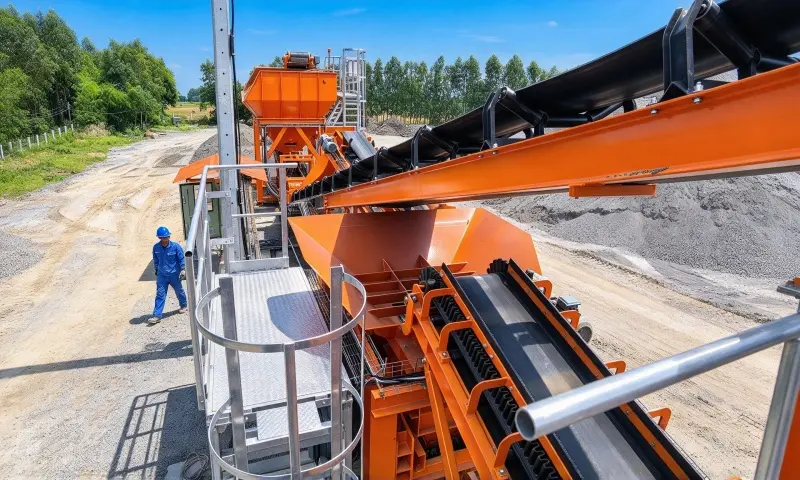
Control the Amount of Oversize Return
The material quantity and particle size ratio of the return belt shall be monitored regularly on site. If the return rate continues to be high, it indicates that there are configuration or parameter problems in the production line: unreasonable crushing ratio setting of crusher, insufficient screening accuracy, excessive particle size of front feed, imbalance of crushing and screening equipment matching. It is necessary to investigate and rectify one by one to reduce invalid return materials from the root cause.
Avoid Excessive Recirculation Load
The same batch of materials repeatedly enter the crusher for recycling, which will greatly reduce the effective throughput rate of the production line, increase the continuous load and wear loss of the equipment, and continuously push up the amount of fine material generated, forming a vicious circle. Excessive recycling is the core reason why many production lines “seem to have high production capacity, but the actual output is very low”.
Match Return Conveyor Capacity to Crusher Capacity
The conveying capacity of the return conveyor belt must be matched with the capacity of the crusher and screening system. If the return belt capacity is insufficient, it will cause the accumulation of return materials, poor return materials, screening area materials, forming the circulation bottleneck of the whole closed-circuit system, disrupting the crushing and screening rhythm.
Re-Crush Only Material That Requires Further Reduction
Gives full play to the classification function of the screening system, completely separates the finished materials that have reached the standard, only allows the oversized materials that do not meet the standard to enter the circular crushing process, eliminates the ineffective circulation of qualified materials, and maximizes the effective output of the system.
Core point of view: closed-circuit crushing ensures stable quality of finished products, but excessive return out of control is an important hidden source of RAP production line efficiency loss.
Balance the Feeder, Crusher, Screen, and Conveyors
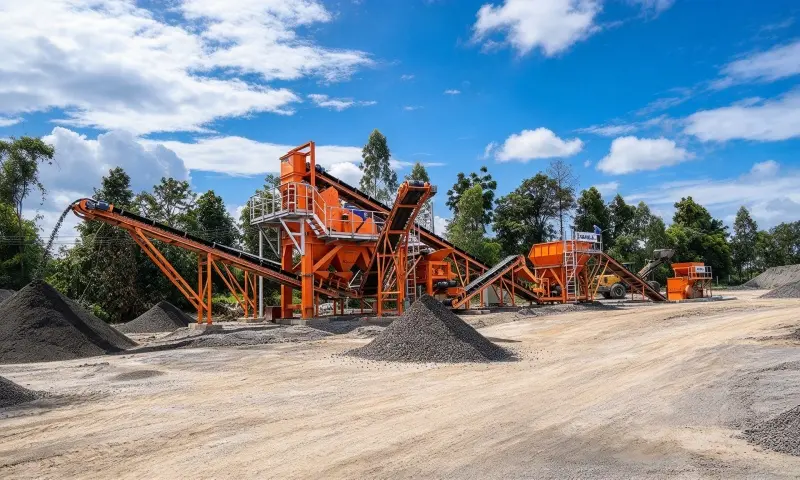
RAP crushing and screening production line is a set of linkage overall system, not an independent operation of single equipment. The parameters of a single crusher and vibrating screen are optimal, which does not represent the optimal efficiency of the whole line. The final capacity of the whole production line is determined by the bottleneck equipment, not the equipment with the strongest performance.
Maintain Stable Feeding
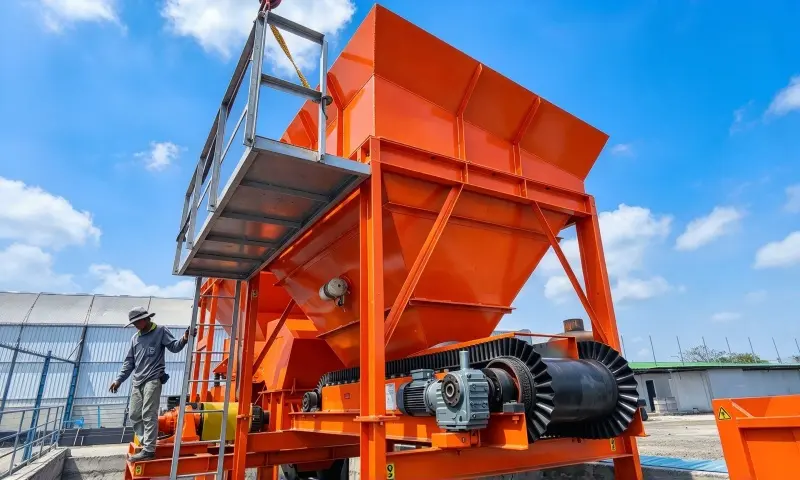
Feeding fluctuations, more and less materials, broken materials and surging materials alternately occur, which will directly cause crusher load fluctuations, screening distribution disorder, and high and low return. It is necessary to realize continuous, uniform and stable feeding through speed regulating feeding equipment, eliminate instantaneous overload and no-load idling, and stabilize the whole production condition.
Accurate Match Crusher and Screen Capacity
If the crusher processing capacity is much greater than the screening system, screening will become a hard bottleneck, crushing capacity can not be released completely; if the screening capacity is excessive, crushing capacity is insufficient, it will cause equipment idle, energy waste. During production commissioning, the comprehensive capacity of feeder, crusher, vibrating screen, return system and conveyor belt must be systematically matched to realize balanced linkage of the whole line.
Prevent Conveyor Bottlenecks
Conveyor belts, conveyor belts and transfer chutes are efficiency shortcomings that are easily overlooked. Transfer point accumulation, insufficient belt capacity and chute blocking will directly cause material accumulation, process stagnation and disrupt the whole production process. It is necessary to dredge the transfer points regularly to ensure the matching of upstream and downstream transmission capacity, and eliminate local bottlenecks restricting the production capacity of the whole line.
Optimize Transfer Points
Optimize chute angle, install diversion device, clean up accumulated dead corners, reduce material adhesion, accumulation and blocking probability, so that materials can flow smoothly among various equipment, and reduce jamming and downtime.
Keep the Whole Line Balanced
The complete RAP production process is as follows: feeding → pre-screening → crushing → finished product screening → oversize material recycling → belt conveyor → finished product stacking. The core of operation and maintenance and debugging is to eliminate the short board of the whole process, so that the rhythm of each equipment and each process is unified and the load is balanced, so as to realize the optimal efficiency of the system.
Equipment selection and capacity matching can refer to “How to Choose a RAP Crushing Plant: Capacity, Configuration, and Equipment Selection”
Reduce Downtime Through Preventive Maintenance
Real production efficiency = theoretical capacity of equipment × effective start-up rate. Many production lines only pay attention to the instantaneous throughput of equipment, but ignore the overall capacity loss caused by frequent downtime and fault maintenance. Preventive maintenance is the basic guarantee for stable high yield, cost reduction and efficiency increase.
Normalization Inspect Crusher Wear Parts
Crusher liner, tooth roller, hammer and other wear parts of the degree of wear, will directly change the crushing gap and crushing effect, resulting in finished grading fluctuations, fine material exceeds the standard, the amount of return increases. It is necessary to regularly detect wear and tear, predict the replacement cycle of accessories in combination with the quality change of finished products, and complete the replacement before the performance is greatly degraded to avoid production with faults.
Check Screen Media and Tension
Continuously check the damage, deformation, loosening and accumulation of the screen, correct the tension of the screen in time, clean up the stubborn bonded materials on the screen surface, ensure the stability of the screening accuracy and screening efficiency, and avoid batch non-conformity and shutdown rectification caused by screen failure.
Inspect Bearings and Conveyors
By monitoring the abnormal noise of the equipment, detecting the vibration frequency and operating temperature, checking the hidden dangers of the bearing, roller, transmission belt and other core components, handling the loosening, wear and aging problems in advance, and eliminating sudden failure shutdown.
Clean Material Build-Up and Blockages
Chute, transfer point, screen surface, belt dead angle accumulated material agglomeration is the main cause of sudden blocking and shutdown. Daily production interval should be cleaned up regularly to reduce unplanned downtime from the source.
Keep Critical Spare Parts Available
Sort out high-frequency wear of production lines, core key accessories, establish reasonable spare parts inventory, avoid no spare parts replacement after parts damage, and maximize the effective operation time of equipment.
Core summary: No matter how high the rated production capacity of equipment is, it also needs stable boot time as support. Equipment availability is the core prerequisite for effective production capacity.
Monitor Key Performance Indicators to Find Efficiency Losses
It is impossible to realize fine efficiency improvement only by debugging equipment and judging working conditions based on experience. In order to continuously optimize RAP crushing and screening efficiency, it is necessary to establish a quantitative KPI monitoring system to locate short boards, investigate hidden dangers and iterate processes through real operation data.
Real-time Monitoring of the Actual Hourly Throughput (t/h)
Compared with the actual discharge of the equipment and the design target capacity gap, statistics of typical production period stable capacity, determine whether there is a continuous bottleneck in the production line, feeding instability, blocking shutdown and other problems. A simple way to track effective throughput is to divide the actual yield by the effective processing time.
Statistics of Oversize Recirculation Rate
Continuous monitoring of the proportion of recycled materials, abnormal increase in recycling rate, directly pointing to the core problems such as unreasonable crusher parameters, insufficient screening accuracy, excessive feed particle size, etc., is an important reference basis for process debugging.
Track the Change of the Proportion of Fine Materials in the Finished RAP
Abnormal fluctuation of the proportion of fine materials represents imbalance of crushing conditions, excessive crushing or insufficient crushing. It is necessary to adjust the crushing parameters and incoming conditions in time to ensure stable and controllable grading of finished products.
Statistics Screening System Downtime
Statistics screening hole blockage, material stuck holes, screen damage, routine maintenance caused by downtime, targeted solutions to high-frequency fault problems, improve screening system continuous operation capacity.
Statistics Crusher Unplanned Downtime
Data records crusher jamming, overload, wear failure, circuit failure and other sudden downtime, sorting out high-frequency fault types, forming standardized rectification and prevention programs.
Calculate Wearing Parts Consumption Level
Combined with total output statistics of parts loss cost per unit output. If wear consumption is abnormally high, it indicates that there are problems such as improper parameters, bad material working conditions and load imbalance, which need to be optimized and adjusted in time.
Statistics of the Proportion of Effective Operation Time
Distinguish between equipment start-up time and effective production time, accurately calculate the real capacity utilization rate, completely get rid of the “nameplate capacity misleading”, master the real production level of the production line.
Core KPI Diagnostic Table for RAP Crushing and Screening Plant
| Core KPI Indicators | What It Shows | Potential Efficiency Issue |
| Actual throughput | Overall production capacity | Line bottleneck, unstable feeding, material blocking shutdown |
| Oversize return | Recirculation load level | Crushing and screening parameters do not match, equipment configuration imbalance |
| Fines percentage | Quality and stability of crushing operation | Over-crushing, wrong parameter settings, abnormal incoming working conditions |
| Screen downtime | Effective operation rate of screening equipment | Blinding, blockage, screen wear |
| Crusher downtime | Crushing equipment operation stability | Wear failure, blockage, improper maintenance |
| Wear consumption | Operation and maintenance cost per unit output | Abnormal load, unreasonable parameters, poor material conditions |
| Effective operating hours | True capacity utilization of production line | Frequent shutdowns, frequent failures, inefficient maintenance |
Optimize RAP processing quality, which can further improve the blending ratio of recycled materials. For details, please refer to How to Increase RAP Percentage in the Recycling Asphalt Plant.
When Should You Reconfigure or Upgrade Your RAP Crushing Plant?
Process optimization, parameter debugging and maintenance rectification can solve most of the mild efficiency problems, but when the production line has continuous and systematic shortcomings, simple fine adjustment can not meet the standards, and it is necessary to reconfigure or upgrade the equipment in time. This section helps users accurately judge upgrade nodes and realize natural business transformation.
Actual Throughput Is Consistently Below the Target
After eliminating accidental factors such as temporary material blocking and operation errors, the production capacity is not up to standard for a long time. It is necessary to check the bottlenecks of feeding, crushing, screening, material returning and transportation one by one, and give priority to optimizing the system configuration instead of directly replacing the host equipment blindly.
Screen Blinding Happens Frequently
After routine cleaning and parameter adjustment, and screen blocking and sticking problems still occur frequently, indicating that the existing screen configuration and screening structure do not match the humidity and bonding characteristics of RAP materials on site, and it is necessary to optimize the screening equipment configuration.
Oversize Recirculation Is Too High
The recovery ratio remains high and cannot be improved by adjusting the crushing gap and screening parameters, indicating that there are inherent shortcomings in equipment matching and production line structure, and it is necessary to re-optimize the configuration of closed-circuit circulation system.
Fines Generation Is Increasing
The amount of fine material continues to rise abnormally for a long time, and the fine material exceeds the standard, resulting in out of control of the finished product grading and rising costs. After eliminating the operation and incoming material problems, it is necessary to upgrade the crushing equipment or adjust the whole machine process structure.
Key Equipment Becomes the Fixed Bottleneck
The whole production line is continuously restricted due to the short capacity and performance of a certain equipment, and the imbalance state of “big horse-drawn trolley” or “small horse-drawn cart” appears. It is necessary to systematically match the configuration of the whole line of equipment instead of single point upgrading.
RAP Processing Demand Has Increased
With the increase in asphalt recycling project capacity demand, the processing capacity, equipment configuration and site layout of existing production lines cannot meet the production and future expansion demand, so it is necessary to plan equipment upgrading and production line reconstruction in advance.
Conclusion: Improve RAP Processing Efficiency as a Complete System
The 8 core optimization strategies sorted out in this paper cover RAP raw material pretreatment, pre-screening process, crushing parameter regulation, screening condition optimization, closed-circuit return control, full-line system balance, preventive maintenance, and data-based KPI diagnosis, forming a set of efficient production system that can be directly implemented.
Efficient RAP crushing and screening processing is never the ultimate performance of a single equipment, but the dynamic balance and fine control of the whole production line. Abandoning the extensive production thinking of “blind speed-up and forced increase of production”, only by stabilizing materials, precise technology, balancing equipment, scientific maintenance and data diagnosis can we truly improve effective production capacity, reduce operation and maintenance costs, reduce failure losses and realize quality improvement, efficiency increase and cost reduction of RAP regeneration processing on the premise of ensuring stable grading and quality standard of finished products.
Call to Action
If you are facing problems such as insufficient RAP capacity, frequent screening, excessive fines, large return volume, and unbalanced equipment matching, ZOOMLINE can provide customized RAP crushing and screening solutions. We can tailor the line configuration and optimization plan that best matches your needs according to your RAP feed conditions, target capacity, finished particle size standards, equipment type (mobile/portable/fixed), site layout, future expansion needs and downstream asphalt recycling production requirements.
Please leave a message to share your project conditions and production pain points. ZOOMLINE professional team will evaluate the optimization and upgrading of production lines for you one-on-one, helping to improve the overall efficiency and production benefits of RAP crushing and screening.
FAQs About RAP Crushing and Screening Efficiency
How can I improve RAP crushing efficiency?
Core optimization direction: stabilize the state of feeding materials, enable pre-screening process as required, accurately adjust crusher parameters, eliminate excessive crushing, reasonably control return circulation, realize linkage balance of the whole line of equipment, match with normal preventive maintenance, and comprehensively improve crushing operation efficiency and quality stability.
How can I improve RAP screening efficiency?
Select screen according to RAP material characteristics, match sufficient screening area and screen layer configuration, optimize uniform distribution of screen surface, control material humidity and bonding state, normalize screen hole blockage, regularly maintain screen accessories, and thoroughly break through screening bottleneck.
Why does RAP cause screen blinding?
The core causes include: high humidity of materials, strong adhesion of aged asphalt residues, fine particles plugging sieve holes, caking accumulation of materials, viscosity fluctuation of asphalt caused by production temperature change, and superposition of multiple factors is easy to cause adhesion, blocking and blocking of sieve holes.
Should RAP be screened before crushing?
It is not universal. When the feed contains a large number of qualified fine materials, pre-screening can effectively reduce ineffective crushing; if the incoming materials are mainly large and the proportion of fine materials is extremely low, pre-screening is not required, and the crushing operation can be carried out directly. The specific judgment needs to be combined with the grading of incoming materials and the finished product standard.
How can I reduce fines during RAP crushing?
By reducing excessive crushing parameters, strictly controlling crushing intensity, stabilizing feeding conditions, reducing unnecessary recycling, avoiding repeated crushing, and accurately controlling the particle size reduction process, excessive generation of fine materials is suppressed from the source.
How can I reduce oversize recirculation in a RAP crushing plant?
Accurately adjust the crushing ratio of the crusher, improve the screening accuracy, strictly control the maximum particle size of the feed material, optimize the matching degree of the whole line equipment, reduce the qualified materials entering the circulation loop, and systematically reduce the invalid return load.
What causes low throughput in a RAP crushing and screening plant?
It mainly includes eight causes: unstable feeding, screening bottleneck, excessive recycling, frequent clogging of sieve holes, wear and aging of crusher accessories, insufficient transportation capacity of conveying equipment, poor material conditions and excessive unplanned downtime.
When should a RAP crushing plant be upgraded or reconfigured?
When there are systemic problems such as continuous substandard production capacity, high return rate, long-term over-standard fine material, frequent screening failures, unbalanced equipment matching, capacity demand expansion, etc., and conventional process commissioning and maintenance cannot be improved, it is necessary to timely reconstruct or upgrade the production line configuration.
What is the most important factor in RAP crushing and screening efficiency?
No single factor determines efficiency. The overall efficiency depends on the synergy of data from feed conditions, crushing, screening, recycling, transportation, maintenance and operation.