




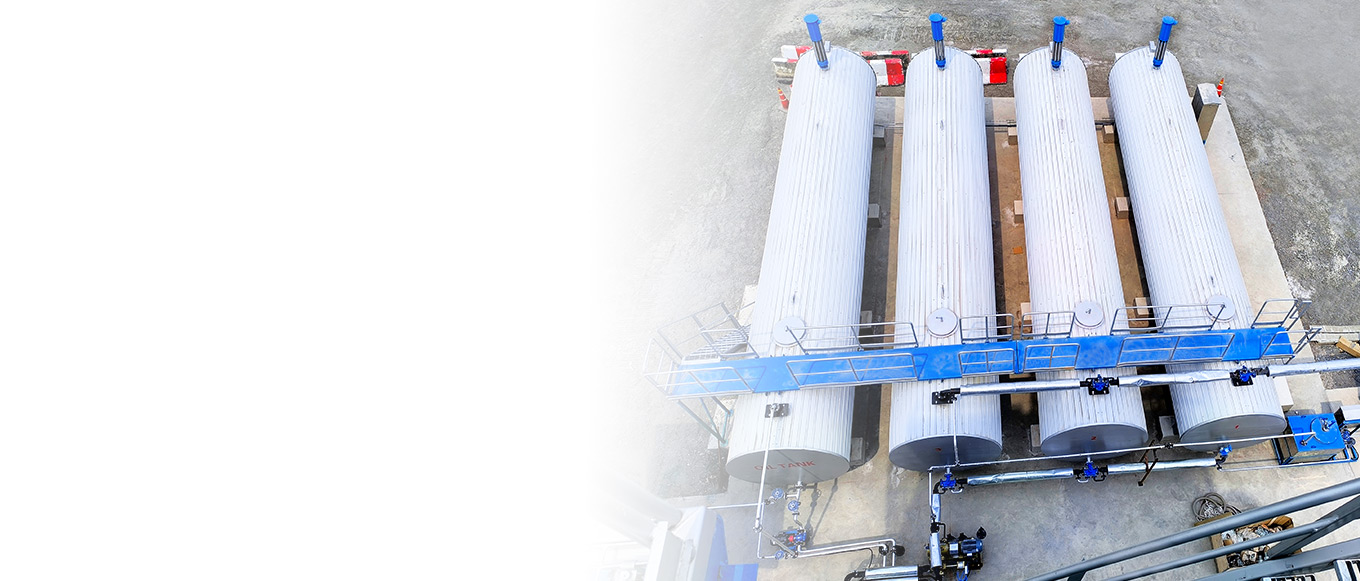


How to Plan Asphalt Plant Capacity, Location, and Service Radius for Road Construction
Introduction
In infrastructure projects such as highways, municipal roads and airport runways, many projects have problems such as delayed construction period, high operating costs and serious waste of production resources. The core reason is not insufficient performance of asphalt mixing plant equipment, but unreasonable planning scheme of asphalt plant in the early stage. Most construction parties and EPC contractors only pay attention to the single indicator of equipment capacity per hour (TPH), ignoring the systematic balance of capacity, site selection, service radius, logistics transportation and long-term operation and maintenance, which eventually leads to the common problem of “sufficient equipment and project loss” in the industry.
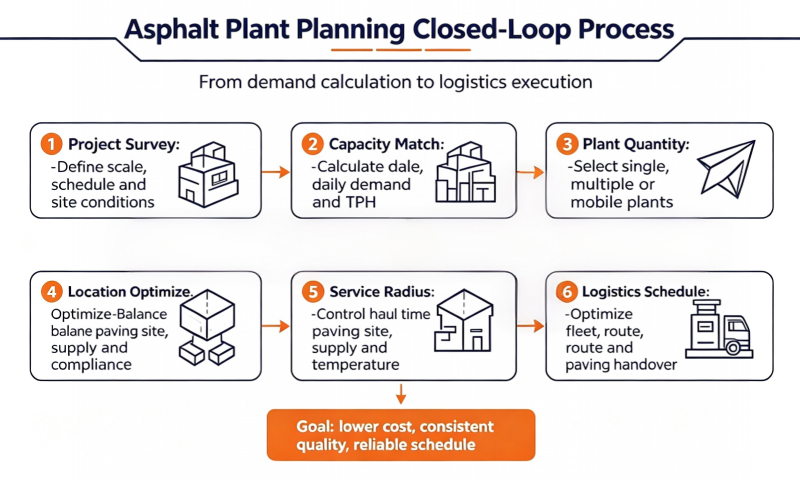
In fact, a scientific and cost-effective bitumen mixing plant scheme does not rely solely on the stacking of large-capacity equipment, but on the comprehensive optimization of six core dimensions: actual project demand, equipment production capacity, site layout and location, transportation scheduling efficiency, economic service radius and long-term operation cost. Only by realizing the dynamic balance of six dimensions can we reduce the comprehensive cost, shorten the construction cycle and improve the overall profit margin of the project on the premise of ensuring the pavement construction quality.
This paper tailor-made the full-process asphalt batching plant planning practical operation system for engineering contractors, EPC engineering enterprises and infrastructure developers, from project pre-survey, capacity matching, site number selection, site selection, service radius calibration, logistics optimization, pit avoidance guide, scenario customization scheme, landing check list and professional engineering empowerment, forming a closed-loop practical operation process to help infrastructure practitioners standardize the asphalt mix plant planning, avoid routine mistakes and maximize project income.
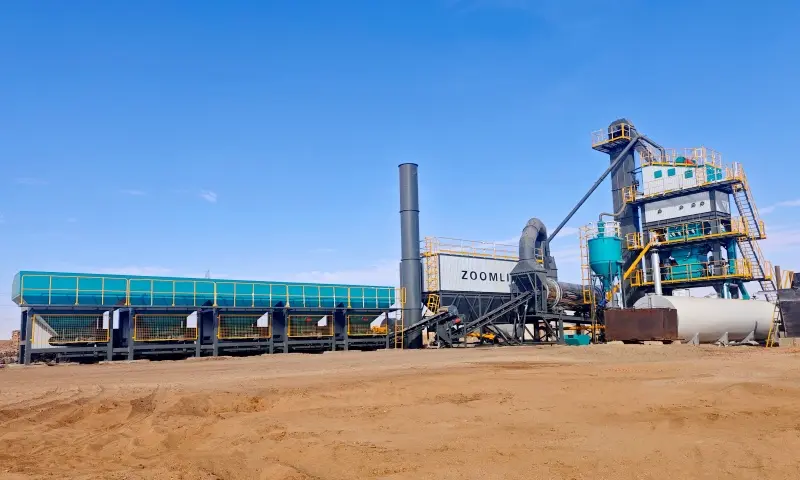
Pre-Planning: Fully Understand Your Road Construction Project
All planning decisions for asphalt batch plants must be based on project requirements rather than equipment parameters. Equipment selection, site selection and radius planning divorced from the actual project will cause problems such as overcapacity, transportation waste and compliance risk. Clear project site conditions are the only prerequisite for accurately matching production capacity, determining site selection and calculating service radius.
Evaluate Project Scale and Construction Schedule
The first step of asphalt mixer plant planning is to quantify the asphalt mixture demand, calculate the overall production pressure through core engineering indicators, and avoid insufficient capacity to slow down the construction period or idle capacity to increase equipment costs. Core measurement indicators include: road length and width size, pavement structure thickness, daily paving construction target, overall construction period and seasonal construction peak demand.
Different road projects have obvious construction light and peak seasons, low construction efficiency in rainy season and winter, concentrated construction in spring and autumn, and short-term surge in asphalt demand. Only by accurately measuring the daily demand and peak demand can accurate data support be provided for subsequent capacity reservation and equipment selection.
Analyze On-Site Construction Conditions
The objective environment of construction site directly determines the construction form, site selection scope and production and transportation mode of batch asphalt mixing plant, which is a hard constraint condition that cannot be ignored. Key survey dimensions include: site terrain flatness, project scene (Urban area/rural wilderness), regional year-round climate characteristics, on-site traffic conditions, and local environmental protection management and control specifications.
For projects in mountainous areas with rugged terrain, the site selection of batch mix asphalt plant is limited and material transportation is difficult; environmental protection control of Urban area projects is strict, and the requirements for noise, dust and exhaust emission of equipment are extremely high; high temperature and rainy areas will directly affect the mixing temperature, transportation insulation effect and construction aging of asphalt mixture, all of which shall be considered in advance in the preliminary planning.
Sort Out Material Supply and Logistics Constraints
Asphalt mixing production is highly dependent on upstream material supply and on-site supporting conditions, and the stability of the supply chain directly determines whether the mixing plant can continue to produce efficiently. In the planning stage, it is necessary to focus on sorting out: the supply distance of sand and gravel aggregate, the supply stability, the supply channel and distribution time limit of asphalt crude oil, whether the water and electricity supporting facilities on the construction site are perfect, and the temporary/permanent road traffic conditions for material transportation.
If the aggregate transportation distance is too long and the asphalt supply cycle is unstable, even if the equipment production capacity is sufficient, there will be frequent downtime and material waiting problems; insufficient water and electricity on site and narrow and congested transportation roads will also directly lower the overall production and construction efficiency, which is the early stage. The core constraint points that must be investigated in planning.
Step 1: Select Scientific Asphalt Plant Capacity (Match Actual Production Demand)
Core planning problem: how to choose the appropriate bach mix plant capacity, neither capacity gap delay construction, nor blind purchase of large capacity equipment resulting in investment waste and idle loss?
Match TPH Capacity with Daily On-Site Production Requirements
The production capacity of mainstream asphalt batch mix plants in the industry is divided into 80TPH, 120TPH, 160TPH, 240TPH and above large-capacity models. Different production capacities correspond to different daily production capacities, which can accurately adapt to the paving needs of road projects of different scales. Small municipal roads and sporadic repair projects have stable demand and small volume, suitable for 80 – 120TPH asphalt plant equipment; medium-sized municipal reconstruction and county highway projects are suitable for 160TPH asphalt mixing plant equipment; high-speed, airport and large-scale EPC infrastructure projects have large paving volume and tight construction period, so it is necessary to select 240TPH and above high-capacity bitumen batch mix plants to ensure continuous construction.
Reserve Capacity for Peak Demand and Future Expansion
Selection based only on current daily demand is a common mistake in the industry. Road construction has centralized rush and phased construction period pressure, while some bitumen hot mix plant projects have secondary construction needs such as road widening and auxiliary pavement construction in later stage. Therefore, marginal redundant capacity must be reserved in capacity planning to cope with construction peaks, sudden rush demand and long-term project expansion, so as to avoid insufficient capacity of medium-term equipment and increase cost of temporary supplementary equipment. Many customers only refer to the rated TPH capacity marked on the brochure when selecting asphalt mixing plants, ignoring the actual effective output affected by site conditions, aggregate moisture, operation and maintenance. For a complete set of methods to narrow the gap between nominal capacity and on-site production, please refer to our in-depth guide on how to optimize real output performance of asphalt mixing plant.
Recommended Asphalt Plant Capacity for Different Road Projects
The following table is formulated based on peak construction demand of road engineering and industry standards for continuous operation of asphalt hot mix plant, which can be directly used for project capacity selection reference:
| Project Type | Daily Asphalt Demand | Recommended Asphalt Plant in Capacity | Typical Application Scenarios |
| Minor municipal roads, road repair works | 300 – 500 tons | 80TPH | Urban area branch road reconstruction, rural road hardening, sporadic pavement repair |
| Medium-sized municipal roads, county roads | 500 – 800 tons | 120TPH | Construction and reconstruction of urban primary and secondary trunk roads, county connecting highway projects |
| Urban expressway, provincial highway | 800 – 1200 tons | 160TPH | Urban expressway, provincial road upgrading and reconstruction, park trunk road project |
| Freeways, airport runways, large EPC projects | More than 1200 tons | 240TPH and above | New expressway, airport pavement, large-scale industrial park overall infrastructure project |
Step 2: Determine Single or Multiple Asphalt Plants (Improve Overall Project Efficiency)
Most project contractors only focus on capacity and site selection, ignoring the number of sites and the model selection of asphalt hot mix plants, which are the core links that directly affect the overall efficiency of the project and have strong decision-making value. Single asphalt plant, multi-asphalt mixer plant or mobile asphalt plant scheme shall be selected in combination with project layout, construction scope and construction period requirements.
Scenarios Where a Single Asphalt Plant Is Sufficient
For small and medium-sized projects with concentrated construction scope, short lines and uniform construction sequence, single stationary asphalt mixing plant shall be preferred. The construction area of such projects is centralized, the material transportation distance is controllable, and all paving requirements can be met by a single asphalt batch plant without repeated investment of equipment, which can save equipment rental, installation and operation and maintenance costs to the greatest extent.
Scenarios Where Multiple Plants Significantly Improve Efficiency
For long-distance expressway, large-scale projects with scattered construction sections and segmented cross construction, a single hot mix asphalt plant will lead to problems such as too long transportation distance, delayed arrival of materials, and paver breakage. The layout of multiple distributed hot asphalt mixing plants can cover different construction sections, shorten the transportation radius, ensure the continuity of supply, adapt to the construction rhythm of sections, and greatly improve the overall construction efficiency.
Mobile Asphalt Plant vs Stationary Asphalt Plant vs Temporary Asphalt Plants: How to Choose
The three hot asphalt plant shapes are adapted to different engineering scenarios, and the core selection depends on the project cycle, construction fluidity and site conditions:
The mobile asphalt mixing plant is convenient to disassemble and flexible to transfer, suitable for short-term temporary engineering and bid section mobile construction projects; For complex mountainous road projects with scattered construction sections and frequent equipment relocation, a high-performance super mobile asphalt plant is the optimal solution. A successful 120TPH project case in Peru proves how integrated single-trailer design and continuous mixing technology solve field construction difficulties and optimize project layout: From One Trailer to 120 TPH: How a Super Mobile Asphalt Plant Is Solving Road Construction Challenges in Peru
Stationary asphalt mixing plant has stable production capacity and low operation and maintenance cost, which is suitable for long-term large-scale infrastructure projects.
The asphalt mixing plant for temporary works is built quickly and with low investment, which can meet the short-term emergency construction needs, but it is not suitable for high-standard and long-term key projects.
Step 3: Optimize Asphalt Plant Location Selection
Site location is the core intermediate link connecting capacity planning and service radius calibration, which directly determines project logistics cost, construction efficiency and compliance. Scientific site selection can lay a foundation for the delimitation of subsequent economic service radius and optimization of logistics scheme, which is the key to long-term and efficient operation of asphalt mixer machine. After confirming a proper site, you need to design a scientific internal plant layout. Learn about linear, L-shaped, U-shaped and tower asphalt plant layouts for different land shapes and production scales.
Key Influencing Factors for Asphalt Plant Location
The site selection needs to comprehensively balance the four dimensions of construction, materials, cost and compliance:
Straight distance between bitumen mix plant and paving surface, transportation distance between aggregate and asphalt raw material, existing infrastructure and water and electricity facilities on site, local land use policy and environmental compliance requirements Priority shall be given to sites with convenient material transportation, close to core construction areas, complete supporting facilities and unimpeded environmental protection approval, so as to control operating costs from the source.
Centralized vs Distributed Plant Layout Strategy
Centralized layout, i.e. single central asphalt mixing plant, unified supply for the whole project, convenient management, low operation and maintenance cost, suitable for centralized construction projects;
Distributed layout, i.e. collaborative operation of multi-regional sites, adapts to long-term and decentralized construction of bid sections;
The temporary site can serve the core operation surface nearby, and the transportation distance can be extremely compressed, which is suitable for short-term key construction sections.
How Asphalt Plant Location Affects Project Productivity and Long-Term Costs
The quality of site selection directly quantifies the operation indicators of the project:
Remote site selection will greatly increase the fuel consumption cost of transportation vehicles, lengthen the waiting time for loading of vehicles back and forth, greatly reduce the utilization rate of vehicles, easily cause the construction site to wait for materials and equipment without load, and slow down the overall construction period. Reasonable site selection can shorten transportation turnover time, improve vehicle utilization rate, ensure stable supply, and realize cost reduction and efficiency increase.
For detailed evaluation standards of land, geology, environmental compliance and raw material transportation distance, check our complete asphalt plant site selection guide.
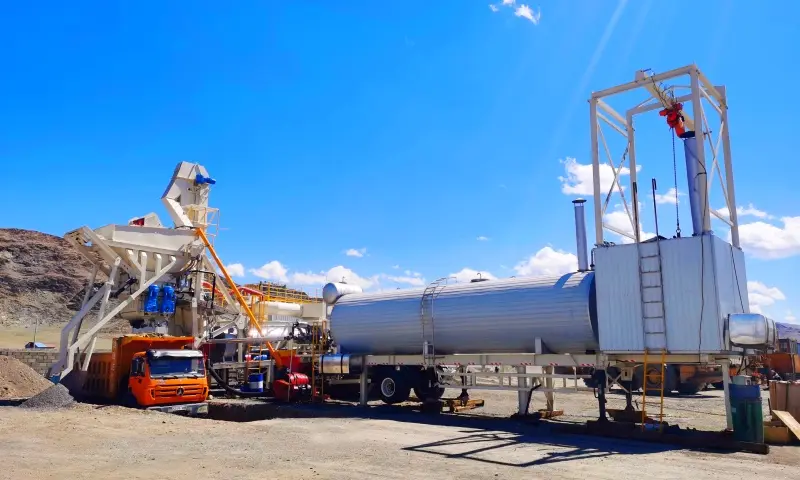
Step 4: Calibrate Optimal Asphalt Plant Service Radius
Many construction parties mistakenly think that the service radius of asphalt mixing machine is a fixed value. In fact, the service radius is the result of combining the dynamic balance of equipment capacity, site location, transportation efficiency and project demand, and is the final quantitative standard for judging whether the site layout is reasonable.
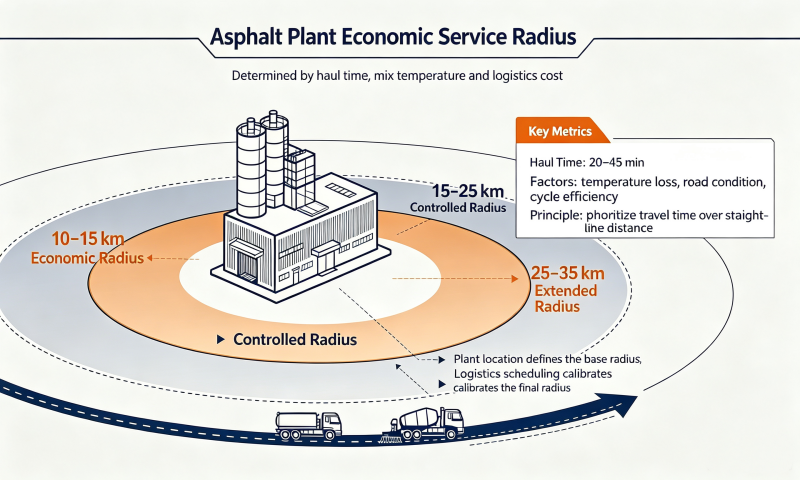
Economic Service Radius vs Maximum Haul Distance
The maximum transportation distance is the transportation limit of physical accessibility of vehicles, which only represents spatial accessibility and has no engineering reference value.
Economic service radius is the optimal transportation range considering asphalt mixture quality, transportation cost and construction efficiency, and is the effective service boundary meeting the requirements of engineering quality standard and cost control, and is also the core reference index of project planning. Beyond the economic service radius, there will be problems such as excessive temperature loss of mixture, sharp increase in fuel consumption, and significant decrease in construction cost performance.
Key Factors Affecting Asphalt Plant Service Radius
The service radius is not a fixed value and is dynamically restricted by multiple site factors: road traffic conditions and one-way transportation time, supporting transportation fleet size, site road smoothness, regional climate temperature, asphalt mixture temperature loss rate, equipment production continuity. For projects with poor road conditions, high temperature and rain, and insufficient fleet capacity, the effective economic service radius will shrink significantly.
Matching Service Radius for Different Asphalt Plant Equipment Capacities
The following table strictly follows the asphalt insulation construction standard, the project economic cost threshold, avoids the invalid radius planning, and can be directly used on the ground:
| Asphalt Plant Capacity | Economic Service Radius | Typical Single-way Haul Time | Applicable Project Types |
| 80TPH | 10–15km | 20 – 30 minutes | Small-scale municipal and rural road rehabilitation projects |
| 120TPH | 15–20km | 25 – 35 minutes | Medium-sized municipal and county highway projects |
| 160TPH | 20–25km | 30 – 40 minutes | Urban Expressway and Provincial Highway Project |
| 240TPH and above | 25–35km | 35 – 45 minutes | Highways, airports, large-scale EPC infrastructure projects |
Step 5: Optimize On-Site Transportation and Logistics
Most industries only focus on bitumen plant parameters and site selection, ignoring logistics transportation as the core cost reduction link. In fact, logistics scheduling is the key to affecting asphalt construction quality and project profits, and it is also the core point to open the project control level.
Transportation Time Is More Important Than Linear Distance
There is a common misconception in the industry that “judging the quality of transportation by distance”. In actual projects, 30km of rugged congested rural roads will have far longer transportation time and fuel consumption than 50km of unobstructed municipal trunk roads. Compared with the straight-line distance, the transportation time determined by traffic conditions, traffic lights, congestion points and road flatness is the core index affecting the mixture quality and transportation cost.
Scientific Optimization of Truck Fleet Scheduling
The transportation fleet planning shall match the asphalt hot plant capacity and construction rhythm, accurately configure the number of vehicles, and avoid vehicles waiting in piles or insufficient supply. By optimizing vehicle turnover process, improving loading efficiency, intelligent scheduling, shortening vehicle cycle cycle, eliminating vehicle idle, construction site material breakage and other problems, accurate matching between production and transportation can be realized.
Reduce Transportation Costs While Ensuring Asphalt Mix Quality
Transportation links need to take into account both cost and quality objectives:
Control the transportation temperature of asphalt mixture in the whole process to avoid too low temperature affecting the paving compaction quality;
Optimize transportation routes to avoid congested sections and reduce fuel consumption and time costs;
Establish a three-party linkage mechanism of production, transportation and paving to realize material distribution on demand and accurately connect construction rhythm.
5 Common Asphalt Plant Planning Mistakes That Boost Project Costs
According to the practical operation cases of the project, most of the problems of overspending and inefficiency of tar mixing plant projects stem from the misunderstanding of early planning. Avoiding the following five mistakes can directly reduce the overall cost of the project.
Blind Capacity Selection Based Only on TPH Parameters
The simple pursuit of high-capacity asphalt mixing plant equipment ignores the daily demand, peak fluctuation and transportation supporting capacity of the project, resulting in long-term idle equipment, high operation and maintenance costs and investment waste.
Unreasonable Asphalt Plant Location Leading to High Logistics Costs
Ignoring material transportation distance and road conditions, blindly selecting low-cost sites, the increment of final transportation fuel consumption, labor and time cost far exceeds the cost saved by the site.
Overestimating Economic Service Radius Beyond Quality and Cost Limits
Blindly expanding the transportation scope, exceeding the quality and economic threshold, resulting in excessive temperature loss of asphalt mixture, substandard pavement construction quality and increased rework rate.
Ignoring Bottleneck Constraints in Field Logistics
Problems such as road congestion, height limit and width limit, traffic restriction, etc. were not checked in advance, and material transportation was blocked during construction peak period, which directly delayed the overall construction period.
Underestimating Peak Demand and Future Project Expansion Demand
Production capacity is planned only according to conventional construction requirements, and problems such as insufficient production capacity and passive construction occur in case of rush work, rush construction period in rainy season and later expansion project.
Customized Planning Recommendations for Different Types of Road Projects
For different project types, a complete set of customized solutions including capacity, site selection, service radius and asphalt batch mix plant form shall be provided.
Municipal Road Projects
preferably 120 – 160TPH capacity asphalt plant equipment;
Single asphalt concrete plant centralized layout shall be adopted, conforming to the construction scope of Urban area; the economic service radius shall be controlled within 15 – 25km;
Priority shall be given to low-noise environment-friendly asphalt mixing plant to meet the environmental protection control requirements of Urban area.
Highways and Expressway Projects
240TPH and above high-capacity asphalt plant equipment is preferred;
The long-term bid section adopts multi-site distributed layout;
The radius of economic service shall be controlled within 25 – 35km;
Fixed asphalt mixing plant is used for main part, and auxiliary mobile equipment for remote bid section is used for filling position.
Airport Runway Pavement Projects
240TPH high-precision asphalt mixing plant is selected to ensure the mixture ratio stability;
Centralized site selection nearby to minimize transportation distance;
Strictly control short-distance transportation within 20km, eliminate temperature loss; full-length stationary high-standard mixing plant, meet the strict quality standards of airport engineering.
Industrial Park Road Projects
80 – 160TPH asphalt mixing equipment shall be selected according to the scale of the park;
Single site covers the whole area of park road network;
Service radius controlled at 15 – 20km;
Mobile asphalt mixing plant or stationary asphalt mix plant can be flexibly selected to meet the needs of phased construction.
Large-Scale EPC Infrastructure Projects
Adopt 240TPH or above high-capacity asphalt mixing reserve sufficient capacity expansion;
Adopt the combination layout of “central master station + regional substation”;
Accurate division of service radius by bid section;
Flexible filling with mobile asphalt plant equipment to meet the construction requirements of multi-bid section, long cycle and full process.
Practical Asphalt Plant Planning Checklist
In order to help the construction party standardize the landing planning process and avoid omissions, it is necessary to sort out a complete set of pre-check lists, which can be checked item by item before asphalt batching plant selection and site construction:
- The overall construction scale and environmental conditions of the project have been comprehensively evaluated.
- Accurate measurement of daily asphalt demand and peak construction demand
- Complete scientific mixing plant capacity matching selection
- Confirm single asphalt plant/multi-asphalt plantcombination layout scheme
- Completion of site site selection compliance and traffic feasibility verification
- Reasonably calculate and delimit the radius of economic service
- Completion of transport fleet size configuration and scheduling scheme planning
- Verify stability of aggregate and asphalt raw material supply
- Confirm that the hydropower facilities on the construction site meet the production requirements
- Reserve equipment capacity and site expansion space to meet long-term demand
How Zoomline Helps Contractors Plan More Efficient Asphalt Plants
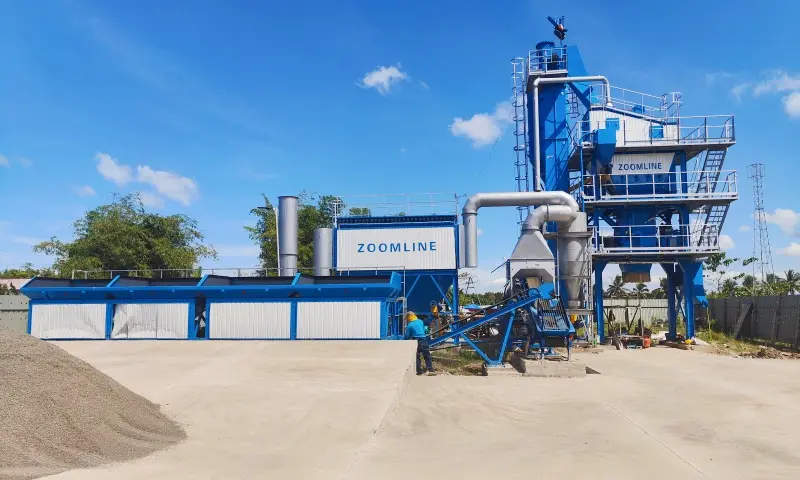
Most asphalt batching plant manufacturers only provide standardized equipment products, while ZOOMLINE focuses on the pain points of global infrastructure projects, takes engineering planning service providers as the core positioning, provides full-process pre-planning empowerment for contractors and EPC general contracting enterprises, rejects simple equipment sales, and takes project cost reduction and efficiency as the core goal.
Core Engineering Services Support includes:
- Full-process project pre-survey and personalized planning consultation
- Accurate capacity matching and scheme calculation based on project data
- Customized site selection and site layout scheme design
- Mobile and stationary complete adaptation solutions
- Professional on-site logistics transportation optimization and scheduling guidance
- Equipment installation, commissioning, operation and maintenance full-cycle technical support
- Relying on global multi-regional infrastructure project experience, adapting to multinational construction and environmental protection standards
For road projects of different scales and scenarios, ZOOMLINE can provide one-to-one exclusive planning solutions to help enterprises avoid planning mistakes, optimize resource allocation, and maximize project construction quality and profit margin.

Conclusion
The asphalt mixing plant planning is a set of systematic engineering with multi-dimensional dynamic balance. The complete closed-loop logic is as follows: taking the actual demand of the project as the core basis, taking accurate capacity matching as the basis, taking scientific site selection layout as the core support, taking the optimal service radius and logistics scheduling as the final guarantee, and all links are interrelated and mutually restricted to form a standardized engineering planning system.
The standardized planning process can solve the core problems such as waste of production capacity, high logistics cost, unstable construction quality and delay of construction period from the source, effectively save project operation cost, avoid waste of resources, ensure pavement construction quality and comprehensively improve the comprehensive profitability of road infrastructure projects.
For the engineering contractor and EPC team, abandoning the traditional thinking of single asphalt mix plant equipment parameter selection, adopting systematic and scenario planning mode and supporting professional engineering consultation are the keys to realize project quality improvement, efficiency improvement and long-term profitability.
Frequently Asked Questions
- What is the ideal service radius of 160TPH asphalt mixing plant?
Under normal road conditions and climatic conditions, the economic service radius of 160TPH asphalt mixing plant is 20 – 25km, and the one-way transportation time is controlled at 30 – 40 minutes, which can effectively balance the mixture insulation quality and transportation economic cost, and adapt to medium-sized long-term projects such as urban expressways and provincial highways. - Is a mobile asphalt plant suitable for highway construction?
Totally applicable. The long-term construction sections of expressways are scattered, the temporary construction sections are many, the coverage of stationary asphalt mixing plantis limited, and the mobile asphalt mixing plantcan be flexibly transferred to meet the needs of sectional construction. It is often used in combination with large stationary asphalt plants to supplement the construction of remote sections and improve the overall construction efficiency. - How to accurately calculate the required capacity of asphalt mixing plant for road project?
The core calculation logic is: calculate the total asphalt consumption according to the road length and width and pavement thickness, calculate the daily average basic demand in combination with the total construction period, then superimpose the construction peak coefficient, equipment loss and maintenance reservation coefficient, finally determine the adaptive capacity, and at the same time consider the long-term expansion demand to avoid insufficient capacity or idle capacity. - What are the core factors affecting the quality of asphalt mixture in long-distance transportation?
It mainly includes transportation time, ambient temperature, bumpy road conditions, vehicle insulation tightness and traffic congestion. Overtime transportation, excessive temperature loss, frequent start and stop bumps will directly lead to mixture segregation, temperature is not up to standard, affecting the paving compaction quality and pavement service life.