


White Paper on the Implementation of an Eco-Friendly Asphalt Mixing Plant in Indonesia: Technological Innovations and Green Practices in Sustainable Road Construction
Contents
- 1 Introduction
- 2 Indonesia Asphalt Industry and Road Construction Market Analysis
- 3 Technology Overview of Environmental Protection Asphalt Mixing Station
- 4 Feasibility Analysis in Indonesia
- 5 Typical Case Studies
- 6 Economic, Environmental, and Social Benefits Analysis
- 7 Implementation Challenges and Response Strategies
- 8 Policy Recommendations and Outlook
- 9 Conclusion
- 10 References
Executive Summary
Indonesia is currently experiencing a period of rapid infrastructure development. From 2020 to 2024, total national infrastructure investment is projected to reach $412 billion, with transportation infrastructure accounting for approximately 60% of this total, and demand for new road construction and maintenance continuing to rise. However, traditional local asphalt mixing plants generally suffer from issues such as excessive dust emissions, direct discharge of asphalt fumes, high energy consumption, and low resource utilization, which run counter to Indonesia’s goals for green infrastructure and carbon reduction.
This white paper, based on the current state of Indonesia’s road construction market, environmental protection policy requirements, combined with Zoomline’s core environmental asphalt mixing technology, local implementation cases in Indonesia, and authoritative global industry research data, systematically demonstrates the feasibility, economic benefits, and environmental value of environmentally friendly asphalt mixing equipment in Indonesia.
Key Conclusions: Zoomline’s low-emission asphalt mixing technology can achieve standard operating condition fuel consumption as low as 6.5kg/t, multi-stage dust removal efficiency exceeding 99%, and full-process recovery and purification of asphalt smoke, fully compatible with Indonesia’s tropical climate and SNI certification requirements; road projects using this equipment can reduce comprehensive costs by more than 25%, and pollutant emissions are reduced by 90% compared to traditional equipment, helping Indonesia achieve the goal of green infrastructure construction.
Key Recommendations: Indonesia’s road projects should prioritize the use of SNI-certified mobile/fixed environmental asphalt mixing stations, large-scale promotion of the RAP recycled asphalt technology, and the co-application of Buton natural asphalt, to promote the green upgrading of the entire road construction chain.
| Year | Volume (tons) | Value (US$) |
| 2016 | 1,700,000 | 925,245,500 |
| 2017 | 1,418,000 | 787,536,440 |
| 2018 | 1,217,219 | 647,712,390 |
| 2019 | 1,311,318 | 691,461,196 |
| 2020 | 828,544 | 430,462,072 |
| 2021 | 883,731 | 471,127,472 |
(Chart 1: Indonesia’s annual asphalt demand trend bar chart; data source: Tekmira research report, Indonesia’s average annual asphalt demand is about 1.2 million tons)
Keyword: Eco-friendly Asphalt Mixing Plant Commissioned in Indonesia, Eco-friendly Asphalt Mixing Equipment, Sustainable Road Construction, Asphalt Mixing Plants in Indonesia, Green Infrastructure, Zoomline Eco-friendly Asphalt Plant Case Study, Low-Emission Asphalt Mixing Technology
Introduction
Research Background: Indonesia’s National Strategic Goals and Green Infrastructure Drive
Indonesia’s “National Medium and Long-Term Development Plan (RPJPN 2025-2045)” lists road network improvement, regional balanced development, and green and low-carbon transformation as core strategic directions. As the largest economy in Southeast Asia, Indonesia’s road construction shows significant regional differences: the Java Island, as the industrial core area, has a dense road network but is in urgent need of upgrading; while the remote areas of Sumatra, Papua, and other islands have low road coverage rates, becoming bottlenecks for economic development.
Against this backdrop, Eco-friendly asphalt mixing plants as core equipment for road construction, have become the key carrier to bridge infrastructure needs and environmental constraints, and are also an important support for Indonesia to achieve the climate goal of unconditional emission reduction of 29% and conditional emission reduction of 41% by 2030.
Industry Pain Points and Market Opportunities
Three core issues are exposed in the application of traditional asphalt mixing stations in Indonesia:
- Inadequate environmental standards: serious dust, smoke, and noise pollution, difficult to pass AMDAL environmental impact assessment;
- High energy consumption and costs: fuel consumption is high, raw material waste is serious, and project costs are increased;
- Poor adaptability: cannot meet both the large-scale continuous construction needs on Java Island and the flexible transfer needs in remote areas of other islands.
On the opportunity side, the Indonesian government is vigorously promoting the construction of cross-Java and cross-Sumatra expressways and rural road access projects, and at the same time, it has issued green road construction specifications, and the market gap of environmental-friendly asphalt mixing equipment is expanding continuously. The technology route of low emissions, high adaptability, and recyclability has become the industry consensus.
Purpose, Scope, and Methods of the White Paper
- Purpose: To provide a comprehensive solution of technology, economy, and policy for the landing of environmental-friendly asphalt mixing stations in Indonesia;
- Scope: Focus on the scenario-based application of Zoomline environmental-friendly asphalt mixing equipment in the Java Island expressways and rural roads of other islands;
- Methods: Integrating Zoomline local project data, Indonesia’s official infrastructure planning, industry LCA life cycle assessment, and authoritative market reports, ensuring that the conclusions are feasible and verifiable.
Target Audience
Indonesia’s Public Works and Housing Ministry (PUPR), transportation authorities, EPC engineering contractors, environmental consulting agencies, and road construction investment enterprises.
Indonesia Asphalt Industry and Road Construction Market Analysis
Market Size and Growth Trends
- Asphalt mixing equipment market: The Indonesian market size is approximately $48.7 million in 2025, expected to reach $54.3 million in 2031, with a compound annual growth rate (CAGR) of 1.8%;
- Asphalt concrete demand: The demand is about 4 million tons in 2025, expected to rise to 5.5 million tons by 2030, with Java and Sumatra accounting for over 70% of the total demand;
- Core drivers: Accelerated urbanization, toll road construction, and the combined demand for maintenance of old roads are driving the growth of both equipment and materials.
Policy and Standard Drivers
- Infrastructure planning: Indonesia announced the addition of 3,650 kilometers of roads and maintenance of 46,770 kilometers of roads in 2019, with a total investment of $67.9 billion; the proportion of transportation infrastructure investment in 2020-2024 is over 60%;
- Material policy: Promoting the utilization of Buton natural asphalt to 30%, encouraging the application of green materials such as RAP recycled asphalt pavement and plastic-modified asphalt;
- Environmental protection and certification: It is mandatory for asphalt mixing stations to comply with national emission limits, and equipment must pass the SNI certification, with matching AMDAL environmental impact assessment and waste management permits.
Regional Variations in Demand
| Region | Road Construction Characteristics | Equipment Compatibility Type |
| Java Island | Highly industrialized region with large-scale construction projects on highways and major urban thoroughfares | Stationary eco-friendly asphalt mixing plants (160–400 t/h) |
| Sumatra / Kalimantan | Resource development and road network expansion proceed in parallel; medium-scale projects | Mobile eco-friendly batching plant (80–120 t/h) |
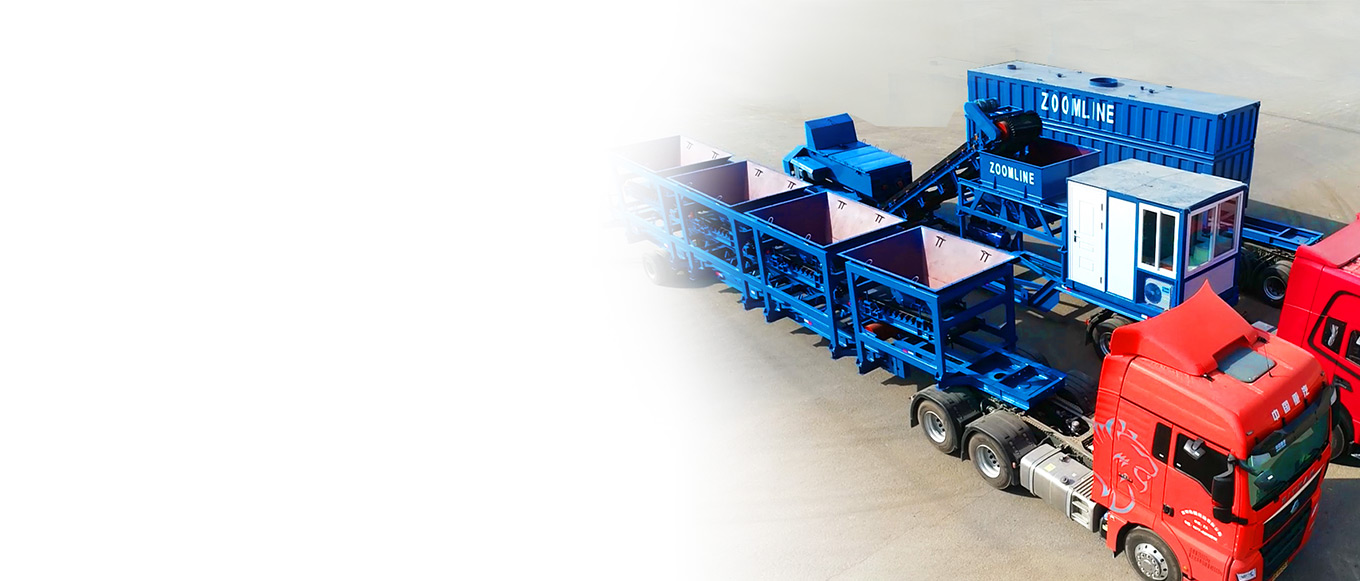
| Remote offshore islands | Projects are scattered, require frequent relocation, and involve small-scale construction | Mobile eco-friendly batching plant (40–60 t/h) |
(Chart 2: Pie chart showing the structure of infrastructure investment in Indonesia; Data sources: National Development Planning Agency, Zoomline Indonesia Market Analysis)
Industry Environmental Protection Trends
Indonesia’s green road construction has formed three major technical directions:
- Warm Mastic Asphalt (WMA): Reduces production temperature, energy consumption, and emissions;
- RAP recycling technology: Waste asphalt pavement recycling rate reaches 30%-80%;
- Environmental-friendly mixing equipment: Fully enclosed, low emission, and intelligent, replacing traditional high-pollution equipment.
Technology Overview of Environmental Protection Asphalt Mixing Station
Core Technology of Zoomline Environmental Protection Asphalt Mixing Station
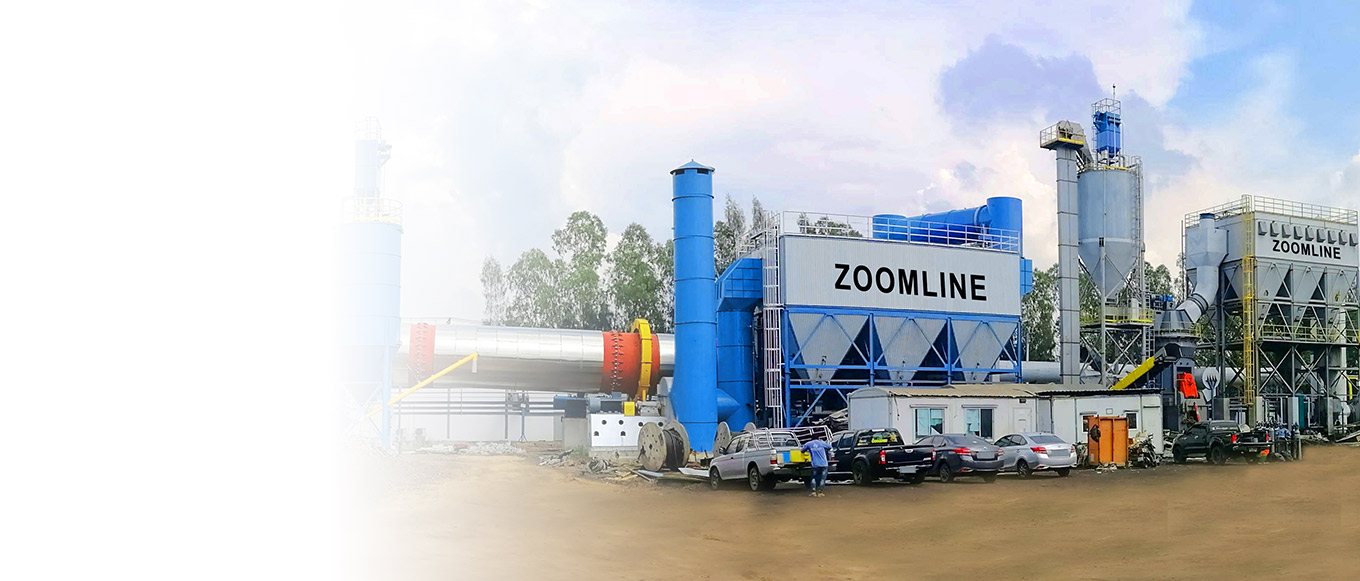
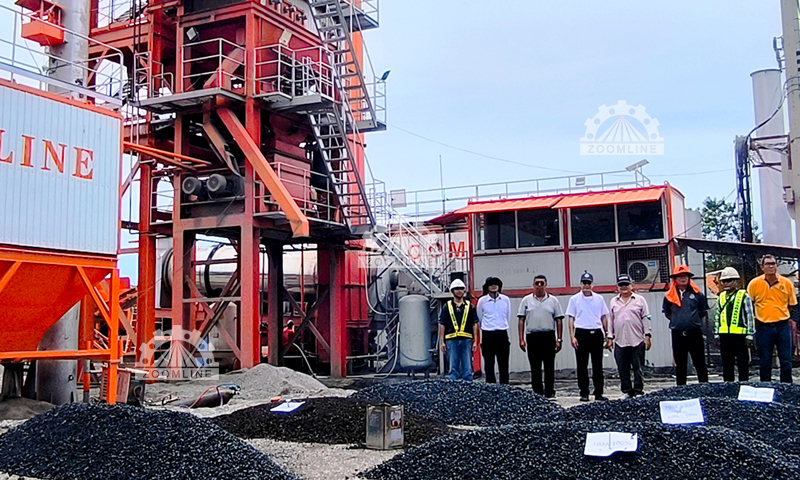
As a supplier of asphalt equipment deeply rooted in the Indonesian market, Zoomline’s ZAP-H series environmental protection asphalt mixing stations are designed around a core technology system for low emissions, low energy consumption, high adaptability, and recyclability, fully adapted to the Indonesian scenario:
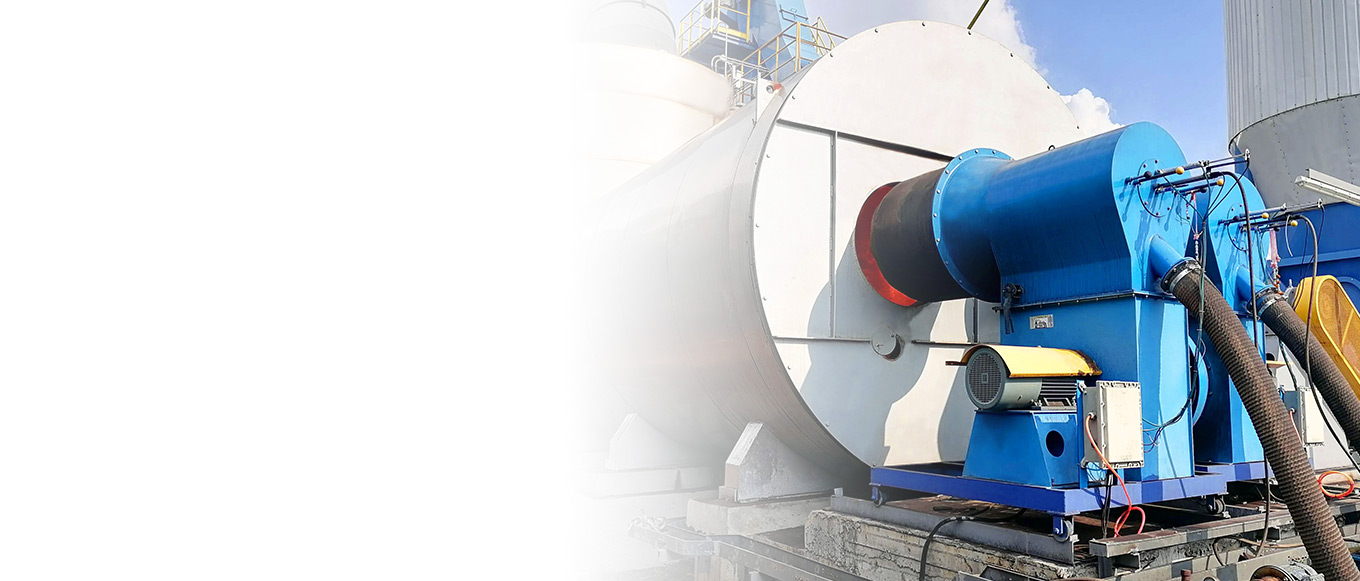
- Two-stage high-efficiency dedusting system: cyclone dedusting + bag filter backblowing dedusting, dust emission concentration far below the Indonesian national standard, efficiency over 99%;
- Full-enclosed environmental design: fully sealed aggregate storage, batching station three-sided sealing + vacuum control, eliminating dust leakage from the source;
- Self-developed waste powder processor: precise control of recycled powder usage, wetting recovery to avoid secondary pollution;
- Blue Fume Collection and Unloading Purification: A dedicated asphalt fume collection system, coupled with dust adsorption equipment in the unloading area, ensures complete purification of fumes;
- Intelligent energy-saving control: PLC remote monitoring, precise temperature control, standard working condition fuel consumption as low as 6.5kg/t finished material.
(Table: Key Specifications of the Zoomline ZAP-H Series Eco-Friendly Asphalt Mixing Plant; Source: Zoomline official website)
| Model | Production Capacity (t/h) | Mixing Vessel Rated Capacity (kg) | Fuel Consumption (kg/t) | Total Installed Power (kW) |
| ZAP-H40 | 40 | 600 | 6.5 | 130 |
| ZAP-H80 | 80 | 1000 | 6.5 | 263 |
| ZAP-H120 | 120 | 1500 | 6.5 | 393 |
| ZAP-H160 | 160 | 2000 | 6.5 | 458 |
| ZAP-H320 | 320 | 4500 | 6.5 | 813 |
| ZAP-H400 | 400 | 5000 | 6.5 | 936 |
Comparison of Environmental Protection Station and Traditional / Mixed Asphalt Technology
- Emission Comparison: The environmental protection station has full control over dust, flue gas, and noise, reduces emissions by over 90% compared to traditional stations, and can be directly located near urban areas;
- Energy Consumption Comparison: Optimized drying cylinder design improves thermal efficiency by 30%, and fuel consumption is reduced by 15%-20%;
- Life Cycle Emission Reduction: The WMA+RAP co-application scheme reduces carbon emissions by 55%-64% compared to traditional processes (data source: ScienceDirect Life Cycle Assessment Study).
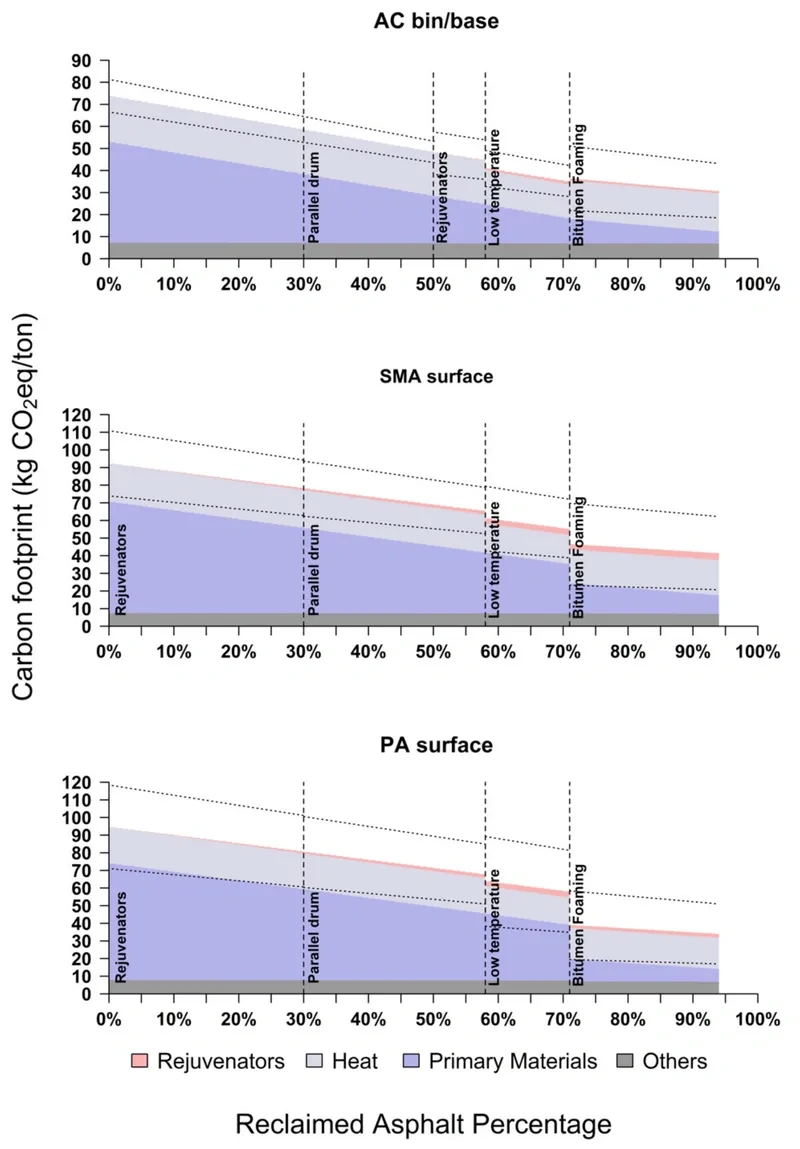
Data source: Industry LCA study
Indonesia Tropical Climate Adaptation Optimization
- High humidity durability design: Core components are corrosion and moisture-resistant, suitable for Indonesia’s tropical rainforest climate, with a device lifespan exceeding 10 years;
- SNI certification compatibility: Products meet Indonesian national standards and can quickly pass local compliance inspections;
- Remote intelligent control: Supports overseas remote debugging and fault diagnosis, reducing on-site maintenance and operation costs.
Feasibility Analysis in Indonesia
Policy and Regulation Compliance
Zoomline Eco Station fully meets Indonesia’s compliance requirements:
- Meets environmental emission standards and the Ministry of Construction’s green building standards;
- Supports the full process of AMDAL environmental impact assessment, waste management permits, and other approval processes;
- Aligns with Indonesia’s circular economy and low-carbon infrastructure policy orientation, and is eligible for green project support.
Supply Chain and Localized Services
- Jakarta Spare Parts Warehouse: Stocks commonly damaged parts, response time ≤ 24 hours;
- Local Service Team: Provides one-stop service for installation, debugging, operation training, and regular maintenance;
- Local Strategic Partnership: Establishes a long-term cooperation with leading Indonesian engineering company PT Waskita Karya to ensure smooth project implementation.
Economic Assessment
- Scenario-based Selection: Selects fixed high-capacity equipment on Java Island and mobile equipment on outer islands to reduce logistics and installation costs;
- Recycled Cost Reduction: RAP recovery rate of 30%-80%, reducing the use of new aggregate and asphalt, with single project costs reduced by over 30%;
- Operation and Maintenance Costs: Intelligent control reduces labor, wear-resistant part design reduces failure rate, and the total cost of ownership is reduced by 25%.
Risk Assessment and Mitigation
| Risk Types | Solution |
| Fuel price volatility | Compatible with multi-fuel burners, enabling the use of low-cost fuels such as natural gas and biodiesel |
| Inter-island raw material transportation costs | Prioritize the use of locally sourced Buton bitumen to reduce reliance on imports |
| Complex compliance approvals | Suppliers provide comprehensive compliance guidance to shorten the approval process |
Typical Case Studies
Zoomline Indonesia Local Landing Case
Case 1: Java Island Highway Reconstruction Project (PT Waskita Karya)
- Project Overview: A key high-speed reconstruction project of the Indonesian government, requiring high productivity, environmental compliance, and controllable schedule;
- Equipment Configuration: 3 ZAP-H320 Fixed Environmental Protection Asphalt Mixing Plants;
- Implementation Effect: Stable production capacity of 320t/h, full-process environmental compliance, 15 days ahead of schedule completion, and highly recognized by the owner.
Case 2: Indonesia’s Remote Island Rural Road Access Project
- Project Overview: Road network construction in remote areas of outer islands, project scattered, frequent site changes;
- Equipment Configuration: Multiple mobile environmental asphalt mixing plants;
- Implementation Effect: Fast site changes, no complex foundation required, solving the equipment deployment difficulties in remote areas, and logistics costs reduced by 25%.
Replicable Cases in Southeast Asia
- Phnom Penh–Sihanoukville Expressway, Cambodia: Zoomline 320t/h Fixed Environmental Protection Station, successfully passed the local environmental acceptance, supporting the construction of the core section;
- Upgrading Rural Roads in Thailand: 120t/h Mobile Environmental Station, adaptable to tropical climate and scattered construction, comprehensive cost reduced by 25%, the case can be directly replicated to Indonesia’s outer island projects.
Quantitative Summary of Benefits
- Production Efficiency: 20% increase compared to traditional equipment, 80% reduction in downtime due to failures;
- Environmental Benefits: Dust and smoke emissions nearly zero, passed all environmental inspections in Indonesia;
- Usability: Stable operation for more than 10 years in tropical environments, far exceeding the industry average.
Economic, Environmental, and Social Benefits Analysis
Environmental Benefits
- Pollutant reduction: dust, asphalt smoke, and noise all meet standards, avoiding ecological damage to the surrounding area;
- Resource conservation: RAP recycling technology reduces the need for new stone and asphalt, protecting mines and ecosystems;
- Low-carbon contribution: helps the Indonesian transportation department reduce carbon emissions, aligning with the commitments of the Paris Agreement.
Economic Benefits
- Direct costs: fuel consumption of 6.5kg/t, raw material recycling reduces costs by 30% or more, and the cost of a single kilometer of road is reduced by 15%-20%;
- Indirect benefits: compliance with environmental protection regulations avoids fines, durable equipment reduces replacement costs, and the project ROI is shortened by 1-2 years;
- Long-term value: adapts to Indonesia’s green infrastructure trend, enhancing the company’s market competitiveness.
Social Benefits
- Air quality improvement: reduces construction pollution, protecting residents’ health;
- Regional balanced development: mobile equipment on outer islands helps improve road networks in remote areas, narrowing the development gap;
- Local employment: equipment operation and maintenance drive the increase of local technical positions.
Core Quantitative Indicators
- Fuel consumption per ton of finished material: 6.5kg (industry leading);
- RAP recycling utilization rate: 30%-80%;
- Comprehensive cost reduction: 25%-30%;
- Pollutant reduction rate: over 90%.
(Chart 5: Environmental Benefits Radar Chart; Data source: Zoomline Eco-friendly asphalt-plant technical parameters, ScienceDirect WMA research)
Implementation Challenges and Response Strategies
Core Implementation Challenges
- Initial investment is high: the cost of purchasing environmental protection equipment is higher than that of traditional equipment;
- Complex compliance approval process: the environmental assessment and permit process is complex;
- Tropical climate maintenance: high humidity and temperature can easily affect equipment stability;
- Insufficient local operational capabilities: local operators lack professional training.
Systematic Response Solutions
- Phased implementation: first pilot small-scale projects, verify benefits after verification and then scale up;
- Green financing support: connect with ADB (Asian Development Bank), World Bank Green Infrastructure Fund to reduce financing costs;
- Exclusive maintenance solutions: customized anti-corrosion and moisture-proof maintenance, 24/7 remote technical support;
- Local training system: Zoomline provides on-site + online training to ensure that operators are certified.
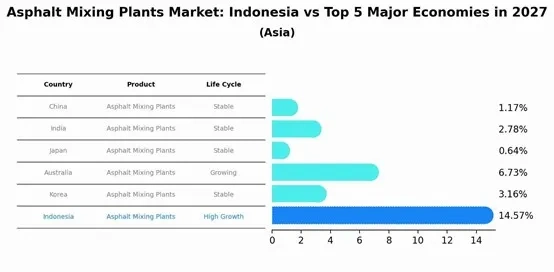
Policy Recommendations and Outlook
Government-level Recommendations
- Issue special subsidies for environmental protection asphalt mixing stations to reduce corporate procurement costs;
- Establish exclusive emission limits for asphalt mixing stations, phase out high-pollution traditional equipment;
- Improve RAP recycling technology standards, promote standardized recycling and utilization of waste asphalt pavement;
- Include environmental protection equipment in the green infrastructure procurement list, and require key projects to use it.
Corporate-level Recommendations
- Prioritize equipment suppliers with local service networks and SNI certification in Indonesia;
- Adopt a fixed + mobile combination selection to meet the differentiated needs of Java Island and outer islands;
- Link with local raw material suppliers, promote the Buton asphalt + RAP co-use scheme to achieve cost reduction and efficiency improvement.
Industry Outlook for 2030
By 2030, the penetration rate of environmentally friendly asphalt mixing stations in Indonesia will exceed 50%, warm-mix + recycling technology will become mainstream, supporting the realization of Indonesia’s 2045 vision for green infrastructure; Zoomline will continue to deepen its local layout, promote local assembly of equipment, further reduce costs, and become a core partner in Indonesia’s sustainable road construction.
Conclusion
Indonesia’s road construction is at a critical juncture of concurrent scale expansion and green transformation. Traditional high-pollution asphalt mixing stations are no longer compatible with policy and market requirements, and eco-friendly asphalt mixing stations have become an inevitable choice for sustainable road construction.
Zoomline’s eco-friendly asphalt mixing equipment, with low emissions, low energy consumption, high adaptability, and localized services as its core advantages, perfectly fits the needs of Indonesia’s infrastructure, climatic characteristics, and compliance requirements, and can achieve triple benefits of environmental, economic, and social benefits. This white paper proves that eco-friendly asphalt mixing stations are fully feasible for implementation in Indonesia and are the core equipment for promoting the high-quality development of green infrastructure in Indonesia.
Choosing compliant, efficient, and green eco-friendly asphalt mixing equipment is choosing a sustainable future for Indonesia’s road construction.
References
- Zoomline Indonesia Asphalt Mixing Plant Manufacturer Official Website: https://www.zoomline.com.cn/asphalt-mixing-plant-manufacturer-in-indonesia/
- Zoomline Eco-friendly Asphalt Mixing Plant Product Page: https://www.zoomline.com.cn/products/eco-friendly-asphalt-plant/
- 6Wresearch. Indonesia Asphalt Mixing Plants Market Outlook 2025-2031. https://www.6wresearch.com/industry-report/indonesia-asphalt-mixing-plants-market-outlook
- Asian Transport Observatory. Indonesia Transport and Climate Policy. https://asiantransportobservatory.org/documents/204/Indonesia-transport-and-climate-policy.pdf
- Atlantis Press. Toward Sustainability: Green Road Construction in Indonesia. https://www.atlantis-press.com/article/125935144.pdf
- Tekmira. Study of Supply-Demand of Indonesia Buton Natural Asphalt. https://jurnal.tekmira.esdm.go.id/index.php/imj/article/download/1364/1031
- ScienceDirect. Eco-friendly design of Warm mix asphalt with recycled concrete aggregate. https://www.sciencedirect.com/science/article/pii/S0950061822005761
- Indonesia National Development Planning Agency (Bappenas), Public Works and Housing Ministry (PUPR) official infrastructure planning documents
Consulting & Service
For information on Zoomline’s selection, quotation, and on-site survey services for local environmental asphalt mixing stations in Indonesia, please directly contact Zoomline’s local team in Jakarta to obtain a dedicated green road construction solution.
📩 Email: [email protected]
🌐 Official Website: https://www.zoomline.com.cn/
📍 Local Service Center: Jakarta, Indonesia
Download this report:White-Paper-Eco-Friendly-Asphalt-Mixing-Plant-Indonesia-2026.pdf