

How Mobile Concrete Batching Plants Reduce Transportation Costs
In construction projects, transportation costs often constitute a significant portion of the budget, especially when concrete needs to be transported from a fixed batching plant to the construction site. Mobile concrete batching plants, with their flexibility and efficiency, solve transportation problems at the source, becoming a core choice for construction companies to reduce costs and increase efficiency.
Structure and Function of Mobile Concrete Batching Plants
Mobile concrete batching plants have the same core functions as fixed batching plants, but through modular design, they achieve “mobility and rapid deployment.” Their rational structural configuration is the foundation for reducing transportation costs. The core structure and functions are as follows:
Core Components
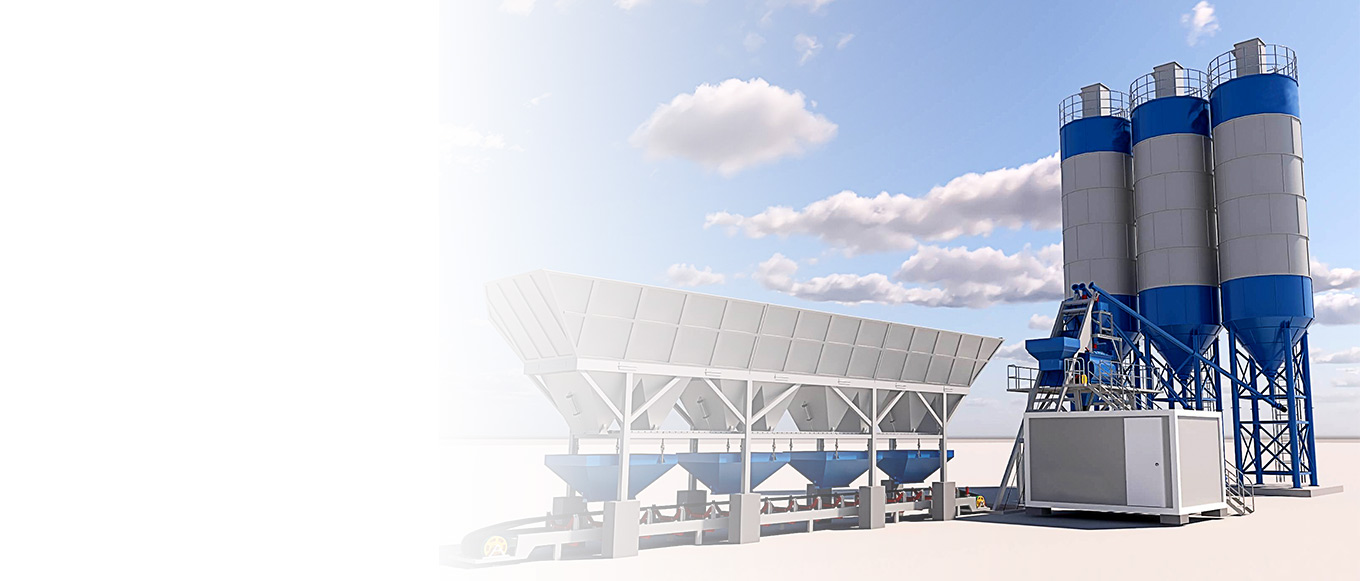
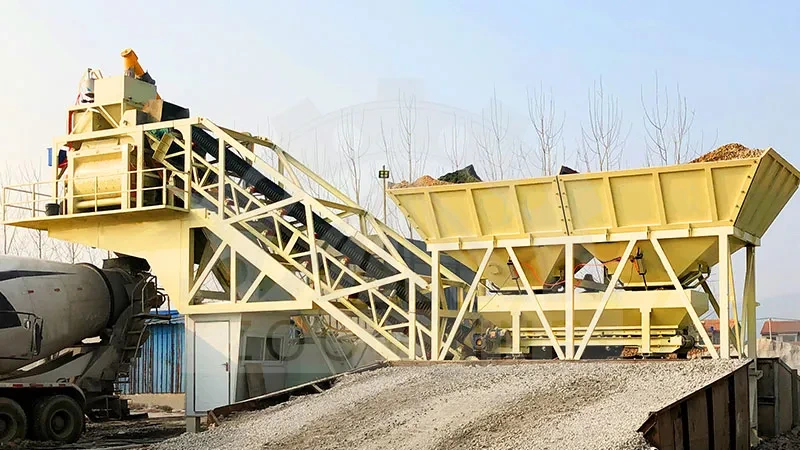
Mobile batching plants integrate all the components required for the entire concrete production process, eliminating the need for additional supporting equipment and reducing transportation links at the source. Core components include:
Mixing Unit: As the “heart” of the equipment, it is responsible for mixing raw materials such as cement, sand, and water into qualified concrete. Types include drum type and twin-shaft type, adapting to the concrete quality requirements of different projects. There is no need to transport the mixing equipment separately.
Storage Silo: Used to store core raw materials such as cement and sand, ensuring continuous on-site production, avoiding increased costs caused by repeated transportation of raw materials, and reducing losses during raw material transportation.
Water Supply System: Equipped with an automated water supply system, it can precisely control the water ratio, eliminating the need for additional transportation of pre-mixed water sources, ensuring mixing quality while simplifying the transportation process.
Control System: Utilizing modern intelligent control, it can monitor the entire mixing process in real time, achieving precise batching and efficient mixing, reducing material waste caused by human error, and indirectly reducing transportation-related losses and costs.
On-site Operation Process
The mobile mixing plant’s operation process is highly simplified, requiring no external transportation. Specifically: After the equipment is transported to the construction site and positioned, the raw materials are directly fed into the storage silo. The batching and mixing process is initiated through the control system, producing fresh concrete within minutes, directly supplying the on-site construction. This completely eliminates the intermediate step of “fixed-station mixing → transportation to the construction site,” avoiding transportation costs at the source.
Deployment Flexibility and Adaptability
The core advantage of mobile batching plants lies in their “mobility and rapid deployment”: They require no complex site modifications and can typically be installed and commissioned within hours, significantly reducing project delays compared to the several days required for fixed batching plants. After project completion, they can be quickly dismantled and transported to the next construction site, minimizing equipment downtime, improving equipment utilization, and avoiding resource waste caused by the inability to relocate fixed-site equipment.
Furthermore, they are highly adaptable. Whether for large-scale projects such as commercial engineering and highways, or smaller projects like residential construction and rural roads, production efficiency can be adjusted according to project needs, eliminating the need for additional transportation equipment based on project size.
Reduced Initial Investment Costs
Mobile concrete batching plants offer better cost-effectiveness in initial investment, especially in transportation-related costs. Compared to fixed batching plants, costs can be reduced across three dimensions: equipment procurement, installation and transportation, and site investment, indirectly reducing hidden transportation-related expenses.
Optimized Equipment Procurement Costs
While the procurement cost of mobile batching plants is influenced by factors such as capacity, configuration, and brand, the overall investment is more aligned with the actual needs of the project, avoiding resource waste:
More Flexible Capacity Matching: Appropriate capacity (e.g., 25m³/h, 50m³/h, 100m³/h) can be selected based on the project’s average daily concrete demand, avoiding equipment idleness caused by overcapacity in fixed plants and reducing additional transportation and maintenance costs due to excess capacity.
Customizable Configuration: The type of mixing host, batching accuracy, control system, and other configurations can be selected according to project needs, eliminating the need to pay extra for unnecessary high-end configurations. For example, small projects can choose a simple, lower-cost drum mixer, lowering the procurement threshold.
Cost Savings in Installation and Transportation
Thanks to its modular, pre-assembled design, the installation and transportation costs of mobile batching plants are significantly lower than those of fixed batching plants:
Easy Installation: No large lifting equipment is required; assembly can be completed with a small workforce, saving the complex foundation construction and equipment installation costs of fixed plants. This also shortens installation time, accelerates project commencement, and reduces transportation cost increases due to installation delays.
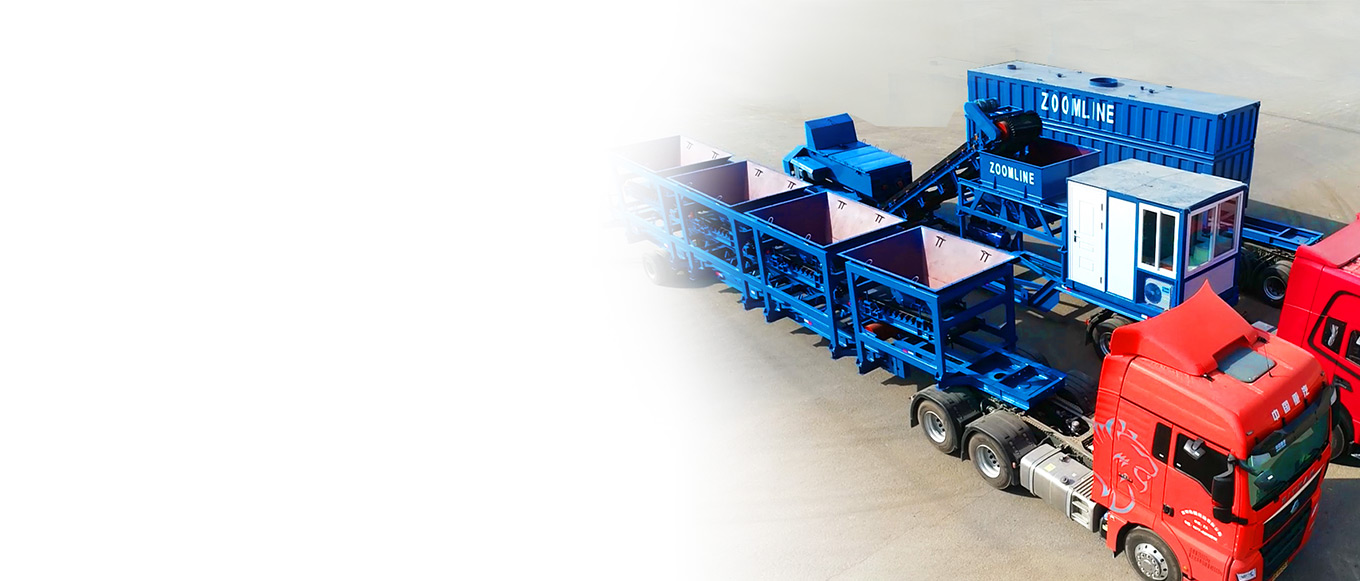
Efficient Transportation: The equipment can be transported as a whole or in parts, adapting to different transportation scenarios. It is particularly suitable for remote construction sites, mountainous areas, and other locations with inconvenient transportation. There is no need to rent large transportation equipment, reducing transportation costs. Furthermore, it can be flexibly relocated according to project progress, reducing costs associated with cross-regional transportation.
Reduced Site Investment Costs
Fixed batching plants require fixed sites, incurring high costs for land acquisition, site hardening, and storage silo construction. Mobile batching plants, on the other hand, only require temporarily leveled sites for operation, eliminating the need for long-term land rentals or purchases and avoiding cost waste due to idle sites. Additionally, the site can be flexibly selected based on the construction site location, minimizing raw material transportation distances and further reducing transportation costs.
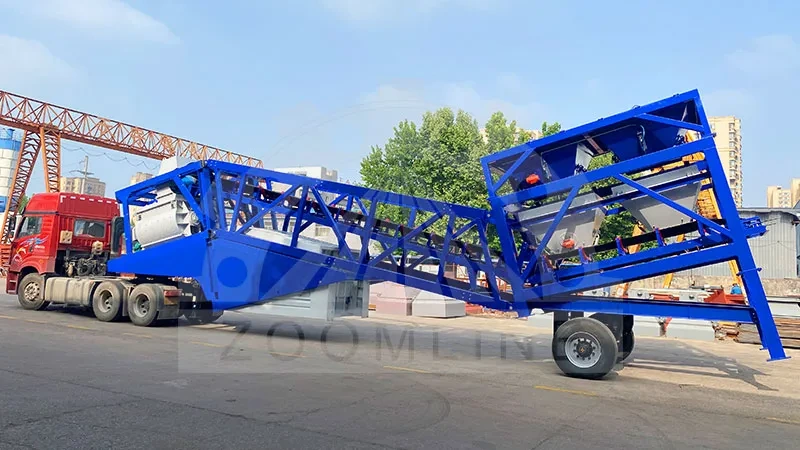
Key Considerations for Selecting the Capacity of a Mobile Concrete Batching Plant
Optimizing the capacity of a mobile batching plant is crucial to avoiding wasteful transportation costs and maximizing cost reduction. Excessive capacity can lead to equipment idleness and increased energy consumption, while insufficient capacity necessitates additional concrete transportation, increasing costs. The core selection points are as follows:
Selecting Capacity Based on Concrete Demand
First, accurately calculate the project’s average daily concrete demand. Considering the project schedule, select an appropriate capacity:
Large Projects (e.g., highways, high-rise buildings): With high daily concrete demand, it is recommended to choose a high-capacity mobile batching plant of 70 m³/h or higher to ensure continuous supply and avoid the need for external concrete transportation due to insufficient capacity, incurring additional transportation costs.
Small to Medium-Sized Projects (e.g., rural roads, residential foundations): With lower daily demand, a capacity of 20-60 m³/h is sufficient. This avoids high-capacity equipment idleness, reduces energy consumption and maintenance costs, and eliminates the need for additional transportation equipment.
Choosing a Mobile Mixing Plant Based on Project Cycle and Usage Frequency
Long-term projects (6 months or more): Select a high-capacity, durable mobile mixing plant to ensure long-term stable operation. Batch production reduces unit transportation costs (larger batches of raw materials transported per trip result in lower average costs).
Short-term, intermittent projects: Choose a small, lightweight mobile mixing plant for rapid deployment and relocation, avoiding long-term equipment idleness and reducing wear and tear during transportation, thus lowering transportation-related costs.
Balancing Quality Requirements with Cost Considerations
The capacity of a mobile mixing plant is closely related to mixing quality. High-capacity equipment typically features a more precise batching system and a high-efficiency mixing unit, reducing raw material waste and indirectly lowering transportation costs. For example, for projects with high concrete quality requirements, such as large bridges and high-rise buildings, choosing a high-capacity, high-precision mobile mixing plant can avoid rework due to substandard quality, reducing the costs associated with concrete and raw material transportation during rework.
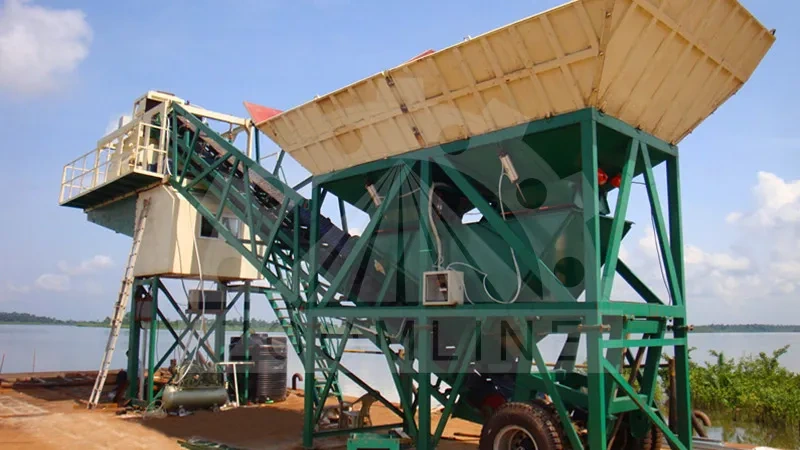
How to Minimize Transportation Costs Through Mobile Technology
The “mobility” of mobile concrete mixing plants is their core competitive advantage in reducing transportation costs. This is achieved through three main dimensions: “on-site production, flexible relocation, and reduced losses,” broken down as follows:
On-site production eliminates finished product transportation costs
This is the core cost-reduction advantage of mobile mixing plants: the mixing equipment is deployed directly on the construction site, raw materials are transported to the equipment via short-distance transport, and the mixed concrete is directly supplied to the construction site, completely eliminating the long-distance transportation link between the fixed plant and the construction site. According to actual case statistics, fuel and vehicle maintenance costs alone can save 30%-40% of transportation costs, making it particularly suitable for projects in remote mountainous areas and coastal regions where transportation is inconvenient.
Flexible relocation adapts to multi-site collaboration, reducing equipment transportation losses
For companies undertaking multiple dispersed construction sites simultaneously, mobile mixing plants can be quickly disassembled and transported to the next site after completion of one, eliminating the need for separate mixing equipment for each site and avoiding resource waste caused by the inability to relocate fixed-site equipment. Meanwhile, the equipment can be disassembled and transported separately during relocation to adapt to different road conditions, reducing equipment damage during transportation and lowering transportation costs.
Reducing Transportation Losses and Hidden Transportation Costs
Long-distance transportation of concrete from fixed batching plants is prone to problems such as setting and segregation, rendering the concrete unusable and resulting in a double waste of raw materials and transportation costs. Mobile batching plants, on the other hand, produce and pour concrete on-site, ensuring high concrete freshness and effectively avoiding setting and segregation problems, reducing raw material waste, and saving on rework transportation costs due to substandard concrete. Furthermore, short-distance transportation of raw materials reduces losses such as sand and gravel spillage and cement dampness, further reducing hidden transportation costs.
Adapting to Complex Scenarios and Mitigating Transportation Risks and Additional Costs
In scenarios where concrete transportation from fixed batching plants is difficult, such as traffic congestion, narrow roads, and remote mountainous areas, mobile batching plants can be deployed directly on the construction site, avoiding construction delays and additional transportation costs. Simultaneously, for cross-regional and highly mobile projects (such as highway construction), mobile batching plants can move with the construction progress, ensuring timely concrete supply, avoiding supply interruptions due to excessive transportation distances, and reducing project delay costs.
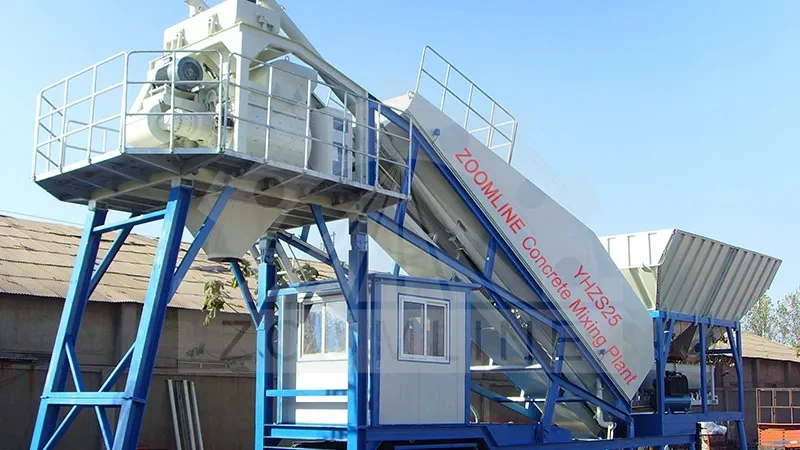
Conclusion
Mobile concrete batching plants significantly reduce the overall cost of concrete production and supply by eliminating long-distance transportation, reducing fleet size, minimizing material waste, and saving on infrastructure investment. Their flexibility, efficiency, and economy make them an ideal choice for various construction projects, especially multi-site, dispersed, and remote projects.
In today’s construction industry, with shrinking profit margins and intensified competition, mobile concrete batching plants offer enterprises a practical solution for cost reduction and efficiency improvement. Enterprises should rationally assess the application value of mobile batching plants based on their own project characteristics and actively adopt this innovative equipment where appropriate to enhance market competitiveness and profitability.
FAQ
Q: How much can a mobile concrete batching plant reduce transportation costs compared to a stationary plant?
A: Depending on the project scenario, transportation costs can be reduced by 30%-50%. The most significant cost reductions are seen at remote construction sites and for long-distance transportation (up to 50%), while short-distance transportation within cities reduces costs by about 30%. The core savings are in fuel, vehicle maintenance, and concrete wastage.
Q: How long does it take to transport and install a mobile concrete batching plant?
A: The transportation time for a mobile concrete batching plant depends on the equipment specifications and the transportation distance. Generally, it can be transported using a flatbed trailer. Installation time is typically between 4-8 hours, depending on the equipment model and site conditions. Modularly designed equipment is installed even faster; some models can even be installed and put into production within 2-3 hours. Compared to the construction cycle of traditional stationary batching plants, which requires weeks or even months, the advantages of mobile batching plants are very obvious.
Q: Are the relocation costs for mobile batching plants high? Will they offset the savings in transportation costs?
A: Relocation costs are extremely low and will not offset the cost reduction advantages in transportation. Mobile batching plants feature a modular design, allowing for rapid disassembly and assembly. Each relocation requires only a small amount of manpower and ordinary transportation equipment, making the relocation cost significantly lower than the long-distance concrete transportation costs of fixed plants. Furthermore, the equipment can be reused for multiple projects, further reducing relocation costs in the long run.
Q: Does a mobile batching plant need recalibration after each relocation?
A: Yes, system calibration is required after each reinstallation, including calibration of the metering system and confirmation of control system parameters. This process typically takes only 1-2 hours and is completed by professional operators. Most modern mobile batching plants are designed with a rapid calibration function, which can be quickly completed using standard weights and preset programs. It is recommended to conduct calibration tests before each relocation and commissioning, using a small amount of material for trial production and concrete quality testing. Only after confirming that everything is correct should formal production begin.
Q: Can the quality of concrete produced on-site be comparable to that of concrete from a fixed plant?
A: Yes. Mobile batching plants are equipped with batching systems and high-efficiency mixing hosts of the same precision as fixed plants. They also employ intelligent control systems to monitor the mixing process in real time, ensuring accurate concrete proportions and uniform mixing. Furthermore, on-site production and pouring avoid segregation and setting problems caused by long-distance transportation, resulting in higher-quality concrete.
Q: When choosing a mobile batching plant, what factors affect the cost reduction effect of transportation?
A: There are three core influencing factors: 1. Capacity matching (matching the project’s average daily demand to avoid overcapacity or undercapacity); 2. Deployment location (as close as possible to raw material supply locations and construction areas to shorten raw material transportation distances); 3. Equipment configuration (selecting equipment with a high degree of automation and low wear to reduce raw material and transportation losses).