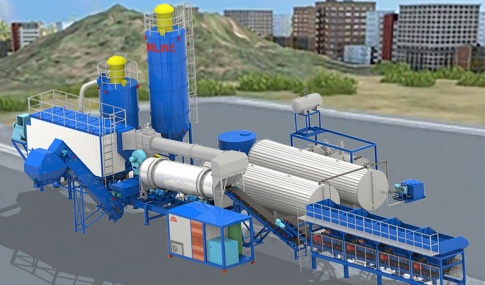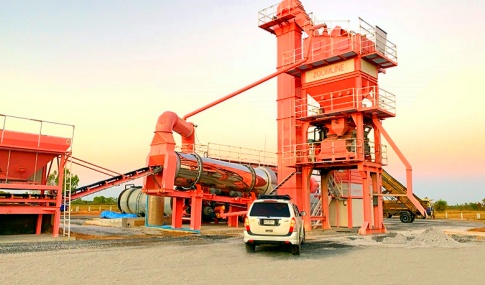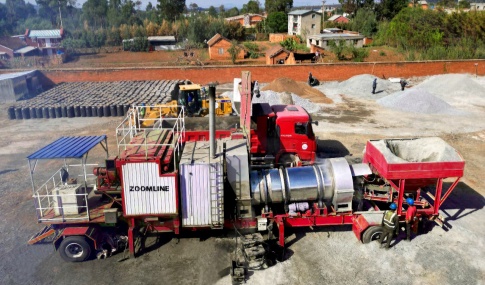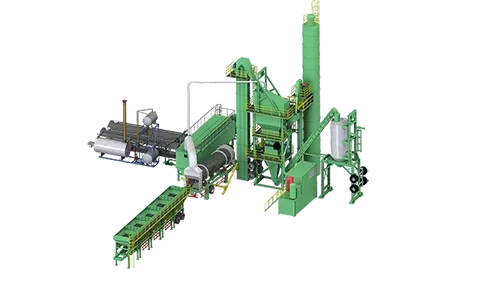






Batch Mix vs. Drum Mix: Which Asphalt Plant Is Better in 2026?
Introduction
For road and bridge engineering contractors, pavement construction enterprises and engineering investors, the selection of asphalt mixing plant is not a simple equipment procurement, but a core decision that directly affects project profitability, construction qualification, quality acceptance and long-term business layout. Many purchasers only pay attention to the initial quotation of equipment, but ignore the hidden losses caused by improper selection: long-term low production efficiency, substandard mixture quality, frequent downtime and maintenance, inability to adapt to the bidding requirements of multiple types of projects, and ultimately resulting in Economic losses far exceeding the price difference of equipment.
In 2026, the road construction industry standards continued to upgrade, and the industry pattern changed significantly: environmental emission standards became more stringent, recycled asphalt (RAP) recycling became just needed, engineering projects presented the characteristics of multiple specifications, multiple scenarios and short cycles, and the traditional “one set of equipment for all projects” selection thinking was completely outdated. There is no absolute difference between batch mix asphalt plant and drum mix asphalt mixing plant, only the difference of adaptation scene.
Most comparison articles on the market define the advantages and disadvantages of equipment one-sidedly, ignore the variables of asphalt plant equipment configuration, manufacturer technology and field working conditions, and cannot really guide the landing procurement. This article will jump out of a single parameter comparison, starting from 9 core procurement dimensions, real construction scenarios, full life cycle costs, and future upgrade potential, and provide the latest and most suitable selection system for B-end procurement needs in 2026.
Core judgment: The real key to selection is not “which asphalt mixing plant equipment is better”, but “which production system is more suitable for your project type, production scheduling and long-term business planning”.
Batch Mix Asphalt Plant vs. Drum Mix Asphalt Plant at a Glance
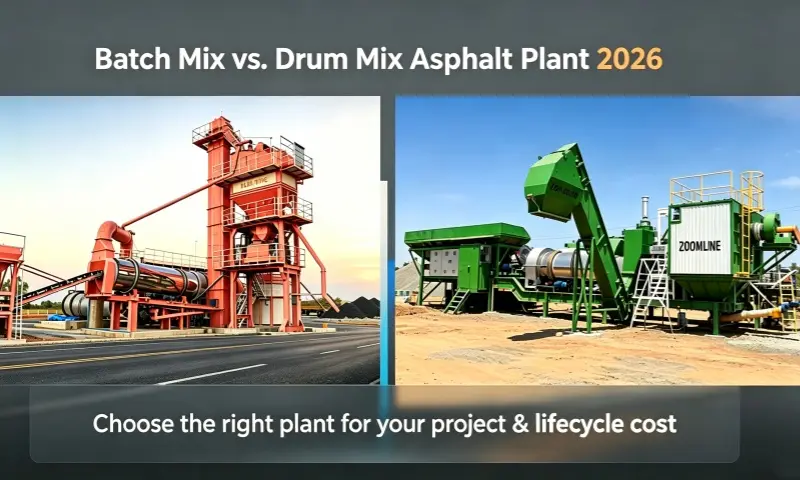
In order to help buyers quickly establish cognition, the following table integrates the core differences between the two types of asphalt plant and deliberately avoids absolute conclusions. Production capacity, finished product quality, RAP blending ratio, environmental emission and other indicators, completely depends on the equipment brand, configuration scheme, calibration accuracy and operating conditions, can not be judged solely according to the asphalt mixing plant type.
| Contrast Dimension | Batch Mix Asphalt Plant | Drum Mix Asphalt Plant |
| Production mode | Batch, intermittent production | Integrated, continuous, uninterrupted production |
| Blend flexibility | Very high, supports high frequency recipe switching | Adapt to stable working conditions, fixed formula production efficiency is higher |
| Aggregate treatment | Hot aggregate screening, storage in silos, independent weighing of single batches | Continuous proportioning through feed system, no thermal screening process |
| Formula adjustment difficulty | Simple operation, low switching loss, fast response | Frequent formula switching is cumbersome, and the material loss is higher. |
| Equipment complexity | Modular structure complete, process flow more complex | Streamlined process, simpler overall equipment layout |
| Initial investment cost | Overall high (floating with high-end configuration) | Conventional configuration has lower initial investment and outstanding cost performance |
| Production models | Single batch independent discharge, accurate and controllable | Uninterrupted continuous discharge, strong production continuity |
| Best fit scenario | Multi-formula, multi-specification, high-standard and changeable items | Long cycle, fixed formula, stable mass production project |
| Special instructions | Production capacity, finished asphalt quality, RAP blending ratio and environmental emission are not absolutely good or bad. The core is determined by equipment configuration, burner system, dust removal equipment, calibration process and operating conditions, and cannot be generalized according to equipment type. | |
The Fundamental Difference: How Batch Mix Asphalt Plants and Drum Mix Asphalt Plants Produce Asphalt
The core reason why many buyers are entangled in the selection is that they do not understand the underlying production logic of the two types of bitumen mixing plant . All the cost, flexibility, operation and maintenance, adaptation scenarios of asphalt batching plant and asphalt drum mix plant are different from the essential difference of production process. Only by mastering the principle can we jump out of the parameter misunderstanding and make long-term decisions that fit our own business.
How a Batch Mix Asphalt Plant Produces Asphalt
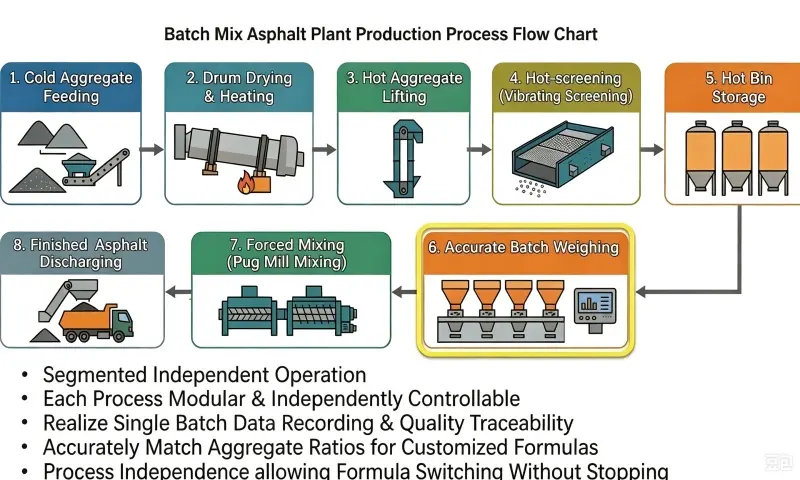
Core process: Cold aggregate feeding → Drum drying heating → Hot aggregate lifting → Vibrating screening → Hot bin storage → Accurate batch weighing → Forced mixing in mixing tank → Finished asphalt discharging
The whole set of asphalt mix plant adopts segmented independent operation mode, and each process is modularized and independently controllable. The core characteristics are very distinct:
The whole process is controlled by sections. The heating, screening, weighing and stirring of each batch of aggregates are completed independently, which can realize single batch data recording and quality traceability.
Relying on the hot screening and multi-storage structure, it can accurately match the aggregate ratio of different particle sizes and adapt to various customized mixture formulas;
The process independence is strong, the formula switching does not need to be stopped for rectification, and it can quickly respond to the material requirements of different pavement layers, which is the core advantage source of multi-scene construction.
How Does a Drum Mix Asphalt Plant Work?
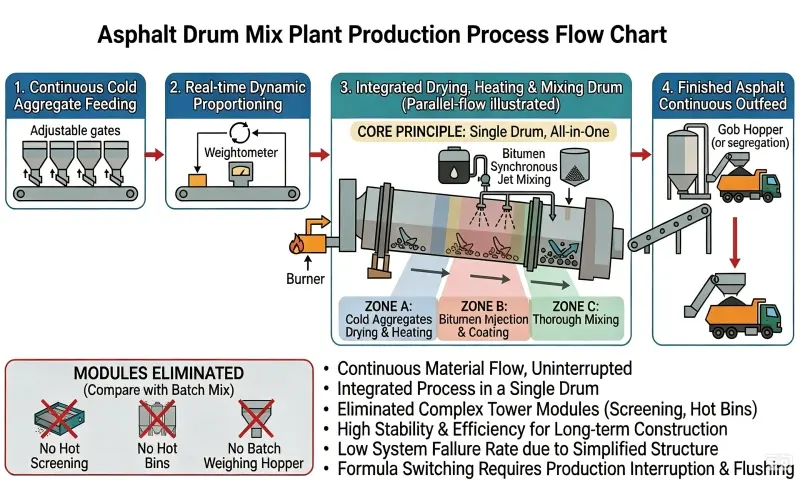
Core process: continuous feeding of cold aggregates → real-time dynamic proportioning → integrated drying and heating → synchronous jet mixing of bitumen→ continuous discharge of finished products
The equipment adopts integrated continuous operation logic, drying and mixing processes are integrated in the same drum, eliminating complex modules such as hot screening, hot bin and independent weighing. The core advantages focus on stability and efficiency:
The uninterrupted flow of materials throughout the process, no batch interval, eliminate intermittent downtime loss, suitable for long-term continuous construction;
The asphalt drum mix plant structure is simplified, the core process is less, and the system failure rate is low;
The production rhythm is stable. Under the fixed formula and mass production scenario, the production efficiency and energy consumption control performance are excellent, but the formula switching operation with high frequency and multiple specifications is not supported.
Batch Mix Asphalt Plant vs. Drum Mix Asphalt Plant: 9 Key Differences That Affect Your Investment
Production Process and Material Flow Logic
Asphalt batch plant for intermittent cycle production, rely on batch cycle to complete material processing, each process independent split, accurate and controllable, process complexity is higher, the core value lies in “controllability”; asphalt drum mixing plant for continuous linear production, one-stop flow of materials, process highly integrated, process is simpler, the core value lies in “stability”.
This bottom difference directly determines the difference of all subsequent dimensions: batch asphalt mixing plant adapts to variable working conditions, sacrificing part of simplicity for flexibility; drum mix asphalt plant adapts to fixed working conditions, with minimal structure for continuous mass production efficiency, which is the basis of all selection decisions.
Mix Flexibility and Recipe Changeovers
Under the diversified construction trend in 2026, the formula switching ability has become the core index of contractor selection, and it is also the core competitive advantage of batch mix asphalt plant. Nowadays, most engineering enterprises undertake multi-type projects such as expressway, municipal, airport and rural roads at the same time, and the mixture formula of different pavement levels is completely different.
Real procurement scenario reference: Many construction teams need to complete multi-specification production in a single day: production of road base asphalt mixture in the morning, switching to middle course binder in the afternoon, and production of surface high-precision wear-resistant mixture in the evening. This kind of high-frequency, multi-category production demand is difficult to adapt to the drum mix asphalt plant.
Batch mix plant relies on independent screening, storage material and accurate weighing system, which can quickly adjust aggregate ratio, asphalt dosage and powder content. The formula switching speed is fast, the material loss is low, and it can meet the production requirements of small batch, multi-category and high precision. This is also in line with the latest selection trend in the industry: priority is given to matching production recipes and scheduling requirements, rather than simply pursuing capacity parameters.
Production Capacity and Continuous Output
There is a widespread one-sided cognition in the industry that “drum asphalt mixing plants have higher production capacity and asphalt batch mix plants have lower production capacity”, which is a typical selection error. In fact, the capacity intervals of the two types of equipment are highly overlapped, and the nameplate TPH capacity is only a theoretical parameter. The actual effective capacity is affected by multiple factors and cannot be used as the only standard for selection.
The core factors affecting the real production capacity include: aggregate moisture content, fuel stability, bitumen supply efficiency, formula switching frequency, material handling vehicle scheduling, equipment start-up rate and utilization rate. The single pursuit of high TPH parameters is prone to the problem of “high nameplate capacity and low actual output”.
Specifically speaking, asphalt batch mix plant relies on batch circulation production, with high precision of single batch, but frequent switching of formula will reduce the overall production capacity; drum asphalt mixing plant has no batch interval, and the effective capacity utilization rate is higher under the scenario of fixed formula, stable materials and uninterrupted construction. If it is a changeable working condition, the comprehensive effective capacity of bitumen batch mix plant is far more than that of drum asphalt mixing plant equipment.
Mix Control, Consistency, and Quality Requirements
Under the premise of standardized configuration, standard calibration and compliance operation, both types of hot mix plant can produce high-quality hot mix asphalt mixture (HMA) conforming to national standards and industry standards, and there is no absolute quality. The difference between the two lies not in the upper limit of finished products, but in the logic and adaptation scenarios of quality control.
Batch-type asphalt mixing plant relies on single batch independent weighing, hot material screening, bin ratio, each batch of materials can be independently verified, traceable, ratio accuracy is stronger, in small batch, high standard, variable formula production, quality stability is more guaranteed; drum-type asphalt mixing plant relies on continuous dynamic ratio, in long-term fixed formula production, finished product consistency is excellent, but frequent adjustment of parameters requires a certain adaptation cycle, short-term ratio fluctuations are easy to occur.
For conventional municipal roads and rural road projects, both types of asphalt hot mix plant can meet the quality requirements; for high-speed, airport and other high-precision projects, the refined control advantages of batch asphalt mixing plants are more suitable for strict acceptance standards.
Initial Investment vs. Long-Term Operating Cost
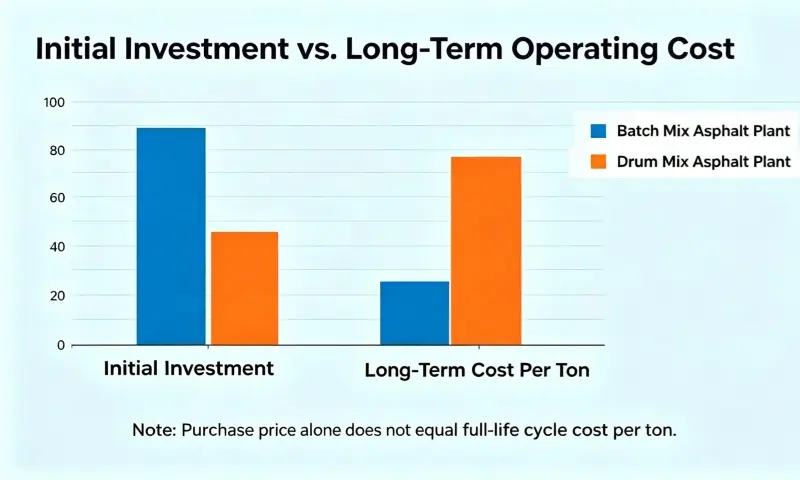
Most small and medium-sized purchasers only compare the purchase price of hot mix plant, ignoring the full life cycle cost, resulting in long-term losses. Professional selection logic in 2026 must distinguish between initial investment and long-term ROI returns.
From the perspective of initial investment: the modular structure of the batch mix asphalt plant is complex, including a complete set of systems such as screening, hot silo, and precise weighing. The investment in equipment procurement, basic construction, installation and debugging, and supporting systems is higher; the structure of asphalt drum mix plant is streamlined, with fewer parts, lower foundation and installation costs, and less short-term capital pressure.
From the perspective of long-term operation cost: although the initial investment of batch mix asphalt plant is high, the formula switching loss is low, the quality rework rate is low, the adaptation project is wider, and the equipment utilization rate is extremely high; the energy consumption and labor cost of drum mix asphalt plant are lower under fixed working conditions, but the hidden cost caused by material waste, commissioning loss and project adaptation limitation under variable scenarios is extremely high. At the same time, the operation and maintenance, parts replacement and shutdown loss of the two types of asphalt hot mix plant change with the use scenarios.
Core conclusion: the lowest purchase price does not represent the lowest production cost per ton in the whole life cycle of bitumen hot mix plant, and the selection must be based on the long-term project layout.
Maintenance Complexity and Downtime
Another common misconception in the industry: that the asphalt drum mix plant has a simple structure and easier operation and maintenance. The real situation is: streamlining the structure does not mean less pressure on operation and maintenance, but the focus of operation and maintenance is different.
Batch mix plant includes multiple modules such as elevator, vibrating screen, hot bin, weighing system, independent mixing cylinder, etc. The operation and maintenance points are scattered, so it is necessary to regularly check the operation status of multiple sets of systems. There are more daily inspection items, but the failure of a single component only affects the production of a single batch, and it is not easy to shut down the whole line.
The overall layout of asphalt drum mix plant is simple, with few scattered operation and maintenance points, but the core drum, continuous feeding system and bitumen injection system operate continuously under high load for a long time, with concentrated wear and failure risks. Once there is a problem with the core components, it will directly lead to the shutdown of the whole line, longer maintenance cycle and greater mass production loss.
RAP Recycling and Future Upgrade Potential
With the tightening of environmental protection policies and the increasing demand for solid waste recycling, RAP recycled asphalt production capacity has become the core bonus item for equipment selection in 2026. The industry should not apply the old conclusion of “high content of asphalt batch mix plant and low content of asphalt drum mix plant”. The regeneration adaptation ability of hot mix asphalt plant depends entirely on the whole configuration scheme, not the type of mixing process.
Asphalt batching plant can be equipped with special recycled material feeding system and drying temperature control system to accurately control the mixing ratio of recycled materials, adapt to RAP production with high content, and upgrade dust removal and energy saving modules according to environmental protection standards; asphalt drum mix plant can also realize RAP recycling production through customized feeding and temperature control transformation, but the flexibility of adaptation is slightly lower than batch asphalt mixing plant.
In terms of long-term upgrading, the modular design of asphalt batch plant reserves more space, which can adapt to stricter environmental protection standards, higher recycled material blending requirements and more diversified mixture formulas in the future; the integrated structure upgrading space of asphalt drum mix plant is limited, which is more suitable for long-term steady state operation with fixed production demand.
Environmental Performance and Energy Efficiency
In 2026, the environmental protection control of road construction in various places will be comprehensively upgraded, and dust emission, heat loss and waste gas treatment will become the hard indicators for asphalt station selection. What needs to be clear is that environmental protection has nothing to do with energy saving effect and equipment type, and the core depends on burner configuration, bag dust removal system, fuel type, RAP utilization scheme and overall equipment design.
Under the same high-end configuration, batch asphalt mixing plant can reduce heat energy waste through precise temperature control, perfect dust removal system can realize low dust emission, energy consumption control is more flexible under variable working conditions; asphalt drum mix plant continuous production heat output is stable, no frequent start and stop loss, energy consumption utilization rate is higher under steady state production.
In short, for projects with frequent start-up and multi-formula switching, batch mix asphalt plant have better environmental energy consumption performance; for projects with long-term continuous mass production, drum mix asphalt plants have stronger energy conservation and environmental stability.
Mobility, Installation, and Project Deployment
The mobility and deployment efficiency of hot mix asphalt plant directly affect the operation efficiency of enterprises with remote construction and multi-project rotation operation. Both batch mix asphalt plants and drum mix asphalt plants are available in fixed, mobile and ultra-mobile versions to meet different deployment needs.
Asphalt batch mix plant modular design, regular disassembly, strong adaptability, can meet the needs of frequent relocation across regions, but the installation cycle is relatively longer, foundation construction requirements are higher; drum asphalt station structure is simple, assembly is convenient, landing speed is fast, lightweight model is more suitable for short-term rural projects, temporary construction scenarios.
Beyond production technology, mobility grade is another critical procurement factor. Read our full comparison covering mobile, stationary and super‑mobile asphalt plant comparison.
Which Asphalt Plant Is Better for Different Projects?
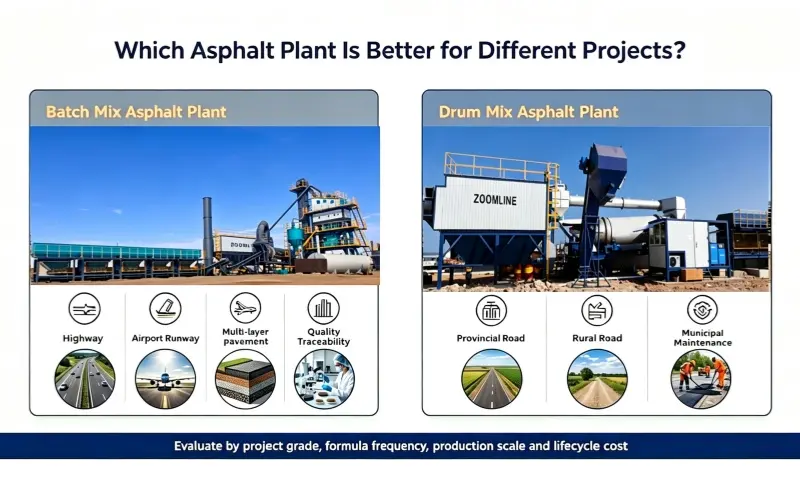
Best for High-Spec Highway and Expressway Projects
This kind of project has the characteristics of strict formulation requirements, many pavement layers, many mixture specifications, high quality traceability requirements and strict acceptance standards. During the construction process, it is necessary to frequently switch the formulation of base layer, middle layer and surface layer mixture, which requires extremely high production precision and flexibility.
On the whole, batch asphalt mixing plant has stronger adaptability, can accurately meet the requirements of multi-formula switching, batch quality control and high standard acceptance, and is the mainstream choice for high-grade highway construction (finally, it still needs to be adjusted according to the specific technical requirements of the project).
Best for Airport and High-Performance Pavement Projects
Airport runway and special pavement engineering require the uniformity, stability and proportion accuracy of asphalt mixture to reach the top industry standards, batch quality deviation is strictly prohibited, and various functional mixture formulas need to be adapted.
Batch independent weighing, accurate proportioning and traceable production mode of batch asphalt mixing plant can meet the strict standards of high-performance pavement to the maximum extent, and has irreplaceable advantages in formula adjustment and quality control.
Best for Long-Distance Road Projects With Stable Mix Requirements
The reconstruction and expansion projects of national roads and provincial roads and long-distance continuous road construction projects generally have the characteristics of long production cycle, fixed mixture formula, large single batch yield and no need to adjust parameters frequently.
At this time, the continuous production advantages of asphalt drum mix plant are fully highlighted, with no batch shutdown loss, stable production rhythm, simple operation and maintenance, lower production cost per ton of materials, which can maximize construction efficiency and reduce construction period cost.
Best for Rural and Cost-Sensitive Projects
Rural roads and small-scale municipal repair projects are generally characterized by limited budget, conventional construction standards, single mixture formula, short project cycle and rapid deployment.
The asphalt drum mix plant has low initial investment, simple operation, fast deployment and low operation and maintenance cost, which can maximize the control of project cost on the premise of meeting the construction quality requirements, and has significant cost performance advantages.
Best for Contractors Handling Multiple Project Types
In 2026, competition in the engineering industry intensified, and most contractors were no longer limited to a single project type, but also undertook multiple businesses such as high speed, municipal administration, rural reconstruction and airport supporting facilities.
This type of enterprise selection cannot be limited to the current single project, but must be based on long-term business layout. The high flexibility, wide adaptability and upgradeability of the batch mix asphalt plant can adapt to the needs of future diversified projects and avoid idle equipment and repeated procurement. The long-term investment value far exceeds that of a single adapted drum-type asphalt station equipment.
2026 Decision Framework: How to Choose Between Batch Mix Asphalt Plant and Drum Mix Asphalt Plant
Choose a Batch Mix Asphalt Plant If You:
- Multiple asphalt mixture formulations are required to be produced every month, and production parameters are switched frequently.
- Construction includes multi-level pavement, which requires differentiated mixture ratio
- Great emphasis on production flexibility, quality traceability and precise batch control
- Future projects tend to be diversified, high-end and customized
- Need to rely on equipment to adapt to high standards bidding and acceptance requirements
Choose a Drum Mix Asphalt Plant If You:
- Long-term undertake long-term cycle, fixed formula, standardized mass production projects
- Pursue a minimalist production process and reduce the difficulty of manual operation and maintenance
- Mix formula adjustment frequency is very low, no diversified production needs
- Prioritize initial investment costs and focus on short-term project profitability
- Stable and continuous discharge is required to ensure long-distance uninterrupted pavement construction.
Consider Both Carefully If You:
- The scale of enterprise business continues to expand, and there is uncertainty about future project demand.
- Plan to lay out RAP recycled asphalt business and improve resource utilization rate
- Frequent cross-regional relocation of asphalt mixer plantis required to adapt to mobile construction scenarios
- The ROI return rate of equipment life cycle is the core selection standard
- Multi-regional layout business, complex and diversified project scenarios
The 7 Questions to Ask Before Buying a Batch Mix Asphalt Plant or Drum Mix Asphalt Plant
Before finalizing the equipment type, complete the self-demand screening through the following 7 questions, completely avoid the selection error, and realize the accurate matching between the demand and the asphalt hot plant:
- How many different asphalt mixture formulations are required to be commissioned each month?
- How often do you adjust the formula in daily construction?
- What is the project’s total annual output and peak capacity demand?
- What special technical and acceptance specifications are required for current and future projects?
- How important is RAP’s recycled asphalt business in the future planning of the enterprise?
- How often does asphalt plant equipment need to be relocated and deployed across regions per year?
- Is the core of the enterprise to keep down the initial investment, or to pursue long-term flexibility and high returns?
Batch Mix Asphalt Plant vs. Drum Mix Asphalt Plant: Final Recommendation
Combined with the new industry standards and new demands in 2026, there is no absolute victory or defeat between asphalt batch mixing plants and asphalt drum plants, only scene adaptation differences. The parameter comparison and evaluation of good and bad from project requirements and business planning do not have landing reference value.
If your core needs are flexible production, multi-formulation adaptation, high standard quality control, long-term diversified business layout: asphalt batch mixing plant is the best investment choice; if your core needs are stable mass production, low cost investment, simple operation and maintenance, long-term construction under fixed conditions, asphalt drum mix plant is more cost-effective and practical.
For enterprises with business expansion, layout of renewable resources and adaptation to future environmental protection upgrading: it is necessary to comprehensively compare the configuration, upgrading space and full life cycle cost of two types of asphalt hot plant, and make careful decisions.
ZOOMLINE professional selection concept: The core of asphalt mixing plant selection is to meet the real production needs, rather than blindly pursuing high production capacity and low quotation. Relying on years of industry experience, we customize our equipment configuration plan in combination with customer’s mixture formulation requirements, production scheduling, construction scenarios, mobile requirements and future expansion planning, so that each equipment can maximize the matching of project requirements and improve long-term return on investment.
Frequently Asked Questions
1. Is batch asphalt mixing plant necessarily better than asphalt drum plant?
Not necessarily. Batch asphalt mixing plant wins in flexibility and accuracy, adapting to variable and high-standard projects; asphalt drum mix plant wins in stability and low cost, adapting to fixed mass production projects, no absolute advantages or disadvantages, only depending on scene matching degree.
2. Which asphalt plant has lower long-term operating costs?
Under steady-state single working condition, the operation and maintenance and energy consumption cost of asphalt drum mix plant are lower; under variable and multi-formulation working condition, the advantages of low loss, low rework and high utilization rate of asphalt batch plant make the whole life cycle cost lower.
3. Can both types of asphalt plant equipment produce high quality asphalt mixtures?
Yes. As long as the equipment configuration is up to standard, regular calibration and standard operation, the two types of asphalt mixer machine can produce high quality hot mix asphalt mixture meeting the national standards and engineering acceptance standards.
4. Which asphalt mixing plant is more suitable for highway construction?
High-speed projects are mostly multi-layer, multi-formula and high-standard construction. Batch mix asphalt plants are preferred to meet the requirements of frequent formula switching and precise quality control.
5. Which asphalt mixing machine shall be selected for frequent change of mixture formula?
Priority batch asphalt mixing plant, formula switching convenient, low loss, stable accuracy, fully adapted to high-frequency multi-category production needs.
6. Can drum asphalt mixing plant adapt RAP regeneration production?
Yes. The RAP adaptation capability is determined by the customized configuration of the equipment. By installing a dedicated recycling system and optimizing the temperature control and feeding structure, the drum-type asphalt plant can also achieve compliant recycled asphalt production.
7. How to determine the appropriate asphalt plant equipment capacity when selecting?
Do not only look at the nameplate TPH parameters, but also calculate the actual effective production capacity in combination with comprehensive factors such as aggregate moisture content, material supply, transportation scheduling, formula switching frequency, equipment utilization rate, etc.
8. Do you need to consider future project requirements in advance when purchasing asphalt hot plant?
Very necessary. In 2026, the engineering industry will have a fast iteration speed, environmental protection standards, recycling needs and project types will continue to change, and based on long-term business layout selection, rapid elimination and repeated investment of asphalt stations can be avoided, and investment cost performance can be improved.