







How to Choose the Right Heat Source for a Bitumen Tank
Introduction
Bitumen as road construction, industrial production in the core materials, solid or semi-solid at room temperature environment, can not directly realize the pumping, transportation and construction, so heating is an indispensable part of the bitumen tank operation process. The choice of heating source directly determines the operating efficiency of the bitumen tank, operating costs, asphalt product quality, and even affect the safety and stability of the entire construction process – choose the right heating source to effectively avoid bitumen deterioration, energy waste, construction delays and other issues, and vice versa, it may increase the operational risk and additional investment.
This article will start from the necessity of bitumen tank heating, detailed disassembly of mainstream heating source types, selection of core factors, combined with different application scenarios to give precise adaptive solutions, interpretation of the industry development trend, to help asphalt production, construction practitioners to accurately select the bitumen tank heating source suitable for their own needs, and to achieve efficiency, cost and safety of the triple balance.
Why Heating Matters for Bitumen Tanks?
Bitumen’s physical properties determine the heating is the premise of its application value – room temperature, bitumen mobility, must be heated to a specific temperature range, in order to be transformed into a pumpable, transportable, constructible fluid state, usually need to maintain the bitumen temperature between 140 ℃ and 180 ℃, the specific temperature according to asphalt grades and field The specific temperature is adjusted according to the asphalt grade and site climatic conditions.
If the heating process is not stable, heating temperature is not enough, bitumen will thicken, separation, degradation and other issues, not only will lead to clogging of the pumping system, increase the energy consumption brought about by repeated heating, but also cause waste of asphalt products, directly affecting the construction quality and progress. Stable, uniform heating can effectively protect the consistency of asphalt performance, avoid delays in the construction process, while reducing operating costs.
Whether it is long-term storage of bitumen, off-site transportation, or on-site construction, heating needs always exist, but different scenarios on the stability of heating, flexibility requirements vary, which also provides a different focus for the choice of heating source.
Main Types of Heat Sources for Bitumen Tanks
Thermal Oil Heating Bitumen Tank
Thermal oil heating system bitumen tank is currently a large-scale bitumen production, storage scenarios in the more widely used heating methods, the core principle of its work is through the coal-fired, gas-fired or oil-fired furnace to heat the organic heat carrier (i.e., thermal oil), and then through the thermal oil pump to promote the thermal oil cycle, indirectly realizing the heating of asphalt, without direct contact with the bitumen itself.
The core features of the system are low pressure and high temperature, uniform heating, and the tank is equipped with a full range of thermal insulation measures, slow cooling rate, in the ambient temperature higher than 20 ℃, the cooling rate can be controlled within 1 ℃ per hour; high degree of automation, equipped with a microcomputer management system, digital temperature control and liquid level display, to achieve accurate temperature control and convenient operation and maintenance. At the same time, the system is also equipped with “local asphalt removal device” and “vertical asphalt heating device”, without the need to heat the entire tank bitumen, you can quickly take the oil to improve operational efficiency, the first time the asphalt heated to 160 ℃ the time required for less than 4 hours. It takes less than 4 hours to heat the asphalt to 160℃ for the first time.
Its advantages are high thermal efficiency, suitable for large-capacity, continuous production scenarios, and can maintain a stable heat supply for a long time to ensure the stability of bitumen performance; disadvantages are the complexity of the structure of the system, a large number of attachments, the initial cost is high, and the need for regular maintenance of the quality of the heat transfer oil, the circulation of the equipment, the maintenance requirements of the relatively stringent. Suitable fuel types include coal, gas, oil, according to the site energy supply flexibility.
Electric Heating Bitumen Tank
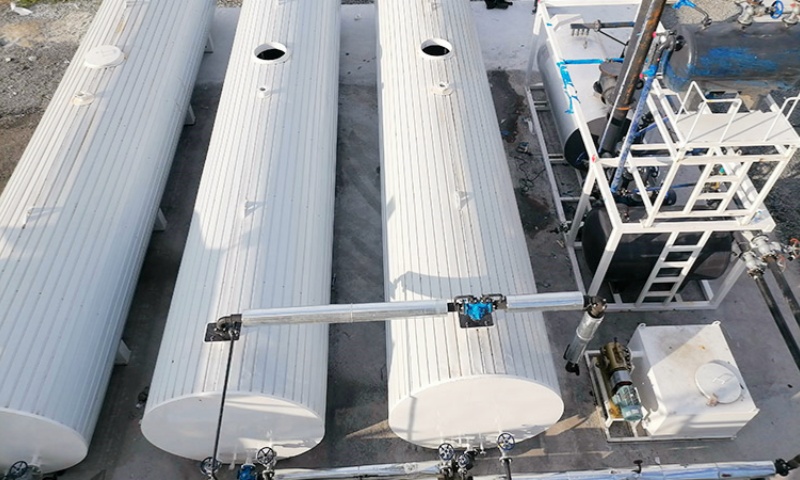
Electric heating system bitumen tank adopts direct electric heating, through the built-in explosion-proof heating tubes and other electric heating elements, electric energy is directly converted into heat, can be directly heated bitumen, can also be combined with the thermal oil system, through the electric heating furnace indirectly heats the bitumen, to adapt to the needs of different scenarios.
The most prominent feature of the system is no open flame, zero emission, excellent environmental performance, very suitable for urban core areas, environmental protection requirements of the region to use; temperature control precision is very high, the temperature fluctuations can be controlled within ± 2 ℃, can accurately meet the heating needs of different grades of bitumen; thermal efficiency of up to 95%, compared with coal-fired heating is more energy-efficient, and to support the modular design, easy to install, to adapt to the small and medium-sized project flexibility. The advantages are fast startup and maintenance.
The advantages of electric heating bitumen tank lies in the fast start-up, simple maintenance, without complex boiler, piping system, can be used alone or combined to meet the frequent start-stop, flexible temperature control of the operational needs; disadvantage is that the operating costs are affected by the price of electricity, when the need for high-power heating, the site of the grid load requirements are higher, if the local electricity prices are high, the long-term operating costs will be significantly increased.
Direct Heating Heating Bitumen Tank
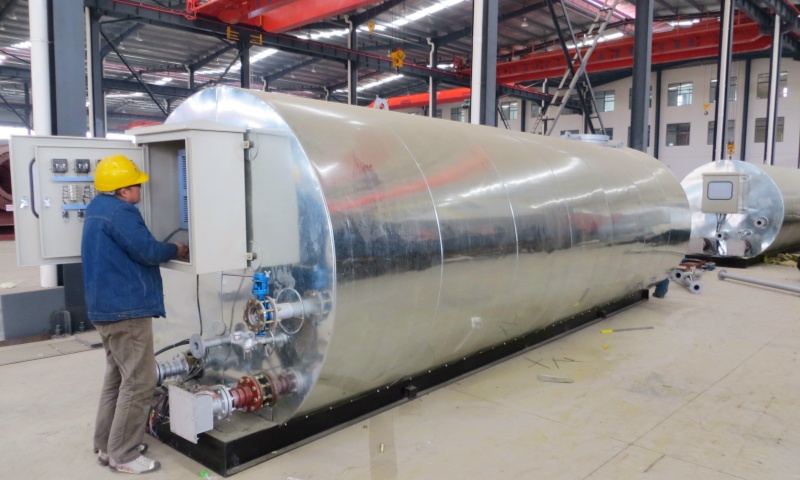
Direct heating bitumen tank belongs to the direct heating mode, no intermediate heat medium, through the combustion of diesel fuel, heavy oil, gas and other fuels, in the tank or through the fire tube, flue directly on the asphalt heating, the structure is relatively simple.
The core feature of the system is the heating speed is very fast, the first time the asphalt heated to 160 ℃ only 30 to 45 minutes, a single set of heating capacity of up to 6 to 8 tons / hour, and the initial cost is low, most of the portable or integrated design, handling, easy to install, very suitable for small and medium-sized construction teams to use.
At the same time, its coal consumption control is reasonable, to meet the cost control needs of small and medium-sized projects.
The advantage of direct heating bitumen tank is that the initial investment is small, high heating efficiency, suitable for temporary construction, mobile operation and other scenes, can quickly respond to the construction needs; disadvantages are more obvious, the heating process is not uniform, easy to appear local overheating, which leads to bitumen aging, affecting the quality of asphalt; and there is a safety risk of open flame, combustion will be discharged in the process of smoke, a certain degree of pollution to the environment, safety is low, is not suitable for densely populated areas Environmental protection requirements of the region to use.
Key Factors to Consider When Choosing a Heat Source for a Bitumen Tank
Project Size and Production Cycle
Project size and production cycle is the core premise of selection, directly determines the suitability of the heating source. For large-scale asphalt mixing plant, continuous production line, due to large capacity, long operating cycle, the stability of heating, continuity requirements are extremely high, thermal oil heating system bitumen tank is the optimal choice – its cycle of stability, can maintain a uniform heat supply in the long-term high load operation process, suitable for large-capacity, continuous production environment, long-term use of more economical. It is suitable for large-capacity, continuous production environment, and more economical to use in the long term.
For small and medium-sized projects or temporary construction projects, such as road maintenance, small mobile asphalt mixing operations, short project cycle, high operational flexibility, without the need for complex heating systems, electric heating systems bitumen tank or direct heat combustion heating systems bitumen tank are more appropriate. This kind of heating source structure is simple, fast start, without supporting complex boiler, piping equipment, can quickly adapt to the needs of mobile operation, short-term construction, reduce the initial investment and operation and maintenance costs.
Selection of the core guidelines are: the longer the project operating cycle, the larger the production scale, the more inclined to choose the thermal oil heating system bitumen tank; project operations, the more flexible, the shorter the cycle, the more suitable for the choice of electric heating bitumen tank or direct heating system bitumen tank.
Energy Conditions and Operating Costs
Energy conditions and operating costs directly affect the long-term use of heating source cost-effective, need to consider the initial investment and full life cycle operating costs. From the point of view of the initial investment, direct thermal combustion heating system costs the lowest, followed by electric heating system, thermal oil heating system bitumen tank is the highest – thermal oil system bitumen tank needs to be supported by boilers, circulating pumps and other equipment, accessories, the initial investment is large.
From the point of view of operating costs, the operating cost of electric heating system bitumen tank is most affected by the price of electricity, if the local price of electricity is high or the energy supply is not stable, the long-term operating costs will increase significantly; the operating cost of direct combustion heating system bitumen tank is moderately high, mainly depending on the price of fuel; thermal oil heating system bitumen tank, although the initial investment is high, but the operating efficiency is high, the fuel cost is relatively stable, and the cost of the whole life cycle of the long-term use of the system has more advantages.
At the same time, energy availability also needs to be considered: if the site fuel is easy to get, low oil prices, choose thermal oil heating system bitumen tank or direct heating combustion heating system bitumen tank is more cost competitive; if the local power supply is stable, renewable energy is abundant, electricity prices are reasonable, electric heating system bitumen tank is more appropriate, both to reduce operating costs, but also to meet environmental requirements.
Temperature Control Requirements and Maintenance Management
Different projects on bitumen heating temperature control accuracy requirements are different, while the ease of maintenance management also directly affects operational efficiency, need to combine their own operation and maintenance capabilities selection. From the point of view of temperature control accuracy, electric heating system bitumen tank is optimal, the temperature fluctuations can be controlled within ± 2 ℃, can accurately meet the high asphalt quality requirements of the scene; thermal oil heating system bitumen tank is second, the temperature stability is strong, suitable for continuous production, and can effectively avoid the asphalt deterioration; direct heating combustion heating system bitumen tank temperature control accuracy is the lowest, the heating is not uniform, easy to lead to the aging of the bitumen, is only suitable for the quality of bitumen quality requirements are not high for the temporary construction of the scene. The system is only suitable for temporary construction scenarios that do not require high bitumen quality.
From the point of view of the difficulty of maintenance and management, electric heating system bitumen tank maintenance is the simplest, only need to regularly check the heating element, to prevent aging, damage to the element can be, without the need for complex maintenance process; direct heat combustion heating system bitumen tank maintenance difficulty is medium, mainly need to clean up the flue ash, check the performance of the burner; thermal oil heating system bitumen tank maintenance difficulty is the highest, need to regularly check the quality of the thermal oil, clean up the pipeline, the pump body, to prevent the leakage of the thermal oil, and deterioration, maintenance costs are relatively high.
In addition, the operating characteristics also need to be taken into account: if the operation process requires frequent start and stop, flexible temperature control, prefer electric heating system; if you need long-term continuous production, to maintain stable temperature control, thermal oil heating system is more appropriate.
Environmental Protection and Safety Requirements
Environmental protection and safety is the bottom line of bitumen tank heating operations, need to strictly comply with local environmental emissions, safety regulations. From an environmental point of view, the electric heating system bitumen tank without open flame, no smoke emissions, low noise, environmental performance is optimal, suitable for urban core areas, environmental control and strict use of the region; thermal oil heating system bitumen tank involves the combustion of fuel, which will produce a certain amount of smoke emissions, need to be equipped with the appropriate smoke treatment equipment, to ensure that the emissions meet the standards; direct heating combustion heating system bitumen tank smoke emissions are more, more pollution of the environment, only suitable for remote areas It is only suitable for remote areas and temporary construction scenarios with lower environmental protection requirements.
From a safety point of view, different heating systems have different safety priorities: thermal oil heating system bitumen tank involves fuel combustion and thermal oil circulation, need to focus on sealing anti-leakage, fire prevention and explosion-proof measures, equipped with the appropriate safety protection equipment; electric heating system bitumen tank needs to focus on grounding, overcurrent, over-temperature protection, to prevent electrical failures caused by safety accidents; direct heating combustion heating system bitumen tank there is a risk of open flames, the need for strict control of open flame. The direct heat combustion heating system bitumen tank has the risk of open flame, which needs to be strictly controlled and fire prevention measures should be taken to avoid fire, asphalt leakage and other potential safety hazards.
Site Conditions and Infrastructure
Site conditions and the degree of infrastructure, directly determines the heating source of the installation and operational feasibility. First of all, consider the grid load: if the site grid capacity is insufficient to meet the operational needs of high-power electric heating system bitumen tank, to avoid the choice of electric heating system bitumen tank, can give priority to the thermal oil or direct heating system bitumen tank; if the site fuel storage space is limited, can not store a sufficient amount of coal, fuel oil and other fuels, need to be careful to choose the thermal oil or direct heating combustion heating system bitumen tank.
Secondly, consider the construction environment: if the site for the humid, dusty areas, need to strengthen the insulation protection of the electric heating system bitumen tank to prevent electrical short circuits; if the site is located in a densely populated area, the use of direct heating combustion heating system bitumen tank should be strictly prohibited, give preference to electric heating bitumen tank or environmentally friendly thermal oil heating system bitumen tank.
Finally consider the supporting facilities: thermal oil heating system bitumen tank requires supporting boilers, circulating pumps and other equipment, need to confirm whether the site has sufficient installation space and infrastructure; electric heating system bitumen tank need to confirm the stability of the site power supply, whether it can meet the heating requirements; direct combustion heating system bitumen tank need to confirm whether the site has a fuel supply channels, whether the smoke emission conditions.
Comparison of Different Heating Methods for Bitumen Tank
| Heating Method | Key Advantages | Suitable Applications | Limitations |
| Thermal oil heating system bitumen tank | heating uniformity, stability, low life cycle cost | large-scale, long-term, continuous production projects | high initial investment, complex maintenance |
| Electric heating system bitumen tank | environmentally friendly, accurate temperature control, simple maintenance | high environmental requirements, flexible operation of small and medium-sized projects | Operating costs are greatly affected by electricity prices, high-power operation of the power grid requirements. |
| Direct heat combustion heating system bitumen tank | low initial cost, fast heating speed, strong portability | limited budget, temporary construction, mobile operation of small and medium-sized projects | with poor environmental protection, uneven heating, low security |
In the actual selection process, the need to combine the project scale, energy conditions, temperature control requirements and other factors, to clarify their core needs – if priority is given to stability and long-term economy, choose thermal oil heating system bitumen tank; if priority is given to environmental protection and flexible operation, choose the electric heating system; if priority is given to the cost and portability, and environmental protection, safety requirements If you prioritize the cost and portability, and environmental protection, safety requirements are lower, choose direct heat combustion heating system bitumen tank.
Application scenarios of Different Heating Methods for Bitumen Tank
Different operational scenarios vary greatly in demand, only to achieve an accurate match between the heating source and the scene in order to maximize the heating efficiency, reduce costs and ensure safety.
For small mobile asphalt mixing plant, the operation is characterized by strong mobility, small production scale, short cycle, the priority recommended direct heating combustion heating system bitumen tank or electric heating system bitumen tank, this kind of heating source portable, fast start, without complex supporting facilities, can quickly adapt to the needs of mobile operations, reduce initial investment.
For medium-sized commercial asphalt plant, the production scale is moderate, the operation cycle is longer, the heating stability and efficiency of certain requirements, it is recommended that the choice of thermal oil heating system bitumen tank, not only to meet the demand for continuous production, but also balance the operating costs and asphalt quality, suitable for medium-sized production capacity of the production scenario.
For large-scale industrial asphalt production base, large-scale production, continuous operation requirements, heating stability, capacity has very high requirements, it is recommended that the choice of thermal oil + natural gas system bitumen tank, natural gas as a clean fuel, can reduce the pressure on environmental protection, while the thermal oil system can ensure long-term stability of the heating to meet the needs of the production of large capacity.
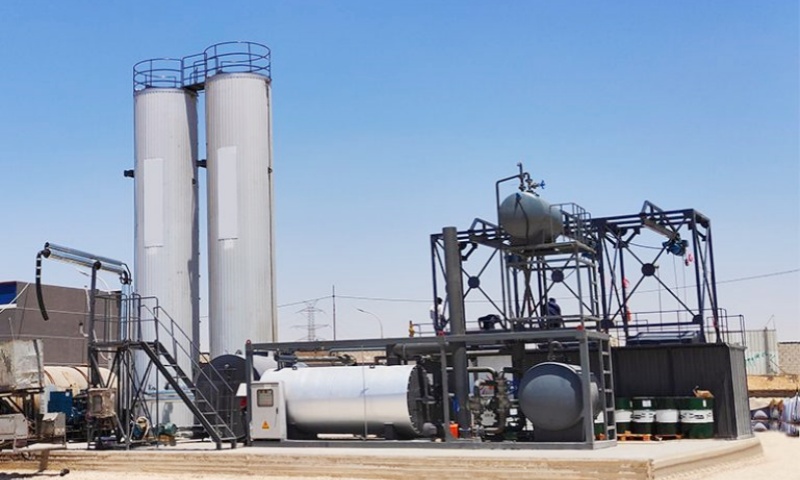
For environmental control areas, such as urban core areas, ecologically sensitive areas, environmental protection requirements are strict, priority is recommended for electric heating system bitumen tank or clean energy heat transfer oil system bitumen tank, electric heating system bitumen tank with zero emissions, clean energy heat transfer oil system bitumen tank (such as gas, biomass fuels) emissions meet the standards to meet the requirements of environmental protection control, and at the same time to avoid the impact on the surrounding environment.
For road maintenance, temporary construction projects, short operating cycles, high flexibility, and mostly outdoor work, it is recommended to choose direct heating combustion heating system bitumen tank or modular electric heating system bitumen tank, direct heating heating speed, low cost, modular electric heating system is easy to install, flexible and adjustable, to adapt to the changing needs of temporary construction.
For urban construction projects, located in densely populated areas, environmental protection and high safety requirements, we recommend the choice of electric heating system bitumen tank, no open flames, zero emissions, not only to meet the construction needs, but also to avoid potential safety hazards and environmental pollution, in line with the city’s construction of environmental protection, safety standards.
Best Practices for Bitumen Tank Heating
Energy Efficiency and Operational Safety
Bitumen tank heating efficiency is far more than simply applying heat, but also need a set of heat loss can be reduced to maintain stable internal working conditions, and with the unloading equipment safety integration of the storage system. Efficient heating and safe operation go hand in hand, and are the key to reducing operating costs as well as the basis for preventing safety hazards and ensuring construction compliance.
The use of insulated bitumen storage tanks is the core means to improve energy efficiency, high-quality insulation design can effectively reduce heat loss, reduce the energy consumption required to maintain the working temperature of the bitumen, especially in the low-temperature environment, can significantly improve the overall efficiency of the heating system, reduce the waste of energy brought about by repeated heating. At the same time, equipped with automated heating control system, can accurately regulate the temperature, to avoid overheating or thermal shock phenomenon, not only to protect the quality of asphalt products, to prevent bitumen due to temperature abnormalities and aging, degradation, but also to protect the tank equipment, to prolong its service life.
Operational safety, supporting the perfect safety system is essential. When dealing with high-temperature bitumen, pressure relief valves, temperature alarms, double-walled anti-leakage base and other safety devices are essential. Pressure relief valve can release the excessive pressure in the tank in time to prevent damage to the tank; temperature alarms can issue timely warnings when the temperature is abnormal, so that operators can quickly dispose of; double-walled anti-leakage base can effectively prevent bitumen, heat transfer oil leakage, to avoid causing environmental pollution and safety accidents. These safety facilities not only protect the personal safety of operators, but also help companies comply with industry-related regulations to minimize environmental and operational risks.
Efficiency Optimization
Optimization of heating efficiency is the key to reducing operating costs, from temperature control, insulation measures, heating plan and other aspects. First of all, the need to maintain a stable bitumen temperature, to avoid frequent fluctuations, frequent heating, cooling will increase energy consumption, and may lead to bitumen deterioration, according to the bitumen grade and construction needs, set a reasonable range of constant temperature, reduce repeated heating.
Secondly, configure a full range of insulation for bitumen tanks, reduce heat loss, reduce the energy consumption required to maintain constant temperature, especially in the low-temperature environment, good insulation measures can significantly improve the heating efficiency and reduce operating costs.
In addition, the need to optimize the heating plan, according to the construction progress of reasonable control of the heating time and temperature, to avoid early heating, excessive heating, reduce energy waste; at the same time, regularly clean up the heating element, piping, remove coking, ash and other debris, to ensure the heat transfer efficiency, to ensure that the heating system operates stably.
Safety Management
Safety is the core of the bitumen tank heating operation, the need to establish a sound safety management system, the implementation of various safety measures. First of all, the need to install perfect safety devices, including temperature monitors, over-temperature alarm devices, pressure relief valves, real-time monitoring of the heating process of temperature, pressure changes, once the anomaly occurs, the timely issuance of alarms and take emergency measures to prevent accidents.
Secondly, double-walled tanks, anti-leakage base and other protective facilities to prevent bitumen, heat transfer oil leakage, to avoid environmental pollution and safety hazards; for heating systems involving open flames and fuel combustion, the use of open flames needs to be strictly controlled, equipped with fire-fighting equipment, and implement fire prevention measures.
At the same time, operators need to receive professional training, familiar with the heating system’s operating procedures, safety precautions and emergency response, to avoid safety accidents caused by improper operation; the establishment of equipment operation logs, detailed records of temperature, pressure, maintenance, etc., to facilitate the timely detection of problems, troubleshooting and hidden dangers.
Maintenance Specification
Regular maintenance is to extend the service life of the heating system, the key to ensure operational stability, according to the characteristics of different heating systems, the development of targeted maintenance specifications. For thermal oil heating system bitumen tank, every 12 months need to test the quality of thermal oil, timely replacement of deteriorated thermal oil; every 6 months to check the pipeline, the pump body, to detect leakage hazards, to ensure the normal operation of the circulatory system.
For the electric heating system bitumen tank, need to regularly clean up the heating tube surface coking, debris, to ensure heating efficiency; regular inspection of cable insulation, to prevent electrical short circuits, leakage, long-term shutdown needs to be disconnected from the power supply, good equipment protection, to avoid component aging.
For direct heat combustion heating system, need to regularly clean up the flue ash, to ensure smooth flue gas emissions; check the performance of the burner, timely replacement of damaged parts, to ensure that the fuel is fully combusted, reduce flue gas emissions and energy waste.
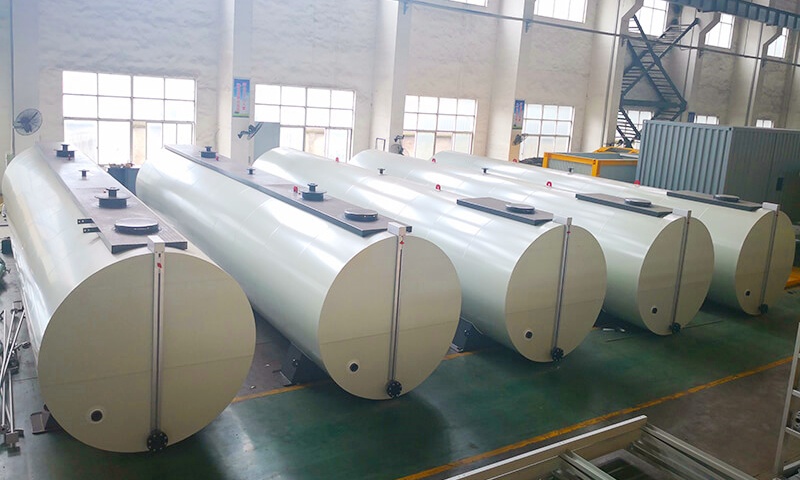
Common Mistakes to Avoid When Choosing the Heat Source for Bitumen Tank
In the bitumen tank heating source selection process, many practitioners are prone to fall into the wrong area, resulting in increased operating costs, safety hazards, need to focus on avoiding the following common mistakes.
Misunderstanding 1: only focus on the initial cost, ignoring the full life cycle operation and maintenance costs.
Many people in the selection of models, give priority to the initial investment in low direct heat bitumen tank or electric heating system bitumen tank, but ignored the long-term operation of the fuel, electricity, maintenance costs, resulting in a substantial increase in operating costs later.
Avoidance method: Comprehensive costing of the whole life cycle, combined with the project cycle, capacity needs, weighing the initial investment and long-term operating costs, to avoid long-term losses due to short-term savings.
Misconception 2: Neglecting local energy availability, leading to later operation obstacles.
Some practitioners blindly choose the popular heating methods, but did not consider the local fuel, power supply, such as remote areas to choose the electric heating system bitumen tank, due to the instability of the power grid can not be normal operation; environmental control areas to choose the direct heating system bitumen tank, due to emissions do not meet the standards were ordered to stop.
Avoidance methods: full research before the selection of local energy supply, price levels, combined with the availability of energy to choose the right heating source.
Misconception 3: The heating capacity is designed too high or too low, resulting in energy waste or insufficient capacity.
If the heating capacity is designed too high, it will lead to excessive energy consumption and increase the operation cost; if the design is too low, it will not be able to meet the demand of production and construction, which will lead to construction delay.
Avoidance method: combined with the actual production scale, bitumen consumption, accurate calculation of heating demand, reasonable design of heating capacity, to avoid over-design or under-design.
Misunderstanding 4: Not configured backup heating system, equipment failure leads to construction stoppages.
Some important projects are only configured with a set of heating system, once the equipment failure, can not resume heating in a timely manner, resulting in construction standstill, resulting in economic losses.
Avoidance: important projects need to be equipped with backup heating source or redundant design to ensure that when a set of equipment failure, another set of equipment can be put into use in a timely manner to protect the construction continuity.
Misunderstanding 5: Bitumen tank insulation measures are not in place, a large number of heat loss to push up the cost. Many people pay attention to the heating system itself, but ignored the tank insulation, resulting in a large loss of heat, the need for repeated heating, increasing energy consumption.
Avoidance method: Priority to choose high thermal insulation performance of bitumen tanks, while doing a good job of upgrading the tank insulation, reduce heat loss, improve heating efficiency.
Misunderstanding 6: Blind pursuit of high temperature control accuracy, increase unnecessary costs. Part of the project on the asphalt temperature control accuracy requirements are not high, but blindly choose high temperature control accuracy of the electric heating system, resulting in increased initial investment and operating costs, resulting in a waste of resources.
Avoidance: According to the asphalt requirements, construction quality standards, matching the appropriate temperature control level, without blindly pursuing too high a precision.
Future Trends in Bitumen Tank Heating
With the continuous improvement of environmental requirements, the rapid development of intelligent technology, bitumen tank heating technology is moving towards intelligent, green, mixed direction, the future will pay more attention to efficiency, environmental protection and safety balance.
Mixed heating solutions will become the mainstream trend, more and more companies will use thermal oil and electric heating combined with the hybrid system bitumen tank- thermal oil system as the main heating source, responsible for long-term continuous heating and temperature control, to protect the production continuity; electric heating system as an auxiliary heating source for nighttime heat preservation, temporary heating or emergency heating to optimize the energy distribution, taking into account the stability and economy. Optimizing energy distribution, taking into account stability, economy and flexibility, and realizing efficient heating in different operation scenarios.
Renewable energy integration will become an important development direction, electric heating system bitumen tank will be gradually paired with photovoltaic, energy storage system, the use of renewable energy power supply, to achieve zero-emission operation, reduce environmental pressure; thermal oil heating system bitumen tank will gradually use biomass fuels, natural gas and other clean energy sources, instead of the traditional coal-fired, reduce smoke emissions, and realize green development.
Intelligent heating system bitumen tank will be widely used, based on the Internet of Things, PLC intelligent temperature control technology will be gradually popularized, real-time monitoring of temperature, pressure, automatic adjustment and fault warning, through data-driven operation and maintenance, to improve the operational efficiency of the heating system, reduce the cost of artificial operation and maintenance, while reducing the security risks caused by human error.
High-efficiency thermal oil bitumen tank technology will continue to be upgraded, through the optimization of burner design, increase the waste heat recovery system, improve the heating efficiency of thermal oil, extend the service life of thermal oil, reduce energy consumption; modular, flexible design will become more mature, removable heating elements, multi-tank parallel thermal oil circulation system will be gradually promoted, to adapt to different scales, different scenarios of the operational needs of the heating system to enhance the flexibility and versatility. Green emission reduction will become an industry consensus.
Green emission reduction will become an industry consensus, direct heat combustion heating system will be gradually upgraded low-NOx burners to reduce NOx emissions; thermal oil system bitumen tank will optimize the flue gas treatment process, to achieve flue gas emissions, the whole chain to reduce carbon emissions, and promote the green and sustainable development of the asphalt industry.
Conclusion
Bitumen tank heating source selection, the core is around the project scale, energy conditions, environmental safety requirements, taking into account the whole life cycle costs and operational efficiency, to achieve the heating source and the precise matching of the operating scenarios. The three mainstream heating sources are suitable for each scenario: thermal oil heating system bitumen tank for large-scale, long-term, continuous asphalt mixing plant production projects, the advantage of strong stability, low life-cycle costs; electric heating system bitumen tank for high environmental requirements, the operation of flexible small and medium-sized projects, the advantage of environmental protection, temperature control precision, simple maintenance; direct heating combustion heating system bitumen tank for limited budget, temporary construction, mobile operation of small and medium-sized projects, the advantage of The advantages are low initial cost and fast heating speed.
Selection process, need to avoid only focusing on the initial cost, ignoring energy availability and other common misconceptions, combined with their own project needs, weigh the advantages and disadvantages of each heating method, if necessary, you can choose a hybrid heating program, to achieve efficiency, cost and safety of the triple balance. At the same time, we need to pay attention to the operation and maintenance of the heating system and safety management, the implementation of best practices, to extend the service life of the equipment and reduce operational risks.
In the future, with the development of intelligent and green technology, the bitumen tank heating system will be upgraded in the direction of hybridization, integration of renewable energy, and intelligence, which will provide support for the efficient, green and safe development of the asphalt industry. It is recommended that practitioners combined with the industry development trend, choose the heating source solutions to meet their needs, improve operational efficiency, reduce environmental pressure and achieve sustainable development.