


What Are The Factors That Affect The Demulsification Speed of Emulsified Asphalt?
Why is Demulsification Speed the Core Factor in Emulsified Asphalt Application?
From “Liquid” to “Solid”: A Simple Definition of Demulsification
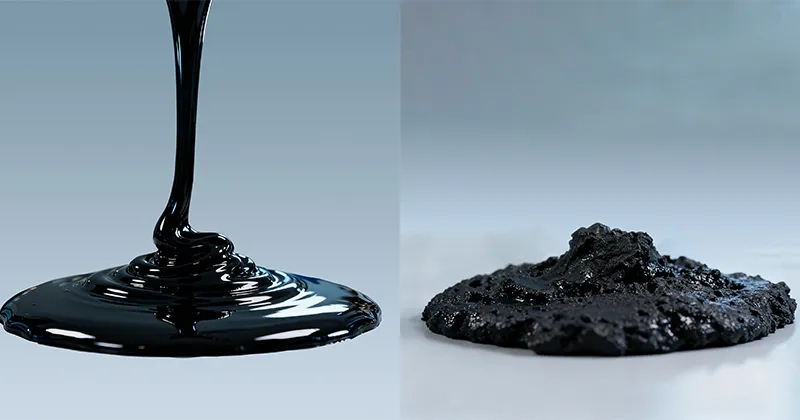
The demulsification of emulsified asphalt is essentially a physicochemical process of “oil-water separation.” Just as fat floats to the surface and water sinks in milk after standing, the asphalt particles in emulsified asphalt, under specific conditions, will break free from the protective film formed by the emulsifier, separate from the aqueous phase, aggregate and fuse together, ultimately restoring the original bonding properties and solid characteristics of the asphalt. This process, seemingly simple, directly determines whether emulsified asphalt can function effectively in engineering projects—without successful demulsification, the asphalt cannot firmly bond with the aggregate, and the strength and durability of the pavement are out of the question.
How Does Demulsification Speed Determine Construction Quality and Efficiency?
The demulsification speed is the “lifeline” of emulsified asphalt application; it directly determines:
Construction Opening Time: The faster the demulsification speed, the earlier the road can be opened to traffic, and the smaller the impact on traffic.
Interlayer Bond Strength: A precise demulsification rate ensures high-strength bonding during optimal compaction. Too rapid demulsification results in the asphalt losing its fluidity before fully coating the aggregate, leading to weak bonding; too slow demulsification causes a water film to form between layers, creating a weak interlayer.
Early-Term Water Damage Resistance: Only after complete demulsification and formation does the pavement possess sufficient resistance to rainwater erosion and infiltration. Slow demulsification makes the pavement susceptible to early rain damage.
Therefore, accurately understanding and controlling the demulsification rate is a fundamental prerequisite for ensuring the quality of emulsified asphalt construction and improving construction efficiency.
The Determinism of Emulsified Asphalt’s Own “Genes”
Type and Dosage of Emulsifier: The “Master Switch” of Demulsification
Ion Type Determines the Fundamental Mechanism
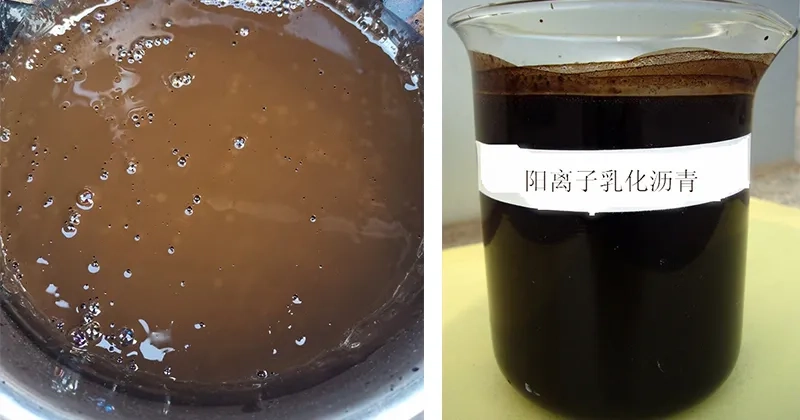
The ionic properties of the emulsifier directly determine the core mechanism of demulsification. Cationic emulsified asphalt uses positively charged emulsifier molecules, while the aggregates commonly used in road engineering (such as granite and limestone) are mostly negatively charged. When the two come into contact, the positive and negative charges quickly neutralize, the protective film formed by the emulsifier breaks instantly, and the asphalt particles rapidly aggregate, making the demulsification process efficient and direct. Conversely, anionic emulsified asphalt uses negatively charged emulsifier molecules, which repel the negative charges on the aggregate surface. Demulsification cannot be achieved through charge neutralization; it mainly relies on the natural evaporation of water to bring the asphalt particles closer together for aggregation, thus the demulsification rate is relatively slow.
The “Seesaw” Effect Between Emulsifier Dosage and Demulsification Rate
The role of the emulsifier is to form a protective film, preventing the aggregation of asphalt particles. The higher the emulsifier dosage, the stronger and denser this protective film, and the higher the stability of the emulsion. Therefore, there is a seesaw-like inverse relationship between emulsifier dosage and demulsification rate: the higher the dosage, the slower the demulsification rate; conversely, to accelerate demulsification, the emulsifier dosage can be appropriately reduced.
Oil to Water Ratio: Asphalt Content is Key
The asphalt content (i.e., the oil-to-particle ratio) in emulsified asphalt directly affects the average distance between asphalt particles. When the asphalt content is high (e.g., above 60%), the asphalt particles in the system are more densely packed, with very small distances between them. Once the emulsion stability is disrupted (e.g., by charge neutralization or water evaporation), they can contact and coalesce more quickly, thus accelerating the demulsification process. Conversely, emulsions with low asphalt content have larger particle spacing, require more time to coalesce, and have a slower demulsification rate.
The Role of Acidity/Alkalinity (pH Value)
Different types of emulsifiers require specific pH environments to achieve optimal stabilization. For example, many cationic emulsifiers are stable under acidic conditions, while some anionic emulsifiers prefer alkaline environments. If the pH value changes after the emulsion comes into contact with aggregates or environmental substances during construction, it will disrupt the stabilizing function of the emulsifier, thereby triggering or accelerating the demulsification process.
External Environmental Factors
Temperature: The Most Active “Accelerator”
Air Temperature and Road Surface Temperature:
Temperature is one of the most significant factors affecting demulsification speed. High temperatures accelerate demulsification in two ways:
Accelerating Moisture Evaporation: For any type of emulsified asphalt, high temperatures can significantly increase the rate of moisture evaporation.
Intensifying Brownian Motion: Increased temperature makes the Brownian motion of asphalt particles more intense, increasing the probability and energy of collisions, making it easier to overcome the emulsifier barrier and aggregate.
Material Temperature:
Besides ambient temperature, the temperature of the emulsified asphalt and aggregates themselves is also crucial. Using hot aggregates for mixing can instantly provide enormous energy for demulsification, enabling it to be completed in a very short time. This is especially critical in processes such as plant-mixed cold recycling or micro-surfacing, which involve rapid traffic opening.
Humidity: The “Retainer” of Moisture
Ambient humidity determines the saturation level of water vapor in the air. In high humidity environments, the air is nearly saturated with moisture, making it difficult for the water in the emulsion to evaporate into the air. This is similar to drying clothes in a steamy room; the clothes are slow to dry. Therefore, high humidity severely hinders the demulsification rate of emulsions that rely primarily on water evaporation (especially anionic emulsions), resulting in prolonged post-construction failure.
Wind: The Invisible “Evaporation Booster”
Wind (airflow) continuously carries away the saturated water vapor layer on the emulsion surface through convection, replacing it with drier air, thus significantly increasing the water evaporation rate. Therefore, construction in windy weather indirectly accelerates the demulsification rate.
Construction and Application Conditions: A Controllable “Regulator”
The “Personality” of Aggregates (Stone) and the Chemical Reaction of Demulsification
Surface Chemical Properties:
Characteristics: This is crucial influencing the demulsification of cationic emulsified asphalt. Strongly negatively charged siliceous aggregates (such as granite) trigger intense charge neutralization, resulting in extremely rapid demulsification; while positively charged or electrically neutral limestone aggregates exhibit a much milder chemical reaction with cationic emulsions, leading to slower demulsification.
Surface Activity: The larger the specific surface area (total surface area per unit mass of aggregate), the higher the porosity, and the stronger the adsorption capacity, the greater its ability to absorb moisture from the emulsion and adsorb emulsifiers. This leads to faster disruption of emulsion stability, thus accelerating demulsification.
Physical State:
Moisture and Water Content: Using damp or water-containing aggregates is a major no-no in construction. It dilutes the emulsified asphalt, reduces the asphalt content, and requires additional water evaporation, significantly delaying the demulsification process.
Temperature: As mentioned earlier, hot aggregates are one of the most effective techniques for accelerating demulsification.
Mechanical Action: The “Catalytic” Effect of Pressure and Agitation
During compaction or agitation, mechanical forces compel asphalt particles to come into closer contact, even directly disrupting the protective emulsifier film surrounding the particles. This physical squeezing and kneading action provides pathways for the aggregation of asphalt particles, strongly catalyzing the demulsification process. This is why thorough compaction is a crucial step in ensuring pavement density and early strength.
Spreading and Contact Area: The Wider the Spread, the Faster the Demulsification
The thickness of the spread directly determines the length of the evaporation path and the size of the evaporation area. When emulsified asphalt is spread thinly, the emulsion per unit volume has a larger surface area in contact with air, allowing water to escape quickly and evenly, naturally accelerating the demulsification process. Conversely, an excessively thick spread layer makes it difficult for the underlying water to evaporate, resulting in slow and uneven demulsification.
Comprehensive Application: How to Precisely Control Demulsification Speed in Practice?
“Targeted Approach”: Selecting Emulsion Type Based on Construction Needs
Tack Coat: Requires penetration; choose slow-setting emulsion asphalt to allow sufficient time for it to penetrate the base layer.
Tilt Coat: Requires rapid bonding; choose fast-setting emulsion asphalt to achieve rapid and strong bonding between layers.
Surface Treatment and Sealing Coat: Select fast-setting or medium-setting emulsions based on traffic opening times.
Mixture: Select slow-setting or medium-setting emulsions based on aggregate properties and the time from mixing to paving and compaction.
“Favorable Timing and Location”: Adjusting Construction Plans Based on Environmental Conditions
In unfavorable weather conditions such as low temperature and high humidity, proactive measures must be taken:
Prioritize the use of fast-setting emulsions to compensate for environmental deficiencies.
Heat-treat the aggregates.
Avoid construction after rain or in the early morning or late evening when humidity is extremely high.
“Human Intervention”: Key Measures for Proactive Adjustment
When the preset demulsification rate does not match the actual situation, the following can be done:
Adjust aggregate properties: Ensure the aggregate is dry and clean, and heat it if necessary.
Use chemical admixtures: This is the most precise control method. Demulsifiers can be added to accelerate the demulsification of specific slow-breaking emulsions; conversely, de-cracking agents (such as a small amount of water) can be added to slightly delay the demulsification of excessively fast-breaking emulsions.
Summary and Frequently Asked Questions (FAQ)
Review of Core Points
The factors affecting the demulsification rate of emulsified asphalt are multi-dimensional and can be mainly summarized into three categories:
Internal factors: Emulsifier type and dosage, asphalt content, pH value.
External environment: Temperature, humidity, wind force.
Construction conditions: Chemical and physical properties of aggregates, mechanical action, spraying thickness.
Successful construction depends on a deep understanding of these factors and systematic optimization and matching.
Frequently Asked Questions
Q1: What if the demulsification is too fast and there is not enough time for compaction?
A1: This is a typical “fast cracking” phenomenon. Solutions include: Replacing with slow-cracking or medium-cracking emulsion asphalt.
Pre-wetting the aggregate by spraying a small amount of water to delay demulsification.
Construction during cooler times (e.g., early morning or evening).
Optimize construction organization to shorten the time interval between spraying and compaction.
Q2: Why is demulsification so slow that traffic cannot be opened for extended periods?
A2: This problem is usually caused by one or more of the following reasons:
Unfavorable environmental conditions: Low ambient temperature, high humidity.
Incorrect material selection: Using a slow-cracking emulsion in a scenario requiring fast cracking.
Poor aggregate condition: Using wet aggregate or aggregate with a charge mismatch with the emulsion (e.g., using cationic emulsion with limestone aggregate without adjustment).
Q3: Why does the demulsification speed vary greatly between different construction sites for the same batch of emulsion asphalt?
A3: This phenomenon precisely demonstrates that the external environment and aggregate properties are the key factors determining the demulsification speed, rather than the unstable quality of the emulsion itself. The same emulsion will naturally exhibit vastly different demulsification rates when encountering aggregates with different properties (such as dry granite in one site and damp limestone in another) and varying temperature and humidity conditions at different construction sites. This underscores the extreme importance of conducting material compatibility and environmental adaptability assessments before construction.