


Why is a Solid Foundation Critical to Asphalt Mixing Plant Performance
Contents
- 1 Introduction
- 2 How Foundation Directly Impacts Asphalt Plant Performance?
- 3 Core Technical Requirements of a High-Performance Foundation
- 4 Foundation Types and Their Impact on Performance
- 5 Step-by-Step: Building a Foundation That Maximizes Performance of Asphalt Mixing Plant
- 6 Common Foundation Issues That Reduce Asphalt Plant Performance
- 7 Performance vs Cost: The Real ROI of a Solid Foundation
- 8 Professional Recommendations for Buyers and Contractors
- 9 Conclusion
Introduction
In the procurement and installation process of an asphalt mixing plant, most users tend to focus on the equipment model, capacity parameters and core configuration, but easily ignore a seemingly basic but key link that determines the final performance of the equipment – foundation construction. Many practitioners will face confusion: why choose the same model, the same configuration of the asphalt mixing plant, different projects in terms of capacity output, operational stability, but there is a huge difference? The answer is very simple: the foundation is the “multiplier” of the asphalt mixing plant’s performance, which directly determines the upper limit of the equipment’s performance. Without a solid foundation, the advanced equipment will not be able to play to its full advantage.
In this paper, we will analyze the foundation and asphalt mixing plant performance of the core linkage, dismantle the technical requirements of the foundation construction, and provide practical points to help practitioners avoid hidden dangers of the foundation, maximize the performance and service life of the asphalt mixing equipment.
How Foundation Directly Impacts Asphalt Plant Performance?
Stable operation of the asphalt mixing plant, accurate production, and long-term durability are directly related to the quality of foundation construction, specifically from the four core dimensions, each of which directly determines the actual operating effect of the equipment.
Structural Stability Determines Continuous Production Output
A solid foundation is the premise of an asphalt mixing plant to achieve continuous and stable production. Asphalt mixing plant in the operation process will produce continuous vibration, if the foundation construction is not solid, structural stability is not enough, it will lead to equipment shaking, shifting, and other problems, which will lead to production interruption. Especially in high-intensity, long-time production scenarios, the stability of the foundation directly determines the continuity of production, to avoid downtime due to equipment vibration, to ensure stable output capacity, and to reduce delays and cost losses due to downtime.
Precision of Foundation Guarantees the Accuracy of Batching and Mixing
The core of asphalt mixture quality lies in the batching accuracy, and the key to the batching accuracy lies in the accuracy of the weighing system, which is closely related to the flatness of the foundation. If the foundation is not flat, it will lead to deviation of the weighing system, which will affect the stability of the oil/stone ratio – as the core index of asphalt mixture quality, the deviation of the oil/stone ratio will directly reduce the quality of the mixture, affecting the durability of the road pavement, and even cause engineering quality problems. Only the foundation that is level and firm can ensure that the weighing system operates accurately and guarantee the accuracy of batching and mixing.
Vibration Control to Extend Asphalt Mixing Plant Life
The core components of an asphalt mixing plant, such as the drying drum, vibrating screen, mixing system, etc., will generate a lot of vibration during operation, and these vibrations are one of the main reasons for the wear and tear of the equipment. The poor quality of the foundation will amplify this vibration, resulting in accelerated wear and tear between the various components of the equipment, shortening the service life of bearings, gears, conveyor belts, and other wear parts, while increasing the incidence of equipment failure, and enhancing the maintenance costs. A solid foundation can effectively absorb and buffer the vibration generated by the operation of the equipment, reduce the loss of vibration on the equipment, and extend the overall service life of the equipment.
Core Component Alignment to Ensure Operational Efficiency
The core components of the asphalt mixing plant, such as the conveying system, elevator, mixer, etc., need to maintain accurate alignment in order to operate efficiently. If the foundation is not solid or the laying precision is not enough, it will lead to the deviation of these core components, which will reduce the operating efficiency of the asphalt plant equipment, increase the friction and loss between the components, and improve the failure rate. The accuracy of the foundation directly determines the core components of the centering effect, which is an important guarantee of efficient and stable operation of the asphalt mixing plant equipment.
Core Technical Requirements of a High-Performance Foundation
In order to realize the “multiplying” effect of foundation on the performance of the asphalt plant equipment, it must meet a series of core technical requirements, which are centered on the key dimensions of load-bearing capacity, stability, and precision, and none of them is indispensable.
Load-Bearing Capacity (Static + Dynamic Loads)
The foundation of an asphalt mixing plant not only needs to bear the static load of the equipment itself, but also needs to cope with the dynamic load and impact load generated during the operation of the equipment. Different capacity of asphalt mixing plant, there are differences in the requirements of the foundation load-bearing capacity, according to the capacity of the asphalt plant equipment need to reasonably design the foundation of the load-bearing standard, to ensure that the foundation can withstand the long-term operation of the equipment brought about by the various types of load, to avoid the foundation due to insufficient bearing settlement, cracking and other issues.
Foundation Stability and Soil Integrity
Foundation stability and soil integrity are the core premises of long-term stability of the foundation. Foundation settlement will have a long-term negative impact on the performance of the asphalt mixing plant, leading to problems such as equipment displacement, precision degradation, and structural damage. Therefore, before the foundation construction, a professional geological investigation must be carried out to fully understand the nature of the soil, bearing capacity and groundwater level, etc., and the foundation program should be designed according to the results of the investigation, so as to avoid the risk of foundation settlement from the source.
Reinforced Structure and Thickness Design
The foundation of the asphalt mixing plant must adopt a reinforced concrete structure, which can effectively improve the strength and stability of the foundation to meet the needs of long-term operation of the equipment. At the same time, the thickness of the foundation design needs to be matched with the layout of the equipment, capacity requirements, according to the load distribution of the various components of the equipment, the reasonable design of the thickness of the foundation in different areas, to ensure that the overall stress on the foundation is uniform, to avoid cracking and damage caused by excessive local stress.
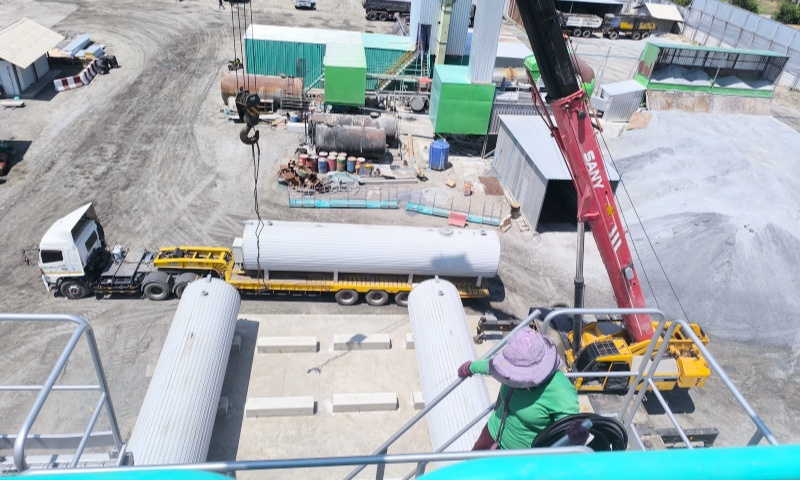
Guarantee Long-term Stability of the Drainage System
Water is one of the biggest hidden dangers affecting the long-term stability of the foundation. If the foundation drainage system is not reasonably designed, rainwater and groundwater will penetrate into the foundation, resulting in softening of the soil, bearing capacity decline, which in turn triggers foundation settlement, cracking, and other problems. Therefore, the foundation construction must be supported by a perfect drainage system, timely discharge of water, to ensure that the foundation is in a dry, stable state, to protect its long-term carrying capacity and stability.
Precision Leveling and Calibration Readiness
Accurate leveling of the foundation directly affects the weighing system and automatic control system operating accuracy, which is a prerequisite for the performance of a high-end asphalt mixing plant. In the process of foundation construction, it is necessary to strictly control the level of the foundation to ensure that the equipment can meet the requirements of accurate calibration after installation, to provide a guarantee for the stable operation of the weighing system and automatic control system, and to avoid production errors and equipment failures due to insufficient leveling accuracy.
Foundation Types and Their Impact on Performance
Different types of asphalt mixing plants have differences in the design of their foundations, and the type of foundation directly determines the stability of the operation of the asphalt plant equipment and performance. According to the project needs, it is necessary to choose reasonably.
Stationary Asphalt Mixing Plants(High Stability+High Output)
Stationary asphalt mixing plant with deep foundation + reinforced concrete structure design, this foundation structure is extremely stable, able to withstand long-term high-load operation of various types of loads. Its core performance advantage lies in the strong operational stability, low production error, can give full play to the advantages of high-capacity equipment, suitable for long-term fixed in the same place, high-intensity continuous production project scenario, is the first choice for large-scale highway, industrial infrastructure projects.
Mobile Asphalt Mixing Plants (Flexibility vs Stability)
The foundation design of the mobile asphalt mixing plant is relatively simplified, mostly using crushed stone bedding or a simple concrete foundation, without the need for complex deep foundation construction. Its core advantage lies in its flexibility, which can be quickly transferred and deployed, and is suitable for small, decentralized construction projects. However, due to the limitation of the foundation design, the stability of long-term operation is weaker, and the capacity and precision performance are slightly lower than that of the stationary asphalt plant equipment.
Modularized Asphalt Mixing Plant (Balanced Solution)
The modular asphalt mixing plant adopts a standardized foundation design, balancing flexibility and stability. Its foundation design does not require complex construction, can be quickly deployed and installed, and at the same time can guarantee the stability of asphalt plant equipment operation, to meet the production needs of medium-sized projects, is a balanced solution to take into account the deployment efficiency and production performance.
Step-by-Step: Building a Foundation That Maximizes Performance of Asphalt Mixing Plant
Foundation construction is a systematic project; you need to follow the scientific steps, control each key link, in order to create a foundation that maximizes the performance of the asphalt plant equipment, which can be divided into five core steps.
Site Investigation and Soil Testing
The first step of foundation construction is to carry out comprehensive site investigation and soil testing, focusing on testing the bearing capacity of the soil, soil type, water table and other key indicators, a comprehensive understanding of the geological conditions of the site, to provide a scientific basis for the foundation design, to avoid hidden dangers due to unknown geological conditions of the foundation.
Engineering Design Based on Plant Layout
The foundation design should be combined with the equipment layout of the asphalt mixing plant, rather than adopting a common template. According to the position and load distribution of each component of the equipment, calculate the impact of dynamic loads, design targeted foundation programs to ensure that the foundation can accurately match the needs of the equipment, to ensure the precision of the alignment of each component of the equipment and the stability of operation.
Construction Execution (Critical Control Points)
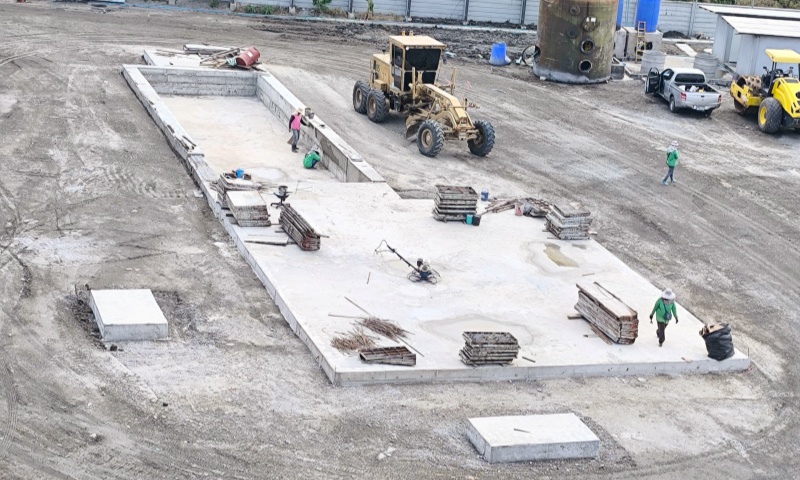
The construction process needs to focus on controlling two key links: one is the reinforcement binding, to ensure that the specifications and spacing of the reinforcement meet the design requirements, and to improve the strength of the foundation; the second is the concrete pouring and maintenance, strict control of the quality of the concrete pouring, and follow the standardized maintenance cycle, to ensure that the concrete strength is up to standard, and to avoid cracking of the foundation due to improper maintenance.
Precision Installation Preparation
After the foundation construction is completed, it is necessary to make preparations for asphalt mixing plant equipment installation, focusing on controlling the positioning accuracy of the embedded parts (ground bolts), to ensure that the position and height of the ground bolts meet the requirements for equipment installation; at the same time, before the equipment installation, the foundation is retested, to confirm that the foundation’s levelness and flatness are up to standard, in order to lay a foundation for the accurate installation of the asphalt plant equipment.
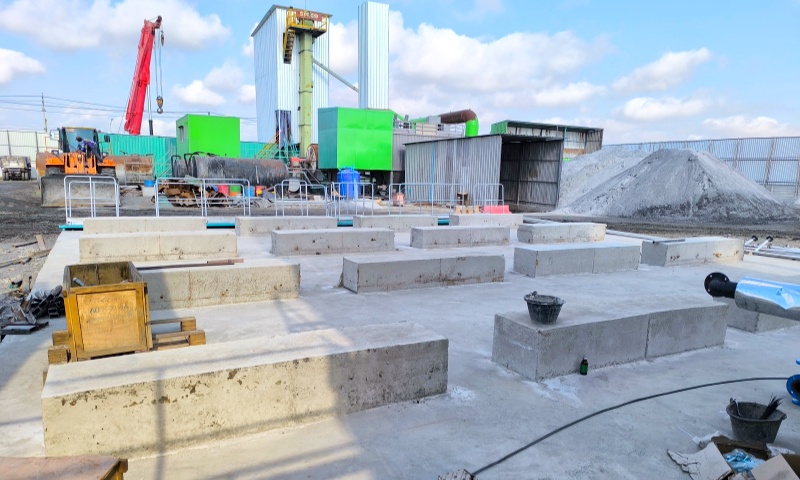
Final Inspection and Performance Validation
After the completion of foundation construction and installation preparation, the final test and performance verification: through the level test to confirm that the foundation accuracy standards, through the equipment no-load, load test, verify the stability of the foundation and asphalt mixing plant equipment performance, to ensure that the foundation to meet the long-term operational needs of the equipment, to avoid the performance of the late hidden problems.
Common Foundation Issues That Reduce Asphalt Plant Performance
In the actual project, many foundation problems will directly reduce the performance of asphalt mixing plant, each type of problem has a clear cause, performance and solutions, need to focus on avoidance and timely processing.
Uneven Settlement: leads to production instability
Causes: Inadequate geological investigation, insufficient design of the foundation bearing capacity, poor drainage leading to softening of the soil, will trigger uneven settlement of the foundation.
Performance: obvious shaking and shifting of the equipment during operation, a decrease in the precision of the weighing system, frequent interruptions in production, and fluctuations in the quality of the mixture.
Solution: Do detailed geological investigation in advance, and reasonably design the foundation bearing capacity; improve the drainage system to avoid soil softening; if settlement has occurred, the foundation needs to be reinforced, and recalibrate the position and accuracy of the asphalt mixing plant quipment.
Foundation Cracks: causing structural weaknesses
Causes: substandard quality of concrete pouring, insufficient maintenance period, irrational design of foundation thickness, or excessive vibration of equipment without an effective buffer, will lead to foundation cracking.
Performance: obvious cracks appear on the surface of the foundation, the cracks gradually expand, the stability of the asphalt plant equipment operation decreases, and in serious cases, it will lead to the damage of the asphalt mixing plant equipment components.
Solution: Strictly control the quality of concrete pouring and maintenance, reasonably design the thickness of the foundation and reinforce the structure; strengthen the vibration buffer measures; repair and reinforce the cracks that have already appeared to prevent the cracks from expanding.
Poor Drainage: leads to long-term degradation
Causes: Irrational design of the drainage system, blockage of drainage pipes, resulting in rainwater and groundwater not being able to be discharged in time, soaking the foundation for a long time.
Performance: The surface of the foundation is wet and softened, the bearing capacity gradually decreases, and the asphalt plant equipment shows slight settlement. Long-term operation will lead to aging and damage of the foundation structure.
Solution: Refine the drainage system’s design, and keep the pipes clean to guarantee water flows as it should. Also, dry out and strengthen the compromised foundation to boost its load-bearing ability.
Misaligned Anchor Bolts: leading to installation errors
Causes: Insufficient positioning accuracy of the foundation bolts during foundation construction or displacement during pouring, resulting in misalignment of the foundation bolts.
Performance: Asphalt mixing plant equipment installation can not be accurately docked, poor alignment of core components, abnormal noise and vibration during operation, reduced equipment efficiency and frequent failures.
Solution: Strictly control the positioning accuracy of the foot bolts during construction, and take good fixing measures during the pouring process; reassess the position of the foot bolts before installation, and make timely adjustments and corrections in case of deviation.
Performance vs Cost: The Real ROI of a Solid Foundation
Many practitioners in the foundation construction will fall into the “cost-saving” misunderstanding, but ignored the quality of the foundation on the long-term cost and performance of the impact of a solid foundation may seem to be a higher investment in the early part of the actual can bring a higher rate of return on investment.
Short-Term Savings vs Long-Term Losses
Lower foundation construction standards, reduce the initial investment, may seem to be able to save short-term costs, but will lead to frequent hidden foundation problems, which will lead to asphalt mixing plant equipment failure, production interruption, mix quality does not meet the standards and other issues, these issues bring long-term losses, much higher than the initial savings in foundation costs, but the loss is not worth it.
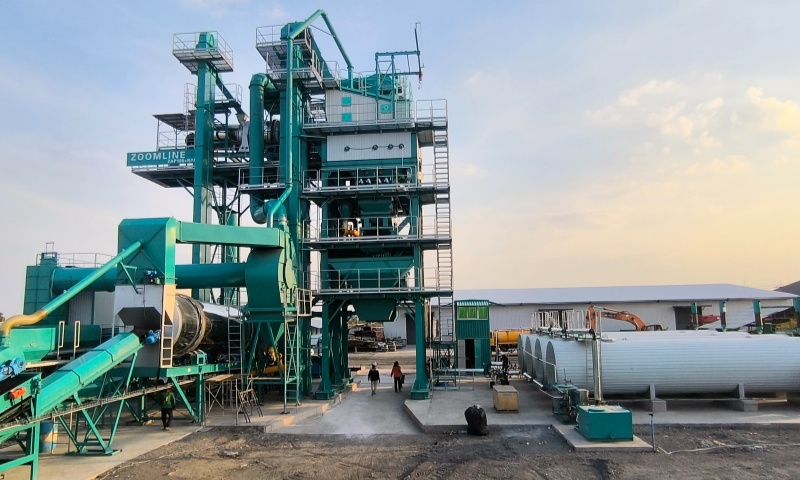
Impact on Maintenance and Downtime
Poor quality of the foundation will lead to frequent asphalt plant equipment failure, will not only increase the cost of equipment maintenance, but also extend the downtime – downtime brought about by schedule delays, labor idleness, waste of raw materials and other costs, much higher than the additional investment in foundation construction. A solid foundation can reduce asphalt mixing plant equipment failures, lower maintenance costs, shorten downtime, ensure production continuity, and indirectly improve project profitability.
Case Comparison (Strong vs Weak Foundation)
In the actual project, the use of a solid foundation of asphalt mixing plant, strong operational stability, low failure rate, production capacity and mix quality is always stable, low maintenance costs, long service life of the asphalt plant equipment, the successful completion of the project duration, to achieve a good return on investment; and the use of a weak foundation of the mixing plant, the frequent occurrence of downtime, failures and other problems, not only delays in the construction period, increase costs, but also due to the quality of the mix does not meet the standards leading to rework, and ultimately, the result will be the result of the weak foundation of the mixing plant. The performance and return on investment of the two are significantly different, as the project is reworked due to substandard quality of the mixture, which ultimately causes huge economic losses.
Professional Recommendations for Buyers and Contractors
To give full play to the performance of the asphalt mixing plant, foundation design and construction needs to be incorporated into the whole process of equipment procurement and project planning, to avoid all kinds of pitfalls in the later stage, specific recommendations are as follows.
- In the stage of asphalt mixing plant equipment procurement, foundation design should be considered synchronously, combined with equipment type, capacity requirements, planning ahead of the foundation program, to avoid the disconnect between equipment procurement and foundation design.
- Regardless of the size of the project, a professional geological survey must be carried out before the foundation construction, and the foundation program should be designed according to the survey results to avoid blind construction.
- Choose to provide foundation drawings and professional guidance to equipment suppliers, to ensure that the foundation design and asphalt plant equipment needs to accurately match, and provide access to professional construction guidance.
- Foundation design should be reserved for the future expansion of asphalt mixing plant equipment bearing capacity, to avoid the later expansion of equipment, due to the lack of foundation bearing to remodel the foundation, which will incur additional costs.
Conclusion
To summarize, the foundation of the asphalt mixing plant is not only to support the equipment “base”, but also to determine the core factors of the performance of the equipment – the foundation determines the stability of the equipment, determines the accuracy of production, determines the service life of the equipment. Without a solid foundation, and then advanced equipment can not perform its due performance, but will lead to all kinds of failures and losses.
Here to remind all practitioners: before installing an asphalt mixing plant, make sure the foundation is designed for performance, not just to support the equipment. Only by paying attention to foundation construction and following scientific design and construction specifications can we maximize the capacity, stability, and service life of the asphalt mixing plant, reduce operating costs, and achieve efficient project progress and good profitability.
We provide customized foundation solutions for each asphalt mixing plant project, combining the equipment model, capacity requirements, and site geological conditions to provide professional foundation design, construction guidance, and testing services to help you maximize equipment performance and reduce long-term operating costs.