




How Long Does It Take to Install an Asphalt Mixing Plant?
Contents
- 1 Full Installation Process and Base Timeline for Asphalt Mixing Plants
- 2 Core Factors Affecting the Installation Cycle of Asphalt Mixing Plants
- 3 Extended Scenario: Reference Cycle for Paving 50 Kilometers of Road Using 120TPH Asphalt Mixing Plant
- 4 Practical Techniques for Shortening Asphalt Mixing Plant Installation Cycles
- 5 Conclusion
In road construction, municipal engineering, and similar projects, the installation efficiency of asphalt mixing plants directly impacts overall construction progress, affecting project cost control and delivery timelines. Many project managers focus intently during the preparatory phase on one core question: How long does it actually take for an asphalt mixing plant to go from site arrival to full operation? In reality, the installation timeline is not fixed, as it is influenced by multiple factors including equipment type, site conditions, and the expertise of the construction team. Drawing on industry best practices, this article provides a detailed breakdown of the entire installation process, typical timeframes, and key influencing factors to assist project planning.
Full Installation Process and Base Timeline for Asphalt Mixing Plants
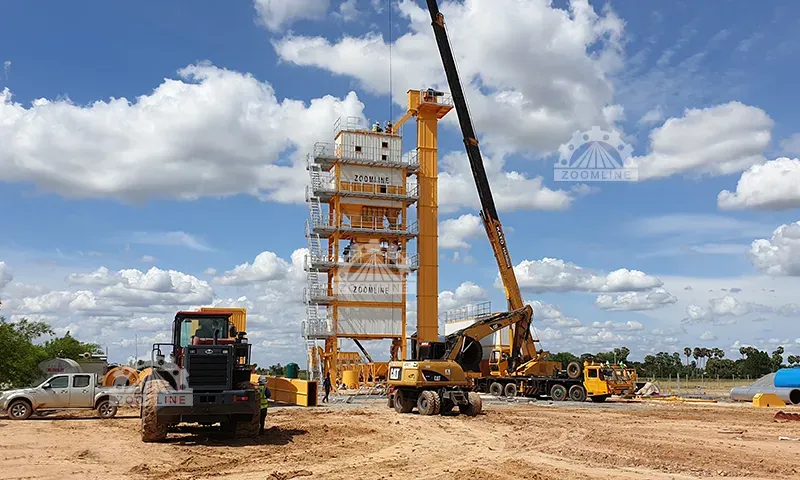
Installing an asphalt mixing plant is a systematic endeavor involving five core phases: site preparation, foundation construction, equipment assembly, commissioning and calibration, and acceptance training. Each phase’s duration is interdependent, collectively determining the total timeline.
Site Preparation Phase: Several Days to Weeks
Site preparation is the prerequisite for installation and directly impacts subsequent construction stability. Core tasks include site clearing, leveling, drainage system installation, and infrastructure provisioning (power, water, fuel connections). If site conditions are favorable, requiring only basic clearing and leveling, this phase can be completed within days. However, if complex terrain modifications (e.g., mountain leveling, marsh hardening), large-scale drainage projects, or temporary road construction are involved, the timeline may extend to several weeks. Additionally, the site must meet equipment load-bearing requirements, necessitating prior geological surveys to ensure subsequent foundation construction meets standards.
Foundation Construction Phase: Approximately 2 weeks
Foundation construction is critical for ensuring long-term stable equipment operation. Reinforced concrete foundations must be designed based on equipment model and weight, encompassing excavation, rebar tying, formwork installation, concrete pouring, and curing. Since concrete curing requires meeting strength requirements, rushing this process is not feasible. Under normal circumstances, this phase takes approximately 2 weeks. If the project demands higher foundation strength (e.g., large fixed stations), the curing period may be extended by 3-5 days.
Equipment Assembly Phase: 2-4 weeks
Following foundation acceptance, the core assembly phase commences. Professional technicians install, assemble, and connect key components including the main unit, hoppers, conveyors, drying drums, and mixing tanks. Concurrently, electrical wiring, hydraulic piping, and dust collection systems are laid and integrated. Assembly duration varies significantly: Compact, highly integrated components in small mobile plants allow completion in approximately 2 weeks. Large stationary or batch plants feature numerous complex components requiring precise calibration of interface tolerances, typically taking 3-4 weeks.
Commissioning and Calibration Phase: 1-2 weeks
Production does not commence immediately after assembly. Rigorous commissioning and calibration ensure equipment performance meets specifications. Technicians conduct sequential testing of the temperature control system, material proportioning accuracy, transmission system, dust removal efficiency, and other critical functions. They fine-tune component parameters to ensure compliance with industry standards and project production requirements. The standard commissioning period is one week. However, it may extend to two weeks if high-precision proportioning is required (e.g., for modified asphalt production) or if complex control systems need adjustment.
Acceptance and Training Phase: Several Days
Following successful commissioning, a comprehensive acceptance inspection is conducted jointly with the client and supervising party to verify equipment safety, production efficiency, and environmental compliance. Concurrently, specialized training is provided to the operating team, covering equipment operation procedures, daily maintenance, and troubleshooting to ensure the team can operate independently. This phase typically takes 3-5 days, depending on acceptance criteria and training requirements.
Overall, the standard installation cycle for an asphalt mixing plant ranges from 4 to 8 weeks. Small mobile plants can be completed in 3 to 5 weeks, while large, complex stationary plants may require 2 to 3 months.
Core Factors Affecting the Installation Cycle of Asphalt Mixing Plants
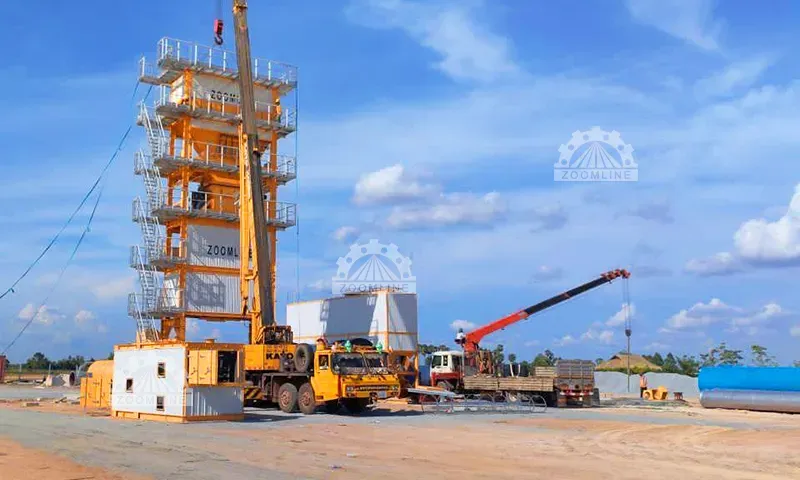
In actual installation, cycle fluctuations primarily stem from the following four major factors, which require careful consideration during project planning to proactively mitigate delay risks.
Equipment Type and Structural Complexity
Different asphalt mixing plant types exhibit significant variations in installation difficulty and duration, making this a primary factor affecting the timeline.
Continuous Asphalt Mixing Plants: Featuring continuous production design, these plants have relatively simple structures with high component integration. They eliminate the need for complex batch batching systems, resulting in streamlined installation processes. Typically, they can be installed 1-2 weeks faster than batch plants of equivalent capacity, making them suitable for temporary projects with high installation efficiency requirements.
Batch-mix type asphalt plants: Require precise control of material ratios and mixing times per batch. Equipped with independent batching silos, metering systems, and mixing drums, they involve more components and stricter commissioning requirements, resulting in longer installation cycles. However, they meet high-quality, customized asphalt production demands, making them suitable for core projects like highways and municipal main roads.
Mobile vs. Stationary Asphalt Plants: mobile asphalt plants disassemble into modular components for easier transport and assembly, reducing installation time by 30%-50% compared to stationary asphalt plants of equivalent capacity. Fixed plants require permanent foundations, larger component sizes, and longer hoisting/commissioning times, but offer superior production stability for long-term, large-scale operations.
Equipment Size and Capacity
Equipment capacity and dimensions directly determine installation workload. Small plants (≤80TPH) feature compact structures, low hoisting difficulty, simple component connections, and shorter installation cycles. Medium-to-large plants (≥120TPH) require multiple silos, large drying drums, high-efficiency dust removal systems, and complex control systems. Their heavier components (some core parts necessitate heavy-duty crane hoisting) and more intricate calibration processes extend installation timelines. For example, installing a 120TPH batch-type stationary plant typically takes 1-2 weeks longer than a 80TPH mobile plant.
Site Conditions and Infrastructure
The inherent characteristics of the site and the completeness of its infrastructure are critical external factors affecting installation efficiency. A level site with favorable geological conditions, where power, water, fuel pipelines, and drainage systems are pre-installed, can significantly reduce preliminary preparation time. Conversely, sites in remote areas or complex terrains (e.g., mountains, wetlands) requiring additional temporary road construction, foundation treatment, or temporary power facilities will significantly extend the installation timeline. Furthermore, surrounding environmental factors may impact progress—residential areas necessitate noise and time restrictions during construction, reducing operational efficiency.
Professionalism of Construction Teams and Technical Support
The experience and technical proficiency of the installation team directly determine construction precision and efficiency. Experienced teams are familiar with various equipment structures and can swiftly resolve unexpected issues during hoisting, connection, and debugging, avoiding rework due to operational errors. Conversely, teams lacking practical experience may frequently make mistakes in component calibration and wiring connections, delaying the project schedule. Simultaneously, technical support from equipment manufacturers is crucial. Manufacturers offering on-site guidance and rapid response to debugging requests can accelerate installation progress. Conversely, delayed technical support can lead to prolonged debugging phases.
Extended Scenario: Reference Cycle for Paving 50 Kilometers of Road Using 120TPH Asphalt Mixing Plant
Many projects coordinate the installation schedule of mixing plants with subsequent paving timelines. Taking a common 120TPH asphalt mixing plant as an example, we can roughly estimate the total cycle for paving 50 kilometers of road, providing a reference for overall project planning.
Core Parameters and Asphalt Requirements
Assuming a two-lane, two-way road with a lane width of 7.5 meters, an asphalt layer thickness of 5 centimeters (0.05 meters), and an asphalt mixture density of 2.4 tons/cubic meter, the total asphalt required for 50 kilometers of road is:
Volume: 50,000 meters × 7.5 meters × 0.05 meters = 18,750 cubic meters; Weight: 18,750 cubic meters × 2.4 tons/cubic meter = 45,000 tons.
Actual Daily Production Capacity of a 120TPH Asphalt Mixing Plant
120TPH represents the theoretical rated capacity. Actual production is influenced by material supply, operational efficiency, and equipment maintenance, typically yielding an effective capacity of 80-95%. Using the midpoint of 100TPH for calculation, with an 8-10 hour workday, daily output can reach 800-1000 tons. Conservative planning assumes 800-900 tons/day.
Estimated Paving Cycle
Considering only asphalt production and paving: 45,000 tons ÷ 900 tons/day ≈ 50 days, equating to 45-55 working days. Factoring in weather impacts (rain/low temperatures halting work), transport distance, paver efficiency, and subgrade construction progress, the total cycle typically extends to 55-65 calendar days.
Practical Techniques for Shortening Asphalt Mixing Plant Installation Cycles
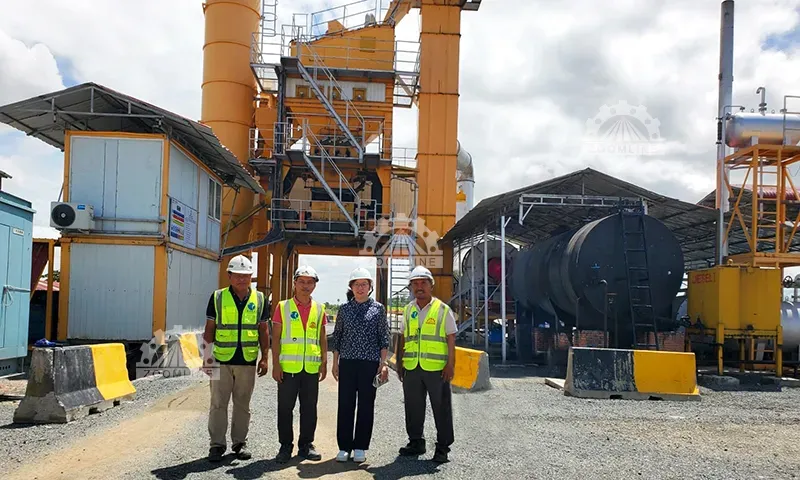
To ensure project progress, optimize installation processes and reduce cycle times through the following methods:
Pre-plan site and infrastructure
Complete geological surveys, site clearance, and foundation design before arrival. Simultaneously lay temporary roads and power/water/fuel pipelines to avoid delays during installation while waiting for infrastructure completion.
Select Equipment Suited to Project Type
For temporary projects, prioritize mobile modular plants that bypass complex foundation work. For fixed installations prioritizing efficiency, consider drum-type plants.
Assemble a Professional Installation Team and Coordinate Manufacturer Support
Engage an installation team with extensive hands-on experience. Communicate proactively with the equipment manufacturer to ensure on-site technical guidance for rapid troubleshooting during commissioning.
Optimize construction workflow and scheduling
During foundation curing, concurrently prepare equipment components and pipeline materials to minimize process gaps. Reasonably schedule work shifts to extend effective operating hours within regulatory compliance.
Conduct thorough equipment pre-inspection and maintenance
Perform comprehensive checks before equipment arrival to ensure undamaged components and complete accessories, preventing installation delays due to part issues. Implement foundational maintenance during installation to reduce subsequent commissioning failures.
Conclusion
The installation timeline for asphalt mixing plants lacks a fixed standard, requiring comprehensive assessment based on equipment type, production capacity, site conditions, and construction team capabilities. Typically spanning 4-8 weeks, this duration may be shortened or extended under special circumstances. During project preparation, we recommend early communication with equipment manufacturers and installation teams to develop customized installation plans aligned with project deadlines. Allow sufficient buffer time for unforeseen issues to ensure timely equipment commissioning and overall construction progress.
Should you require precise calculations of installation and paving cycles based on specific project parameters (e.g., equipment capacity, site conditions, road specifications), feel free to consult China ZOOMLINE Machinery at any time. We will provide professional customized analysis solutions.