










How Accurate Weighing Systems Boost Efficiency & Quality in Asphalt Batch Mixing Plants
Contents
- 1 Introduction
- 2 Key Components of the Accurate Weighing Systems for Asphalt Batch Mix Plants
- 3 Operational Process of Accurate Weighing Systems in Asphalt Batch Mix Plants
- 4 The Importance of Accurate Weighing in Asphalt Batch Mixing Plants
- 5 Common Pain Points of Inaccurate Weighing in Asphalt Batch Mix Plants
- 6 How Accurate Weighing Systems Boost Efficiency & Quality in Asphalt Batch Mix Plants?
- 7 Technological Advancements in Modern Accurate Weighing Systems
- 8 Choose the Right Accurate Weighing System for Your Asphalt Batch Mix Plant
- 9 Conclusion
Introduction
The asphalt batch mixing plant is the core equipment in road construction, and its core requirement is to produce asphalt mixtures with stable performance and in accordance with the specifications, and the consistency of the mixtures directly determines the construction quality and service life of the road. In the whole production process of asphalt batch mixing plant, accurate weighing system is often overlooked, but is called to protect the quality of the mixture and production efficiency of the “invisible hero” – it is not a simple auxiliary components, but the basis of the entire production process, directly determining the The stability of the asphalt mixture ratio, and then effectively improve production efficiency, reduce material loss, safeguard industry compliance, and ultimately optimize the comprehensive road performance of the asphalt mixture, for high-quality road construction to provide solid technical support.

Key Components of the Accurate Weighing Systems for Asphalt Batch Mix Plants
Asphalt batch mixing plant precision weighing system accuracy cannot be achieved by a single component, but depends on the core components of the work; each component in the data acquisition, signal transmission, precision regulation, and control plays an irreplaceable role, together constituting a complete set of precision weighing system.
High-precision Sensor
High-precision sensors are the foundation of accurate weighing, which are mainly installed in the key positions of aggregate, powder, and asphalt conveying paths of the asphalt batch mixing plant. For example, weighing sensors are installed on the weighing bridge under the aggregate conveyor belt to monitor the instantaneous weight and flow of aggregate in real time, which can ensure the stability of the collected data even under complex working conditions such as temperature fluctuations and changes in the moisture content of the material and provide accurate basic data support for the subsequent regulation of the proportioning to avoid the deviation of the proportion caused by the error of the sensor.
Dynamic Detection Module
The dynamic detection module consists of a high-speed data acquisition card and a signal amplifier, which is the key to realizing real-time control. In the key positions of aggregate conveyor belt and asphalt conveying pipeline of asphalt batch mixing plant, this module can transmit the weight signals collected by sensors to the control system in milliseconds, effectively eliminating the compensation hysteresis caused by the signal delay, ensuring the synchronization of weighing data with the actual conveying state of the materials, and providing timely and reliable signal support for accurate compensation.
Feed Control Valve
The feed control valve is installed on the feed pipeline of aggregate, powder, or asphalt, and is the executive part for realizing accurate proportioning adjustment. Its core role is to instantly open or close according to the instructions of the control system of the asphalt batch mixing plant to complete the precise supply and cut-off of materials. For example, when the weight of powder is detected to be slightly lower than the set value, the control valve will be opened immediately to accurately replenish a small amount of powder; on the contrary, if the weight of asphalt is slightly higher than the specified value, the control valve will be closed quickly to prevent asphalt from being added excessively to ensure that the dosage of each kind of material meets the formula requirements.
Intelligent Algorithm Control System (PLC/AI)
Intelligent algorithm control system (PLC/AI) is the “brain” of the whole accurate weighing system of the asphalt batch mixing plant, which undertakes the core task of data comparison, logic calculation, and instruction issuance. It compares the actual weighing data collected by the sensor with the preset target value of the formula in real time, and once the deviation is found, it will immediately complete the error calculation and issue the adjustment instruction to the feed control valve. For example, when the detected aggregate weight is 2% lower than the target value, the system will quickly calculate the weight of the aggregate to be supplemented, and accurately control the valve to open, to ensure that the ratio is corrected in time.
Operational Process of Accurate Weighing Systems in Asphalt Batch Mix Plants
The asphalt batch mixing plant‘s precision weighing system is the core of the operation process, which is “accurate without slowing down”. Through the “delivery, detection, correction” synchronized mode, without affecting the production efficiency of the premise, it achieves the second precise adjustment of the mixture ratio, to ensure that each batch of mixes meets the design standard.
Initial Weighing
After the production process of the asphalt batch mixing plant starts, raw materials such as aggregate, powder, and asphalt will first enter the weighing hopper to complete the initial weighing, which is the first line of defense for ratio control, mainly realizing the initial confirmation of raw material dosage and laying the foundation for subsequent accurate adjustment.
Conveyor Inspection
After the initial weighing of raw materials, in the process of being conveyed to the mixing cylinder, the high-precision sensors installed on the conveying path of the asphalt batch mixing plant will continue to monitor the actual weight of the materials, and track the weight changes in the process of conveying the materials in real time, to ensure that the weight of the materials can be accurately captured at every moment, to avoid the loss or deviation in the process of conveying, resulting in an imbalance in the proportion.
Error Analysis
The intelligent algorithm control system of asphalt batch mixing plant will receive real-time weight data in the process of conveying and testing, and compare it with the preset target value of the formula, quickly identify minor weight deviations, and at the same time analyze the reasons for the deviation to provide data support for the subsequent accurate compensation, so as to ensure that the deviation can be found in time and accurately localized.
Accurate Compensation
According to the results of the error analysis, the control system will immediately send commands to the feed control valve, through the instantaneous opening or closing of the control valve, automatically replenish or reduce the corresponding weight of the material, to achieve the second precision adjustment of the ratio. This process does not require manual intervention and has a fast response time, ensuring that the deviation can be completely corrected before the material enters the mixing cylinder of the asphalt batch mixing plant.
Final Mixing
When the material has been accurately compensated and conveyed to the mixing tank, its ratio has been accurately restored to the design value, and then it enters the final mixing process. The whole process of “conveying, testing, correcting” synchronization, not only to ensure the accuracy of the ratio, but also to ensure that it will not reduce the production speed of the asphalt batch mixing plant, taking into account the quality and efficiency.
The Importance of Accurate Weighing in Asphalt Batch Mixing Plants
Accurate weighing is not an optional part of the asphalt batch mixing plant, but to determine the quality of production, efficiency, cost, and compliance of the core factors, directly affecting the quality and efficiency of the entire road construction project, is an indispensable key link in the asphalt production process.
Impact on Asphalt Quality
The various properties of the asphalt mixture, including strength, flexibility, durability, etc., are dependent on the accurate proportion of raw materials – asphalt to provide adhesion, aggregate to determine the structural strength and stability, and powder plays a filling role.
If the weighing is inaccurate, it will directly lead to imbalance in the performance of the mixture: too much asphalt will make the mixture soft, unstable, easy to oil, rutting and other problems; asphalt is not enough to make the mixture brittle, easy to crack, loose; aggregate ratio deviation will affect the load-bearing capacity of the mixture, so that it can not withstand the heavy traffic loads and the extreme environment test. Accurate weighing can ensure the stability of the raw material ratio, the production of asphalt mixture in line with the performance standards, and protect the long-term stability and safety of the road surface.
Impact on Production Efficiency
Batch production is the core of the asphalt batch mixing plant, and the production efficiency of each batch is closely related to the weighing accuracy.
Inaccurate weighing will lead to batch rework, re-weighing, error correction, and other problems, seriously delaying the production schedule and reducing the output efficiency of the equipment; for a small asphalt batch mixing plant, this loss of efficiency will directly affect the project schedule. The accurate weighing system can realize the smooth advancement of batch production, avoid the stoppage and rework caused by the proportioning deviation, ensure the stability of asphalt supply, protect the construction progress from being affected, and improve the overall production efficiency.
Reducing Waste and Cost Control
An accurate weighing system can accurately control the dosage of raw materials to avoid overuse or underuse of materials and reduce material waste from the source.
For example, asphalt is a high-priced raw material; excessive addition will directly increase the production cost, but also reduce the performance of the mixture; excessive aggregate will cause waste of resources and increased transportation costs. Accurate weighing optimizes the efficiency of raw material use, reduces waste batches, and lowers additional costs for rework and replenishment. For cost-sensitive projects, especially small asphalt batch mixing plants, accurate weighing is the key to controlling production costs and improving profitability.
Compliance with Industry Standards
The road and bridge construction industry has strict standards and specifications. The ratio of asphalt mixture must meet the design requirements and industry standards; it will lead to rework of the asphalt batch mixing plant project, schedule delays, and even lead to early damage to the road surface and other safety hazards. Precision weighing systems ensure that every batch of asphalt mix meets specifications, effectively avoiding compliance risks. Especially in the use of recycled asphalt pavement (RAP) and other recycled materials, accurate weighing is more critical, only accurate control of the proportion of recycled materials and new materials in order to ensure the strength and durability of recycled asphalt mixtures, to avoid the quality of the pavement due to the deviation of the ratio.
Common Pain Points of Inaccurate Weighing in Asphalt Batch Mix Plants
In the production and operation of an asphalt batch mixing plant, weighing inaccuracies brought about by the problem are not a single asphalt mixture quality deviation, but a series of production errors throughout the entire process, latent and far-reaching cost loss, and operational risk. These pain points are often due to the initial impact not being intuitive and are ignored by most operators, but the long-term accumulation will continue to erode the profitability of enterprises, market reputation, and brand reputation, and even affect the core competitiveness of enterprises in the industry, becoming a key bottleneck restricting the high-quality development of the mixing plant. Whether it is a large asphalt batch mixing plant or a small mixing plant, the pain points of inaccurate weighing will appear in different forms, causing a multi-dimensional negative impact on production and operation.
Quality Fluctuation
Weighing inaccuracies on the production of the asphalt batch mixing plant has the most direct, the most central impact on the quality of asphalt mixture fluctuations, this fluctuation through the whole process of batch production and has a hidden and persistent. Due to the aggregate, powder, asphalt, and other raw materials ratio can not be accurately controlled, different batches or even the same batch within the mixture, in the degree of penetration, ductility, softening point, and other core performance indicators, there are obvious differences, directly manifested in uneven hardness of the mixture, unstable bonding, and uneven load-bearing capacity. Such quality fluctuations in the mixture applied to the pavement construction can very easily cause a series of pavement diseases: local areas due to the mixture is brittle, early cracking, heavy traffic sections due to the mixture’s strength not being sufficient to produce rutting, the surface layer due to the uneven, loose, and unevenly distributed asphalt coating, shedding and other issues. This will not only lead to the project’s acceptance being denied, but also require rework of a large area of rectification, significantly increase the later pavement maintenance costs, shorten the service life of the road, and indirectly damage the market reputation of the mixing plant.
Production Delays and Low Efficiency
Weighing deviation is one of the core causes of production delays and inefficiency in asphalt batch mixing plants, especially for batch production mode mixing plants, where the impact is more prominent. Inaccurate weighing will directly lead to unqualified batches of mix, which in turn will lead to a series of ineffective operations such as reworking, reweighing, error correction, etc., frequently interrupting the normal production process and causing production interruptions. Such interruptions will not only reduce the utilization rate of the core equipment of the mixing plant, reduce the production output per unit of time, but also lead to the asphalt supply not meeting the demand of the construction site on time, directly affecting the project schedule. At the same time, rework and reproduction process, you need to invest in additional labor for parameter adjustment, material cleaning, equipment debugging, not only increased labor costs, but also exacerbate the wear and tear of the mixing machine, conveying equipment and other core components, further reducing production efficiency, the formation of the “error – rework – reduced efficiency -Cost increase” vicious cycle.
Material Waste and Rising Costs
Weighing deviation will directly lead to material waste in the asphalt batch mixing plant, which will push up the production cost significantly, and this pain point is especially obvious in small-scale mixing plant and cost-sensitive projects. On the one hand, inaccurate weighing can lead to overuse or underuse of raw materials: asphalt as a high-value raw material, over-addition not only directly increases the cost of raw material purchases, but also destroys the performance of the mixture, leading to batch scrapping; aggregates, powders, over-putting will result in waste of resources, and at the same time, increase the additional cost of transportation and storage of materials. On the other hand, the rework of unqualified batches will consume additional energy resources such as fuel and electricity, and the waste mixes generated during rework cannot be utilized twice, further aggravating the waste. In the long run, this waste due to weighing deviation will continue to compress the profit margin of the enterprise, increase operational pressure, and even affect the market competitiveness of the enterprise.
Compliance Risks
The road and bridge construction industry is subject to strict industry standards and project specifications, and the proportioning accuracy of the asphalt mixture is the core indicator for compliance acceptance, while inaccurate weighing will directly lead to serious compliance risks for mixing stations. If the oil/stone ratio, grading, and other key indicators of the asphalt mixture do not meet the industry standards or project design requirements due to weighing deviation, it will not only lead to project rework and delay, but also may result in fines and penalties from the industry authorities. In extreme cases, if the unqualified mixture is applied to the project after the road safety hazards, it may also lead to the termination of the project, the enterprise needs to bear the corresponding liability, and at the same time, serious damage to the enterprise’s reputation in the market, affecting the bidding and cooperation of the subsequent projects, and irreparable impact on the long-term development of the enterprise. Especially in the recycled asphalt pavement (RAP) utilization, high-performance asphalt production, and other scenarios, the compliance requirements are more stringent, and the inaccuracies brought about by the compliance risk are more prominent.
How Accurate Weighing Systems Boost Efficiency & Quality in Asphalt Batch Mix Plants?
As the core support for the production process of asphalt batch mixing plant, accurate weighing system is not a simple realization of the “weighing” function, but through the whole process of accurate control, dynamic control and efficient coordination, from the root to crack the quality instability, low efficiency of the industry pain points, asphalt production to achieve the double enhancement of quality and efficiency. The value of the accurate weighing system, the essence is through the proportion of accurate, open up the quality and efficiency of the synergistic channel, so that each batch of production can take into account the “high quality” and “high efficiency”, not only to avoid the quality of substandard rework caused by the waste, but also to put an end to inefficiency caused by schedule delays. avoiding both the waste of rework caused by substandard quality and the delays caused by inefficiency.
How Accurate Weighing Boosts Asphalt Quality?
The core of asphalt mixture quality is “ratio consistency”, and precision weighing system is the key to achieve this core goal, it is through the whole process of accurate control, from the source to avoid ratio deviation, all-round enhancement of asphalt mixture of comprehensive road performance, to ensure that each batch of products in line with the design standards and industry norms. Relying on the high-precision sensors, dynamic detection module and intelligent PLC/AI control system, the accurate weighing system can realize the accurate measurement and dynamic correction of each raw material, such as aggregate, powder, asphalt, etc., to ensure that the dosage of raw materials matches the preset formula, which can avoid the problems of excessive or insufficient asphalt, imbalance in the proportion of aggregates, and uneven filling of powders.
Specifically, accurate weighing ensures that the ratio of asphalt and aggregate is in the optimal range, so that each aggregate can be evenly wrapped by the appropriate amount of asphalt to form a dense, stable mixture structure – neither too much asphalt will lead to soft mixture, high temperature easy to flooding, rutting, nor insufficient asphalt will lead to brittle mixture, poor crack resistance, easy to loose off It will not become brittle, poor cracking resistance and easy to loose and fall off due to insufficient asphalt. At the same time, accurate weighing of powder can effectively fill the gap between the aggregates, improve the compaction and adhesion of the mixture, enhance the pavement’s load-bearing capacity and resistance to water damage, so that the asphalt pavement can better withstand heavy traffic loads, extreme temperature changes, and other complex working conditions.
Especially in high-performance asphalt production and recycled asphalt pavement (RAP) utilization, the role of accurate weighing is more prominent. For example, in the production of epoxy asphalt and other high-performance asphalt, high-precision weighing sensors accuracy of up to 0.1 kg, can accurately control the amount of epoxy resin and other additives, to ensure that the adhesion properties of the mixture to meet the standards, and effectively solve the bridge deck “slippage” problem, which is the Shuangliu Yangtze River Bridge epoxy asphalt pavement to create a world record of important support! This is also one of the important supports for the Shuangliu Yangtze River Bridge epoxy asphalt paving to set a world record. In the utilization of recycled material, accurate weighing can strictly control the proportion of recycled material and new material, to ensure that the strength and durability of recycled asphalt mixture is the same as that of new material, and the quality of asphalt pavement will not be sacrificed while realizing the recycling of resources, which is in line with the demand for the development of the industry of green construction and recycling of resources. In addition, accurate weighing can ensure the consistency of the performance of each batch of mixture, avoiding local damage and early aging caused by quality fluctuations, prolonging the service life of the road, and reducing the cost of later maintenance.
How Accurate Weighing Enhances Production Efficiency?
An accurate weighing system to improve production efficiency, the core is to “reduce ineffective consumption, optimize the production process, improve equipment utilization”, through the “conveying, testing, correction” synchronization of the core model, breaking the “precision and efficiency can not be achieved”. Through the core mode of “conveying, testing and correcting” synchronization, it breaks the industry misunderstanding of “precision and high efficiency can’t be achieved at the same time”, realizes the two-way improvement of production efficiency and quality accuracy, especially adapts to the batch production characteristics of batch-type asphalt mixing plant, so that each batch of production can be efficiently pushed forward.
On the one hand, accurate weighing can reduce unqualified batches and rework rate from the root, avoiding invalid work such as batch scrapping, reweighing, and secondary mixing due to proportioning deviation, and saving a lot of time, labor, and material costs. Traditional mixing stations often experience batch rework due to inaccurate weighing, which not only delays the production schedule but also consumes additional fuel, electricity, and raw materials. Through the whole process control of initial weighing, conveying and testing, error analysis and accurate compensation, the accurate weighing system can completely correct the proportioning deviation of the material before it enters the mixing tank to ensure that each batch of mixture is qualified at one time, which greatly reduces the efficiency and loss brought by rework, and allows the production process to flow smoothly. This greatly reduces the efficiency loss caused by reworking and allows the production process to advance smoothly, avoiding the problems of stopping work and waiting for materials, reworking, and re-production.
On the other hand, the intelligent characteristics of the precision weighing system can greatly simplify the operation process, reduce manual intervention, lower the operating difficulty and manual error, and further enhance the production efficiency. The modern precision weighing system is deeply integrated with the digital control system of the mixing plant, which can realize the full automation of weighing, regulating and feedback, and the operators do not need to manually calculate and adjust manually, but only need to monitor the data in real time through the control panel, which not only reduces the manual operation time, but also reduces the training cost of the personnel and the operation error rate. Just like the intelligent weighing and conveying system adopted by Shudao Logistics Guang’an Pavement Material Base, through the automation of accurate feeding and closed conveying, it greatly reduces the labor input, and the number of people working in a single day is reduced from the traditional 15 to 6, and at the same time, it realizes the lean management of the whole process of production, which greatly improves the production efficiency and the qualification rate of the products.
In addition, the accurate weighing system can realize the stable control of the production rhythm and ensure the consistency and stability of the batch production. The production efficiency of an asphalt batch mixing plant depends on the batch turnover speed. An accurate weighing system can accurately control the weighing time and adjustment time of each batch, avoiding the production rhythm disruption caused by the long weighing time or frequent adjustments, ensuring that the equipment is always in a highly efficient operating state, and improving the utilization rate of the equipment. At the same time, accurate weighing can optimize the efficiency of the use of raw materials, reduce material waste, to avoid production interruptions due to lack of materials, to ensure a stable supply of asphalt, to protect the construction progress will not be affected, especially for large-scale projects or projects with a tight schedule, can effectively improve the overall construction efficiency, help the project completed on time.
Technological Advancements in Modern Accurate Weighing Systems
With the continuous upgrading of asphalt mixing plant technology, the modern precision weighing system is no longer an independent device, but is integrated into the entire mixing plant digital, intelligent system integration, and continues to meet the industry’s higher demand for quality, efficiency, and environmental protection.
Integration with Modern Asphalt Mixing Plant Technology
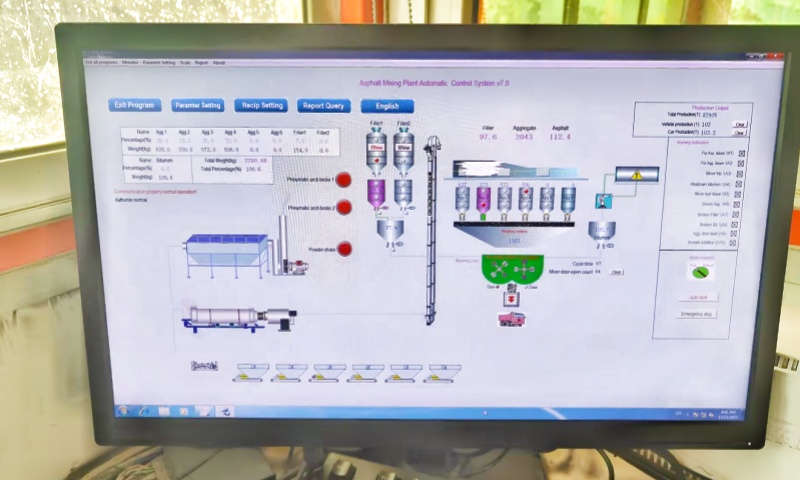
A modern precision weighing system has been fully integrated into the digital control environment of the asphalt mixing plant, and is no longer an independently operated component. For example, an asphalt mixing plant equipped with intelligent load cells can automatically adjust the raw material feeding speed according to real-time production data, and realize automatic compensation for factors such as material moisture content, temperature fluctuations, and uneven flow rates. The operator can obtain the weighing data and system status in real time through the control panel of the asphalt batch mixing plant, and can complete the parameter adjustment without stopping the asphalt mixing plant machine, ensuring the stability and efficiency of the whole production process.
Supporting Green Construction Practices
The high-precision weighing system can minimize the waste of raw materials and reduce the consumption of resources through accurate batching, which in turn reduces the reheating cycle of the waste batch, and reduces the fuel consumption and greenhouse gas emission, which is in line with the development needs of modern green road construction. Meanwhile, the precise weighing system, energy-saving burner, and recycled material processing system can further improve the environmental performance of the asphalt mixing plant and realize sustainable production while guaranteeing the quality and efficiency.
Meeting the Demands of High-Grade Highways
High-grade highways have more stringent requirements on the performance of the asphalt mixture, which needs to have higher load-bearing capacity, flatter surface, and longer service life, which puts forward higher requirements on the proportioning accuracy of the mixture. Modern precision weighing systems of asphalt batch mixing plants, with their high accuracy and stability, ensure that asphalt mixtures always meet the design standards of high-grade highways, directly enhancing the durability and safety of pavements. For contractors involved in infrastructure construction, the adoption of precision weighing technology in an asphalt batch mixing plant is the key to enhancing core competitiveness and winning project trust.
Choose the Right Accurate Weighing System for Your Asphalt Batch Mix Plant
Choosing an accurate weighing system is not “the more accurate the better”, but to combine the actual needs of your own mixing plant, choose a system with strong adaptability and reliable performance, in order to realize the double improvement of quality and efficiency, and to avoid the waste of resources.
Key Considerations
First of all, consider the scale of the mixing plant, large-scale asphalt batch mixing plant and small-scale asphalt batch mixing plant with different production capacity and accuracy needs, need to choose the corresponding range and accuracy of the weighing system; secondly, consider the type of raw materials, including aggregates, asphalt, additives and recycled materials (RAP), etc., to ensure that the weighing system can be adapted to the characteristics of the different materials; but also pay attention to the integration of the system to ensure that it can be integrated with the existing PLC/asphalt plant, to ensure that it can be used in the mixing plant, to avoid waste of resources, and to avoid waste of resources. It should also pay attention to the integration ability of the system to ensure that it can be seamlessly connected with the existing PLC/AI control system of the asphalt batch mixing plant to realize data interoperability and automatic regulation. Finally, it should consider the working environment of the asphalt batch mixing plant and select a weighing system that can adapt to complex working conditions such as temperature fluctuation, dust, humidity, etc., to ensure stable operation in the long term.
Core Selection Criteria
Sensor accuracy is the core index, choose the high precision sensor with stable performance and strong anti-interference ability to ensure the accuracy of weighing data; the intelligent level of the control system is also crucial, give priority to the PLC/AI control system with real-time comparison, automatic compensation and data feedback function to reduce manual intervention; at the same time, the durability of the system should not be ignored, choose the equipment that is resistant to abrasion, corrosion and harsh industrial environments; in addition, choose the equipment that can adapt to dust fluctuation and other complicated working conditions. At the same time, the durability of the system should not be neglected, and it is necessary to choose the equipment that is wear-resistant, corrosion-resistant, and adaptable to the harsh industrial environment; in addition, reliable after-sales service and calibration support are also very critical to ensure that the weighing system can maintain long-term accuracy, and can be resolved in time in the event of a failure.
Conclusion
An accurate weighing system is the “invisible hero” of an asphalt batch mixing plant, and it is the core foundation for guaranteeing the quality of the asphalt mixture, improving production efficiency, controlling costs, and ensuring compliance. It can not only realize the accurate control of raw material proportion, reduce waste and rework, but also, with modern digital, green technology integration, meet the new needs of the industry. For asphalt mixing plant operators, investing in a set of appropriate and accurate weighing systems is not an additional expense, but a strategic investment that can enhance profitability and guarantee project quality in the long run.
By choosing an accurate weighing system with reliable performance, standardized accuracy and strong adaptability, strengthening the daily maintenance and calibration of the system, and giving full play to its core role in the production process, we can continuously and stably produce high-quality asphalt mixtures to meet the stringent requirements of road construction, enhance the core competitiveness of enterprises, and promote the high-quality development of the highway construction industry.